The short version
The Habring² Start is not a watch designed to be photographed. It is a watch designed to be worn, and the difference becomes obvious within about an hour of putting it on. It is hand-wound, cleanly finished, unusually comfortable and completely free of the visual noise that passes for design in most of the modern market. If you have been circling independent watchmaking and wondering where to begin without spending five figures, this is a serious answer.
Below is what a full week on the wrist actually told me: how it sits, how it reads, how the movement behaves, and whether the price makes sense for someone who intends to wear it rather than store it.
Who Habring² are, and why it matters
Habring² is Richard and Maria Habring, working out of Völkermarkt in Carinthia, Austria. Richard's background is the part that matters here. He developed the split-seconds mechanism used by IWC, and he spent years inside the movement departments of respected German and Swiss houses before the couple founded their own workshop in 2004.
That history explains the products. Habring² does not build complications for the sake of spectacle, and it does not chase case sizes. It takes well-understood Swiss ébauches, reworks them by hand, and puts them in cases that are designed around a human wrist rather than a display case. The Start is the purest expression of that approach: a simple three-hand watch with a small seconds display and nothing else competing for attention.
There is also a practical point. Buying from a workshop this small means buying from people, not from a department. That has real advantages in finishing and communication, and one real disadvantage in service logistics, which I will get to.
Case, dial and the business of legibility
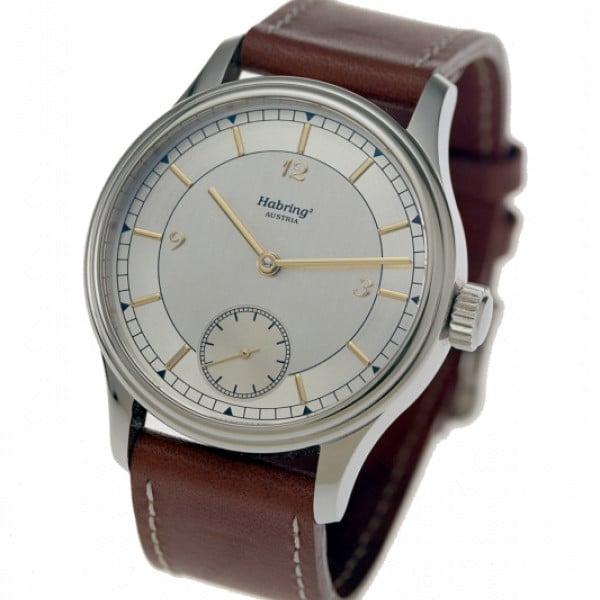
The Start's case is stainless steel, compact and quiet. There is no chamfered bezel screaming for attention, no mixed finishing designed to catch light in a boutique. The profile is slim, the lugs curve down decisively, and the whole watch reads as though someone removed everything that was not strictly necessary.
The dial is where the watch earns its keep. Applied markers, clean hands, and a small seconds subdial placed where it does not disturb the balance of the layout. There is no date window cutting into the symmetry, and no text beyond what is required. In daylight the contrast is excellent and the time is readable at a glance from almost any angle, which is the entire point of a three-hand watch and something a surprising number of expensive watches fail at.
There is no lume. That is a deliberate choice rather than an oversight, and it tells you who this watch is for. In a dark restaurant you will read it by the light of the candle, not by a glowing index. If you need to check the time on a night flight without waking the person next to you, this is not the tool. If you need a watch that looks correct with a jacket, it is.
The crystal is sapphire, which is the right call for something that will be worn rather than handled on weekends.
On the wrist
Here is where the Start separates itself from most of the category. The case is compact, the lugs drop away sharply, and the watch sits low and close to the wrist instead of balancing on top of it. The result is a watch that stays centred through a full day without needing to be pushed back into place.
Weight is the other half of the equation. The Start is light enough that you genuinely stop registering it by the second morning. I wore it through a day of typing, a school run, a dinner, a short flight and a wet Saturday, and at no point did I find myself adjusting it or thinking about it. That sounds like faint praise. It is not. The highest compliment a daily wearer can receive is that it never intrudes.
Balance matters more than dimensions. A narrow strap matched to an oversized case pulls a watch to one side; a heavy case on a thin strap twists on the wrist. Habring² gets the relationship right, and the Start stays put. If you have spent years in heavy sports watches and wondered why your wrist aches by Thursday, an afternoon with this watch will explain the problem.
The movement
The Start is hand-wound, built on an ETA 7001 base that Habring² reworks and finishes in the workshop. It runs at 21,600 vibrations per hour with a power reserve of around 42 hours. Those figures are unremarkable on paper, and that is precisely the point: this is old, well-understood architecture that any competent watchmaker can service and that behaves predictably in daily use.
What you are paying for is not exotic engineering. It is finishing and regulation done by hand, by people whose names you could learn, on a movement thin enough to keep the case slim. The winding action is one of the small daily pleasures of ownership: firm, positive, with a clear stop when the mainspring is full. People who have only owned automatics tend to be surprised by how much they enjoy winding a watch every morning. It is a two-minute ritual that makes the object feel owned rather than merely worn.
The small seconds subdial is the only complication, and it suits the watch. A central seconds hand would have been busier; this is calmer, and it gives the dial a focal point without adding clutter.
Accuracy in the real world
Small-workshop regulation is not the same as chronometer certification, and Habring² does not claim it is. What you should expect from a well-regulated example of this movement is stability in the region of a few seconds a day, rather than a headline number. Over my week the Start held steady, with no dramatic positional variation and no drift that required correction.
The practical advice is simple: wind it at the same time each morning, and it will be more consistent than most automatics you have owned. Hand-wound movements reward routine. If you leave it on the bedside table for three days, you will be resetting it, and the fault will be yours rather than the watch's.
Strap, clasp and the small things
The Start arrives on a leather strap with a pin buckle, which is the correct decision. A deployant would add bulk to a watch whose entire argument is about staying out of the way. The pin buckle is simple, replaceable and comfortable, and the strap itself is good enough that you will not immediately want to change it.
Because the watch is compact and the lugs are short, strap changes are easy and the watch takes well to different leathers. A dark brown shell cordovan for winter, a lighter tan for summer, and you have effectively two watches. That flexibility is part of what makes a simple three-hander worth owning for a decade rather than a season.
The one omission that will matter to some buyers is the absence of lume. It is worth being honest about this: the Start is a daytime and evening watch, not a field watch. If your week involves early-morning trail runs or night shifts, look elsewhere in the catalogue.
Where it fits
This is a watch that covers formal, daily and dress duty without complaint, and it travels well because it is thin, light and unshowy. It will not survive a diving holiday in the sense that you should not take it there, and it is not the watch for a gym session. Within its lane, though, it is close to ideal.
It pairs with a suit, a knit and a T-shirt, and it never looks as though it is trying too hard. That versatility is a function of restraint rather than clever design, and it is much harder to achieve than it looks.
Price, value and the long hold
The Start sits in the region of seven to eight thousand dollars depending on configuration and where you buy. For that money you get hand-finishing, a hand-wound movement, a compact stainless case and access to a two-person workshop rather than a call centre.
On the secondary market these watches trade in the mid five to high six thousands, and they hold there rather than climbing. Production is tiny, which supports prices, but the audience is narrow, which caps the upside. Buy it because you want to wear it. Do not buy it as a store of value.
Servicing runs through the workshop or its authorised partners. That is normal for an independent of this size and worth planning for, because you should not hand it to a local shop that has never seen one. Factor the service into your ownership maths and the value case remains solid.
Competition comes from several directions. The Nomos Tangente offers German minimalism and in-house calibres at a similar price, with a slightly larger and more architectural wrist presence. Grand Seiko's hand-wound dress pieces deliver extraordinary finishing for more money. Jaeger-LeCoultre's Master Ultra Thin gives you a famous name and a thinner case. None of them give you a watch finished by two people in Carinthia, and for a certain kind of buyer that is the whole point.
Verdict
The Habring² Start is the rare watch that improves your day rather than your wrist shot. It is comfortable beyond its price, legible in the way only a genuinely well-designed dial can be, and mechanically honest in a market full of overcomplicated showpieces.
It is not for everyone. There is no lume, minimal wrist presence, and the brand recognition of a well-kept secret. But if you want a daily wearer with a real workshop behind it, built by people who have spent their lives inside movements, the Start is one of the smartest purchases in independent watchmaking. Wear it for a week and you will understand why the people who own one rarely sell it.