A field watch with no theatre
There is a particular kind of watch that asks nothing of you. It does not want to be photographed on a marble countertop, it does not require a winder, and it does not punish you for wearing it to a hardware store. The Hamilton Khaki Field Automatic is that watch, and it has been the reference point for the category for the better part of two decades.
The formula is unglamorous: a stainless steel case, a matte dial with printed Arabic numerals, a sapphire crystal, and a Swatch Group automatic with an 80-hour reserve. What separates it from the dozens of imitators is proportion and discipline. Hamilton did not try to make a field watch that also works as a dress watch. It made a field watch, then spent years refining the details that matter — legibility, case profile, strap geometry — while leaving the rest alone.
At a street price well under a thousand dollars, it is also the most common entry point into mechanical watch ownership for a generation of collectors. That creates its own problem: familiarity breeds contempt. This review argues the opposite. The Khaki Field Automatic is not a starter watch you graduate from. It is a watch you keep.
Hamilton, from Lancaster to Bienne
Hamilton was founded in Lancaster, Pennsylvania, in 1892, and spent its first half-century building precision pocket watches for American railroads — a market where a few seconds a day was the difference between a job and a dismissal. The company's military record is even more consequential: Hamilton supplied the United States armed forces through both world wars, producing more than a million timepieces for the war effort. The Khaki name itself dates to 1918, when it was applied to the company's first purpose-built military wristwatches.
The post-war story is one of relocation. Hamilton acquired the Swiss firm Büren in 1969 and shifted production to Bienne, and the brand has been Swiss-made ever since — a fact that still surprises collectors who associate the name with Pennsylvania. Since 1974 it has sat inside what is now the Swatch Group, which gives it access to ETA-derived movements at a scale no independent could match.
The modern Khaki Field Automatic is the direct descendant of that lineage. It is not a reissue and it does not pretend to be. It is a contemporary tool watch that borrows the visual grammar of a 1940s infantry watch — rail-track minute markers, sword hands, a matte black dial — and executes it with modern manufacturing tolerances.
The H-10: an honest workhorse, honestly finished
The Khaki Field Automatic runs Hamilton's H-10 caliber. The H-10 is a Swatch Group development built on the ETA 2824 architecture, reworked with a longer mainspring and a lower beat rate to stretch the power reserve to 80 hours. That is the headline number, and it is a genuinely useful one: wind it Friday evening, set it down, pick it up Monday morning and it is still running and still roughly on time.
The trade-off is frequency. The H-10 beats at 21,600 vibrations per hour — three hertz rather than the four hertz of a standard 2824. On paper that reads as a downgrade. In practice the lower beat rate gives the seconds hand a slightly more deliberate sweep, and it is part of how the movement achieves its reserve without a larger barrel. The caliber hacks, hand-winds, and carries 25 jewels. It is not COSC-certified, and Hamilton does not claim chronometer performance.
Finishing is industrial and entirely appropriate to the price. The H-10 is rhodium-plated with basic surface decoration, but you will not see any of it: the Khaki Field Automatic ships with a solid steel caseback. This is a deliberate choice, and the correct one. An exhibition back on a sub-$1,000 field watch is a promise the movement cannot keep, and the solid back keeps the case slim while adding a layer of protection against the exact kind of knocks a field watch is meant to absorb.
One note for the technically minded: the H-10 is not in-house in the strict sense, and Hamilton does not market it as such. It is a group caliber, shared across Swatch brands under different designations. That is not a criticism — it is the reason the watch costs what it does, and it means parts and service are available almost anywhere in the world.
Case, dial, and the discipline of legibility
The reference reviewed here is the 38mm H70455533, and 38mm is the right number. The Khaki Field Automatic has been offered at 42mm, and that version has its adherents, but the smaller case is where the design coheres. The bezel is narrow, the dial is wide open, and the watch reads instantly at a glance — which is the entire point of a field watch.
The case is stainless steel with a brushed finish throughout and a polished bezel edge that catches light without calling attention to itself. Water resistance is rated to 100 meters, which is more than enough for swimming and rain and considerably more than most owners will ever need. The crystal is sapphire — a meaningful upgrade over the acrylic found on the cheaper Khaki Field Mechanical, and one that matters if the watch is going to be worn hard.
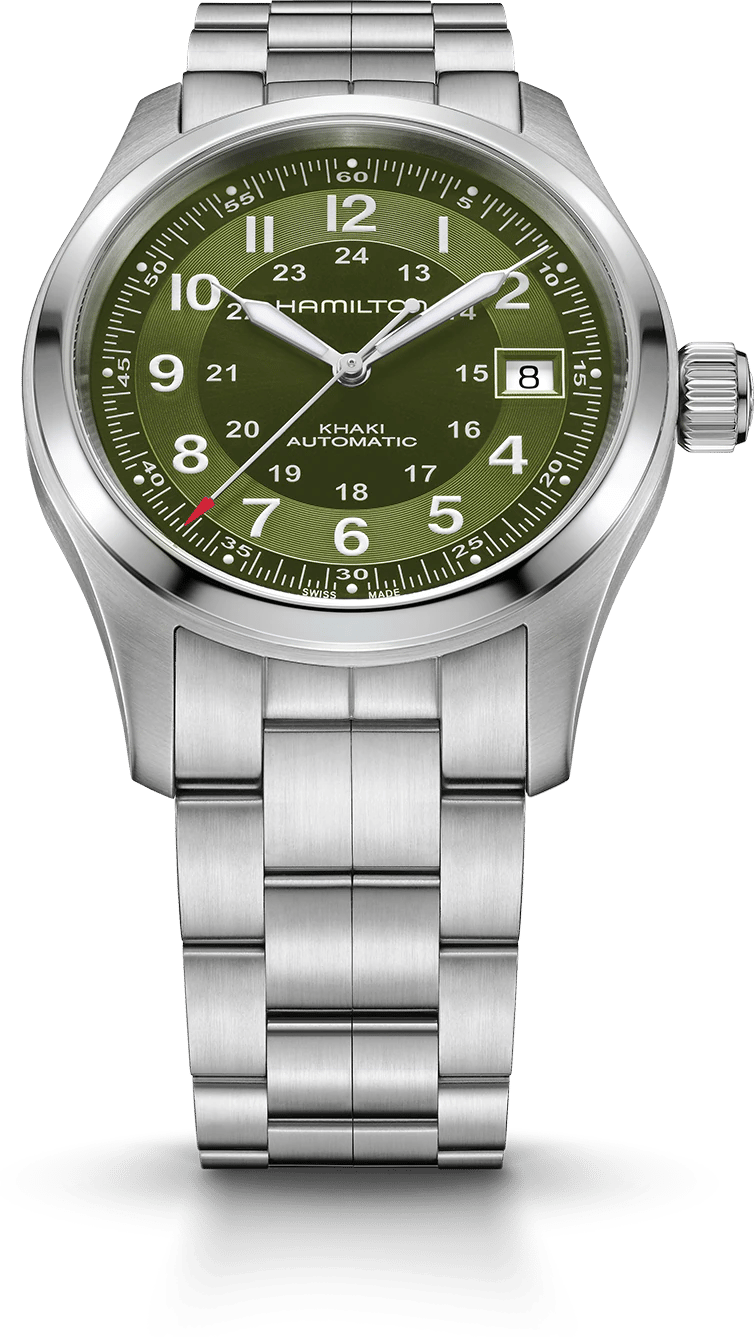
The dial is matte black with white printed Arabic numerals at every hour, a 24-hour inner track, and a date window at three o'clock. The date is the one concession to modern convenience, and it is executed cleanly — white disc, black numerals, sized to the aperture rather than floating in it. The hands are luminous-filled sword shapes, and the lume is Super-LumiNova, applied generously enough to read through a dark room. It is not dive-watch bright, but it does the job.
The strap is where Hamilton has historically economized, and the standard brown leather is serviceable rather than special. It softens considerably after a few weeks. Most owners end up on a NATO or a perlon within a month, and the watch is better for it — the lug geometry suits a single-pass strap, and the drilled lugs make swaps painless.
On the wrist
The Khaki Field Automatic wears smaller than its 38mm specification suggests, largely because the dial is so open and the case so flat against the wrist. It sits low, distributes its weight evenly, and disappears under a shirt cuff without a fight. On a 6.75-inch wrist it occupies the center of the forearm with room to spare on either side; on a 7.5-inch wrist it reads as a modest, deliberate choice rather than an undersized one.
There is essentially no wrist presence in the pejorative sense — no heft, no wobble, no crown digging into the back of the hand. The crown is small and unsigned, which is period-correct but does make hand-winding a slightly fiddly operation for those with larger fingers. It is a minor complaint. The larger point is that this is one of the few mechanical watches that genuinely disappears, and that is a rare and underrated quality.
Balance is the watch's defining physical characteristic. Nothing about the case wants to rotate on the wrist, nothing catches on a sleeve, and the strap channels sit close enough to the case that the watch does not ride up. It is a design that has been iterated on for years rather than rethought, and the accumulated small decisions show.
Accuracy in the real world
The H-10 is not a chronometer and should not be judged as one. Expect somewhere between minus ten and plus fifteen seconds per day out of the box, with most examples settling into a tighter band after a few weeks of wear. Many owners report single-digit deviations once the movement is broken in, but that is luck rather than specification.
The more relevant accuracy metric for this watch is positional stability. Because the power reserve is long, the watch spends more of its life at partial wind than a 38-hour movement would, and amplitude drops accordingly. In practice, wearers who wind it fully once a week and wear it daily will see more consistent rates than those who let it run down and reset it. If precision matters to you, the Khaki Field Automatic is a reasonable daily wearer and a poor timekeeping instrument. That is the correct trade at this price.
Occasions
This is a daily watch first and a sport watch second. It handles office wear without embarrassment, particularly on a leather strap, and it handles weekends better than most of what sits alongside it in a collection. It is not a formal watch — a matte black dial with printed numerals will always read casual — and it is not a travel watch in the GMT sense, though the 24-hour track is a useful reference if you are crossing time zones and want a second frame.
Where it excels is the ambiguous middle: the flight, the hike, the Tuesday. It is the watch you put on when you do not want to think about which watch to put on.
References and variants
Hamilton's reference system is opaque, and the same watch appears under multiple numbers depending on strap and market. The core variants are the 38mm on leather (H70455533), the 38mm on a steel bracelet (H70455733), and the 42mm on leather (H70555533). The bracelet version is worth the premium if you intend to wear it to an office — Hamilton's three-link bracelet is well made for the money, with solid links and a folding clasp, though it adds noticeable weight.
Beyond the core line, the Khaki Field Mechanical (H69439931) offers a hand-wound, acrylic-crystal, no-date alternative at a lower price, and the Khaki Field Murph — the watch designed for Interstellar — sits above it with a more elaborate dial and a higher price. Both are worth considering, and both are different watches rather than trim levels.
Comparisons
The obvious rival is the Tudor Ranger, which does the same job with a manufacture movement and a much higher price. The Ranger is the better watch; the Hamilton is the better value, and the gap in daily satisfaction is narrower than the gap in cost.
Within the Swatch Group, the Longines Spirit 37mm offers COSC certification and a more refined case for roughly double the money. The Oris Big Crown Pointer Date brings a pointer date and a more vintage silhouette. The Seiko Prospex Alpinist adds a compass bezel and a Japanese alternative perspective. The Christopher Ward C65 Sandhurst is the closest thing to a direct competitor on specification, and it is a genuinely good watch.
None of them displace the Hamilton. They occupy adjacent positions on the same spectrum, and the Khaki Field Automatic remains the cheapest way to get a well-proportioned, Swiss-made, 80-hour automatic field watch from a brand with real military heritage.
Value, service, and the long hold
At a retail price around $695 on leather, the Khaki Field Automatic is not the bargain it was five years ago — Hamilton has raised prices with the rest of the industry. But it remains one of the few mechanical watches under a thousand dollars that does not feel like a compromise. Secondary market examples trade in the mid-three-hundreds to high-four-hundreds, which means the depreciation hit is real but bounded. Buy used if you can; the watch is robust enough that a clean pre-owned example is a sensible purchase.
Service is straightforward. The H-10 is an ETA-derived caliber, and any competent watchmaker can service it. Hamilton's authorized service is not the only route, and for a watch at this price an independent is often the better call. Expect a routine service to be a meaningful fraction of the watch's value — which is an argument for servicing only when the rate actually drifts.
This is not an investment. It will not appreciate. What it will do is hold a floor, because demand for a well-made sub-$1,000 field watch is structural and not going away.
Verdict
The Hamilton Khaki Field Automatic is the most honest watch in its price bracket. It does not pretend to be a luxury object, it does not hide its movement behind an exhibition caseback it cannot justify, and it does not ask to be treated gently. What it offers is a well-proportioned 38mm steel case, a genuinely useful 80-hour movement, and a dial that can be read in the dark at arm's length.
Buy it as a first mechanical watch and you will not outgrow it. Buy it as a fifth and it will become the one you reach for without thinking. Either way, it earns its place.