Hamilton Ventura Edge Skeleton Review: The Shield Gets X-Ray Treatment
The Hamilton Ventura is one of the few watches that can be called a piece of pop culture without exaggeration. It arrived in 1957 as a futuristic electric watch, then became inseparable from Elvis Presley. Later it reappeared in Men in Black and cemented its status as the watch for people who do not want a round case. The Ventura Edge Skeleton takes that silhouette and does the obvious modern thing: it opens the dial and lets the movement become the show.
This is a watch for collectors who came to horology through design, film, fashion, or the internet rather than through old auction catalogues. It is not trying to be a Patek Philippe. It is trying to be the most interesting watch you can buy for around the price of a decent laptop. On that front, it has a real argument.
Hamilton History and the Ventura Line
Hamilton was founded in Lancaster, Pennsylvania, in 1892 and built its early reputation on railroad accuracy and military issue. The brand later became a Hollywood favorite because its watches looked good on camera and kept time on set. The Ventura was launched in 1957 as one of the first electric watches, with a shield-shaped case that looked like a prop from a future that had not arrived yet. Elvis wore one, and the rest is design history.
Today Hamilton sits inside the Swatch Group, which means American design language with Swiss production and Swatch Group movement architecture. The Ventura line has expanded over the years with quartz models, automatic models, skeleton versions, and limited editions. The Edge Skeleton is the current expression of the line's most extroverted idea: take the shield, remove the dial, and let the wearer see the machine.
Movement: H-10-S Automatic
The Ventura Edge Skeleton runs the H-10-S, a skeletonized automatic from Hamilton's H-10 family. The H-10 is part of the Swatch Group's broad automatic architecture, and it is known for one headline number: 80 hours of power reserve. That is a genuine daily advantage. You can take the watch off on Friday evening and put it back on Monday morning without resetting it. The movement beats at 21,600 vph and uses 25 jewels.
This is not haute horlogerie finishing. The H-10-S is industrial, openworked, and built for visual impact rather than hand-bevelled bridges. The skeletonization exposes the balance, the gear train, and the mainspring area, which is exactly what buyers in this segment want. It is not COSC-certified, and Hamilton does not pretend otherwise. What you get is a robust, long-reserve automatic with enough visual drama to justify the open dial.
Case, Crystal, and Water Resistance
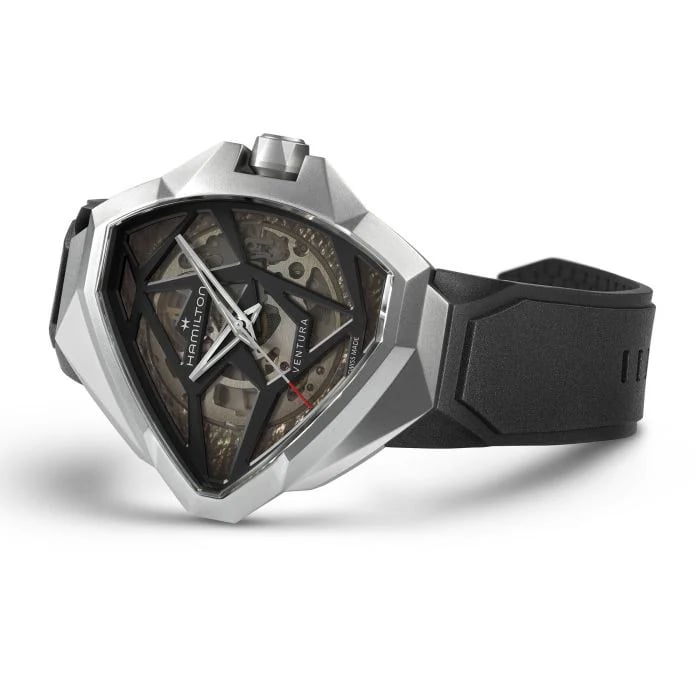
The case is stainless steel with a black PVD coating, and it measures 43.5mm across and 11.8mm thick. The shield shape is the point. It is not a round watch with a weird bezel; it is a genuinely different case architecture, with no traditional lugs and a strap that integrates directly into the case. The crystal is sapphire, which is the right call at this price. Water resistance is 50 meters, so it will handle rain, handwashing, and daily life, but it is not a swim watch.
There is no lume on this reference. That is worth stating plainly because the Edge Skeleton is a watch you will want to wear in the evening, and the open dial does not glow. Legibility is acceptable in daylight because the hands are distinct against the open movement, but this is not a watch for reading in a dark cinema. It is a watch for being seen in a dark cinema.
Strap and Clasp
The black rubber strap is the correct pairing for the black PVD case. It keeps the watch from feeling too precious and makes the shield shape look more architectural than dressy. The clasp is a pin buckle, which is simple and period-appropriate for this kind of sport-design watch. The integrated strap also means you should think twice before planning to swap it onto something else; this is not a strap monster in the traditional sense.
On the Wrist
The Ventura Edge Skeleton wears like a piece of wrist architecture. The 43.5mm-wide shield case has a different footprint than a round watch, and the lack of traditional lugs means the strap wraps close to the wrist rather than extending out. At 11.8mm thick, it has enough presence to feel substantial without becoming a slab. The black PVD finish keeps the visual weight down, and the rubber strap does most of the ergonomic work.
It is not a universal fit. Collectors with very small wrists should try it on before buying, because the shield shape creates a wider visual footprint than the number suggests. On a medium wrist it sits comfortably and feels balanced. The open dial makes it feel lighter than it is, and the lack of a date keeps the design clean. This is a watch you notice on your own wrist, which is usually the sign of a successful design.
Accuracy and Daily Use
The H-10-S is not COSC-certified, so do not expect chronometer paperwork. In real-world use, most examples should run within roughly -10 to +15 seconds per day depending on position, temperature, and wearing habits. The 80-hour power reserve is the bigger daily advantage: you can take it off for a weekend and pick it up without resetting. As with any non-certified automatic, consistency matters more than a single timegrapher number.
Daily use is a mixed bag. The watch is comfortable enough for all-day wear, and the rubber strap handles heat and sweat better than leather. But the open dial and lack of lume mean it is not the best choice for low-light legibility. It is a design-first watch, not a tool watch. If you want one watch to do everything, this is not it. If you want a watch that makes a daily commute feel less boring, it is exactly right.
Occasions and Wrist Presence
The Edge Skeleton works for daily wear, dressy casual, formal events with a fashion-forward dress code, and sporty outfits. It is not a traditional formal watch, but the black PVD case and rubber strap give it a modern evening look that works with a dark suit or a leather jacket. It is not a gym watch, and it is not a swim watch, but it is a watch that can go from the office to dinner without feeling out of place.
Wrist presence is strong. I would rate it 4 out of 5. The shield case and open dial make it a conversation piece, but the black finish keeps it from being flashy. It reads as design-forward rather than wealthy, which is a useful distinction for young collectors. It is the kind of watch that gets noticed by people who know watches and by people who just like interesting objects.
Reference Variants
The main reference reviewed here is H24655331, which pairs the black PVD stainless steel case with a black rubber strap. Hamilton also offers the H24655141, which uses a stainless steel case and a black leather strap. The steel version is the dressier option, while the black PVD version is the more tactical, modern choice. Both share the same skeleton dial and H-10-S automatic movement.
Within the wider Ventura family, the H24555331 Elvis80 Skeleton Auto is the closest sibling, with a different case execution and a similarly open dial. The H24411732 Ventura Quartz is the entry point for the line and a good reminder of how far the design has come. If you want the full Ventura experience without the skeleton drama, the quartz model is the classic starting point.
Other Hamilton Models to Consider
If you like Hamilton but want something more conventional, the Khaki Field Mechanical H69439931 is the brand's utility icon. The Jazzmaster Open Heart H32705581 gives you an open dial in a round case with a more traditional dress-watch feel. The Intra-Matic Auto Chrono H38416711 is the vintage-racing option, with a panda dial and a chronograph movement. Each of these watches does a different job, but they all share Hamilton's knack for giving you a lot of story for the money.
Similar Watches
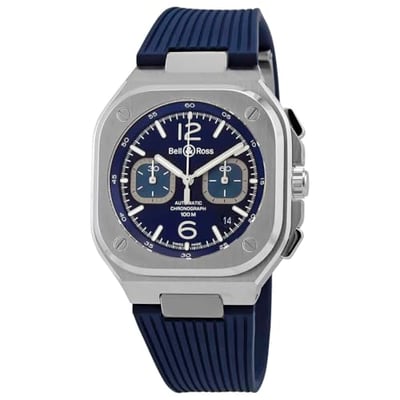
The Rado DiaStar Original Skeleton is the closest alternative in spirit: a non-round case, an open dial, and an accessible automatic movement. The Bell & Ross BR 05 Skeleton Black is the more expensive, more architectural option, with a square case and a similarly open movement. The Tissot PRX Powermatic 80 Skeleton is the integrated-bracelet choice, with Swatch Group automatic power and a lower entry point. The Mido Multifort Skeleton Vertigo is the industrial alternative, with an 80-hour movement and a similarly mechanical look.
There is no meaningful direct homage worth chasing. The affordable skeleton space is crowded with generic open dials, but none of them replicate the Ventura silhouette. If you want this shape, you are buying the Hamilton.
Investment Value
The MSRP is around $1,395, and current retail is in the same range depending on the variant. Pre-owned examples typically trade between $850 and $1,100, which means the watch depreciates like most mass-produced Hamiltons. This is not an investment piece. There is no major auction history for the standard Edge Skeleton, and there is no reason to expect one. Buy it because you want to wear it, not because you want to flip it.
Special editions and cinema-linked Hamiltons can sometimes outperform, but the standard Ventura Edge Skeleton is a wearer's watch. If you find one pre-owned at a fair price, it is a good value. If you pay full retail, you are paying for the design, the warranty, and the experience of owning it from new.
Service and Ownership
The H-10 family is well supported by Swatch Group service centers and many independent watchmakers. Service intervals vary depending on use, so follow Hamilton's guidance and confirm parts availability before buying pre-owned. The movement is not exotic, which is good news for long-term ownership. The black PVD case is more of a concern than the movement: PVD can show scratches and wear over time, so treat it like a design finish rather than an indestructible coating.
Price and Value
The Ventura Edge Skeleton sits in the $1,295 to $1,395 range depending on the variant. That price buys a Swiss automatic skeleton with an 80-hour power reserve, a sapphire crystal, and a case design that has real history. It is not the cheapest skeleton on the market, but it is one of the few that does not look like a generic open dial. The value is in the silhouette and the movement, not in resale.
Pros and Cons
Pros: the shield case has genuine design lineage, the H-10-S delivers an 80-hour reserve, the rubber strap is comfortable, and the watch is a strong entry point for an automatic skeleton. Cons: legibility suffers in low light, the fit is polarizing, it depreciates like most mass-produced Hamiltons, and it lacks a date or lume for daily utility.
Final Verdict
The Ventura Edge Skeleton is the rare affordable watch that feels like a piece of pop-culture architecture. It is not a do-everything daily, but it is a sharp, comfortable, and mechanically interesting choice for collectors who want a skeleton that does not look like every other open dial. Buy it for the silhouette and the 80-hour automatic; do not buy it as an investment.
If you want a watch that starts conversations, wears comfortably, and connects to one of the most recognizable shapes in modern watch design, this is a strong buy. If you need one watch for everything, keep looking. The Ventura Edge Skeleton is a specialist, and that is exactly why it works.