The Short Version
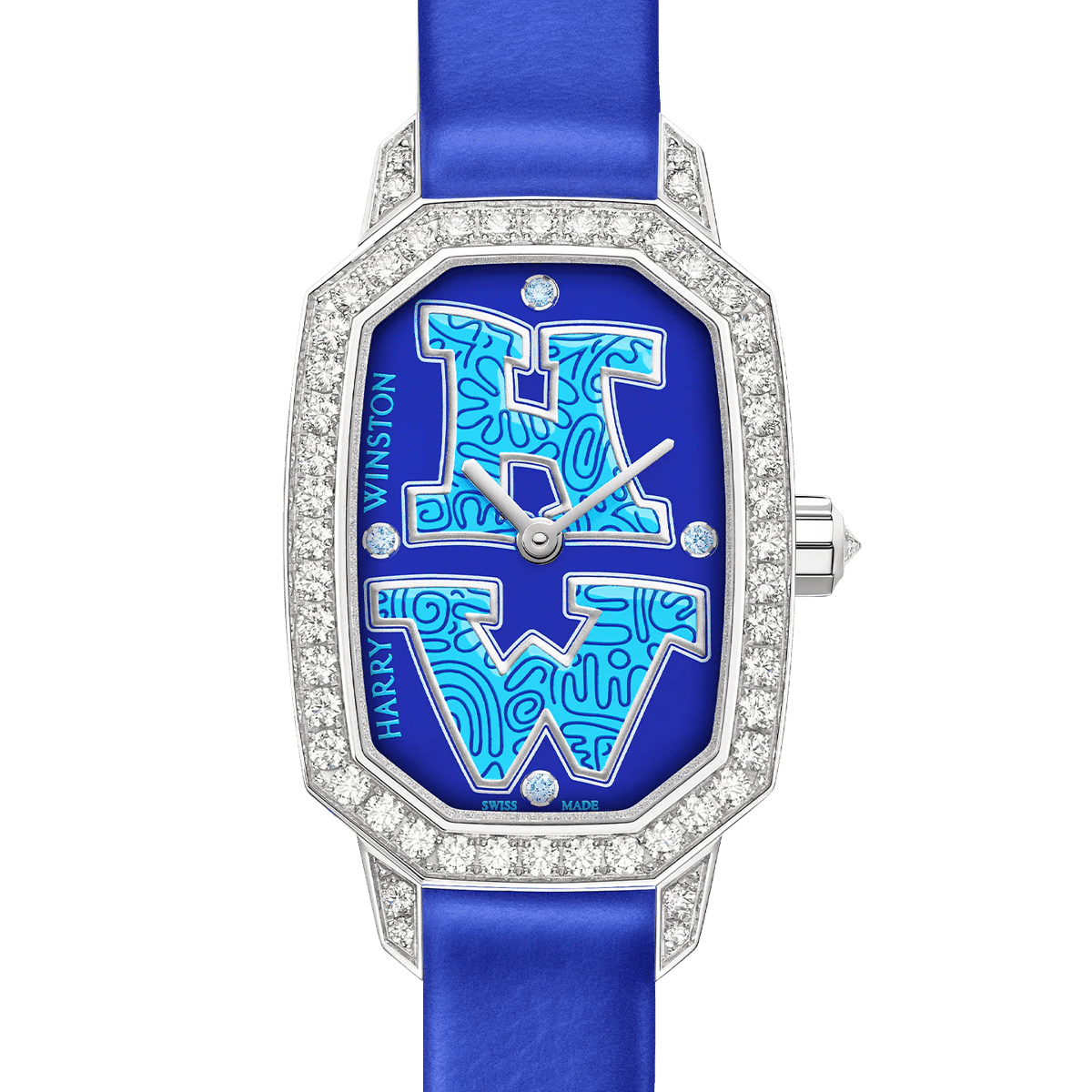
The Emerald Graffiti is Harry Winston's most self-aware gesture: a quartz, white-gold jewelry watch whose dial reworks the maison's own initials into a graffiti tag. It is not a tool watch, not an investment, and not remotely subtle. What it is: a genuinely distinctive evening piece from a house that usually plays it safe, priced like jewelry because that is exactly what it is.
If you want the short buying advice, here it is. Buy it pre-owned, wear it to things that involve a guest list, and do not open a spreadsheet about resale. If you want the long version — the case shape, the movement argument, the market reality — keep reading.
Harry Winston in Sixty Seconds
Harry Winston opened in New York in 1932. Within two decades the name meant one thing: the biggest stones, the most famous clients, the kind of jewelry that got its own exhibition tour. Harry Winston donated the Hope Diamond to the Smithsonian in 1958. The Court of Jewels traveled America like a rock tour. The phrase jeweler to the stars was not marketing copy so much as a job description.
In 2013 the Swatch Group acquired the brand, splitting the jewelry business from the Geneva watchmaking operation. That Geneva side is not a vanity project. Harry Winston launched the Opus series in 2001 with Francois-Paul Journe, and has spent two decades commissioning some of the most complicated watches in the world from independent watchmakers — tourbillons, perpetual calendars, movements built from scratch by people who work in small rooms with very good lighting.
Which is precisely why the Emerald Graffiti is interesting. This is a house that can build a grand complication to order, choosing instead to make a quartz watch for a woman who wants a beautiful object and does not want to think about amplitude. That is not a compromise. It is a product decision, and it tells you exactly who the Emerald is for.
The Emerald collection itself arrived in the mid-2010s, part of a broader push by heritage jewelers into ladies' watches that could hold their own next to the jewelry counter rather than being an afterthought in a display case. The Graffiti variants followed, borrowing a motif the maison had already applied elsewhere in its catalogue — the HW monogram rendered as a looser, hand-drawn tag rather than a rigid corporate mark.
Reading the Dial
The design move is simple and, in this segment, surprisingly rare: instead of blanking the dial and letting the diamonds do all the talking, Harry Winston put the decoration in the middle. The Graffiti dial is built around the interlocking HW initials, redrawn so they read as a scrawl rather than a stamp. Depending on the version, the motif is picked out with diamonds against the dial surface, giving it a brightness that shifts as the wrist moves and the light changes.
It is a dial that rewards a certain kind of owner. If you came of age with sneakers, streetwear drops and gallery walls, the reference lands immediately — this is a logo that has been deliberately de-corporate-ized, the way a luxury house gets interesting only when it stops protecting its trademark. If your reference point for a ladies' watch is mother-of-pearl and Roman numerals, it will read as vandalism. That, presumably, is the point.
The rest of the dial is deliberately quiet: no date window interrupting the composition, no sub-dials, no text beyond the essentials. That restraint matters more than it sounds. A graffiti motif with a date aperture would collapse into novelty. A graffiti motif with a chronograph would be a joke. Harry Winston kept it to hours and minutes and let the idea breathe.
It also makes the watch photograph unusually well, which is not a trivial consideration in 2024. Jewelry watches live or die on how they look in a single image on a phone screen, and the Emerald Graffiti has a legible silhouette at thumbnail size — elongated case, bright dial, one clear graphic idea. That is harder to achieve than most brands will admit.
The Case
The Emerald case is an elongated octagon — a shape that reads as a rectangle from across a room and as a faceted gem up close. It is the collection's entire identity, and it is why the watch photographs the way it does: the flat planes catch light in a way a round case never will, throwing small bright edges rather than one continuous curve.
In this reference the case is white gold, which is the correct choice for a piece like this. Yellow gold would push the graffiti motif toward retro, into the territory of 1980s downtown art and oversized earrings. Rose gold would soften it into something sweeter and more bridal. White gold keeps it cool and slightly clinical, and clinical is what you want when the dial is doing something cheeky.
Crystal is sapphire. That sounds like a baseline spec, but it is worth stating plainly, because a jewelry watch that scratches in the first month is a jewelry watch you stop wearing. Sapphire is the difference between an object that ages and an object that deteriorates.
Harry Winston does not publish a full dimensional breakdown for every Emerald reference, and this is a piece where the numbers genuinely matter less than the proportion. What you need to know is that the case is small, flat and built to sit close to the wrist rather than announce itself from across a restaurant. The shape does the work; the measurements are a detail for the spec sheet, not the sales conversation.
The Movement Question
Here is where the Emerald Graffiti loses half the room. It is quartz — the Q in the reference number tells you so before you even open the case back. Harry Winston does not publish a caliber designation for this movement, and there is no display back to admire, because there is nothing to admire. It is a time-only Swiss quartz movement doing a job.
The case for quartz is not lazy. A thin, low-maintenance movement lets the case stay slim and lets the watch function as jewelry rather than as a machine you have to wind and worry about. For an owner who rotates between pieces, travels with a small case, and does not want a watch winder occupying the bedroom, that is a feature rather than a shortcut. The battery is a two-to-three-year errand, not a ritual.
The case against quartz is equally obvious, and it is not about accuracy — a quartz movement will beat a mechanical one every day of the week and twice on Sundays. It is about price and romance. At jewelry-house money, a buyer can reasonably ask why there is no mechanical option, and the honest answer is that Harry Winston already makes one. The Emerald Automatic exists for that customer. The Graffiti is not that watch, and it is not trying to be.
What you should not do is buy this watch expecting a movement conversation. Nobody at dinner is going to ask about the escapement. They are going to ask where the dial came from, and that is a much better conversation anyway.
On the Wrist
The Emerald wears like a bracelet that happens to tell time. The case is small and flat, the profile sits close to the skin, and there is none of the top-heaviness you get from a heavy round case on a thin strap. On a smaller wrist it reads exactly as intended — an elongated flash of white gold rather than a watch competing for space with a cuff. It does not swing, it does not catch on sleeves, and it disappears under a shirt cuff the way good evening jewelry should.
The strap is the other half of the equation. This reference is catalogued on a satin strap with a pin buckle, which is the right call. Leather would look too corporate against a graffiti dial. A full gold bracelet would push both the price and the mood in the wrong direction, turning a piece of attitude into a piece of capital. Satin keeps it evening-appropriate and lets the case do the work.
The trade-off is durability. Satin is not a material that enjoys summer, swimming pools or daily abuse, and it will show wear long before the case ever does. If you plan to wear this four days a week, budget for straps the way you budget for shoes. If you plan to wear it to openings and dinners, it will hold up just fine.
Living With It
Day to day, this is a frictionless object. Quartz accuracy means you will not be adjusting it; expect it to hold within a handful of seconds a month, which is better than you will ever notice. There is no lume, so it is not a watch for reading in a dark cinema. There is no date, so you will check your phone like everyone else. Neither absence feels like a loss on a watch with this brief.
Service is a boutique affair. Harry Winston handles battery changes and servicing through its own network, and while any competent watchmaker can change a quartz battery, you do not want an independent opening a diamond-set white-gold case if it can be avoided. Budget for the maison, not the mall.
Water resistance is not the story here, and Harry Winston does not position the Emerald as a sports watch. Treat it as you would any fine jewelry watch: put it on last when you get dressed, take it off before the pool, and do not test it in the sea for the sake of a photograph.
The Market
Harry Winston does not run this reference through the kind of transparent price list that makes comparison shopping easy. Retail on Emerald pieces moves with metal, diamond content and boutique, and the Graffiti sits toward the upper end of the collection's quartz range. What is clear is the secondary market. Ladies' quartz jewelry watches from jewelry houses depreciate — they are bought for occasions, not portfolios, and the resale pool is thin because owners tend to keep them.
That is good news if you are buying pre-owned and bad news if you are buying new and already planning an exit. Auction houses are not the venue for this watch. Harry Winston's watch-auction footprint is built on the Opus series and high-complication pieces, not on quartz Emeralds. If one surfaces at auction, it will likely be inside a jewelry sale rather than a watch sale, and it will likely be priced to move quickly.
The honest framing: buy this at retail only if you love it and intend to keep it for a decade. Buy it pre-owned if you want the design without absorbing the depreciation. Either way, do not confuse a jewelry purchase with an allocation. This is not a steel sports watch with a waiting list, and it never will be.
What Else to Look At
Cartier's Panthere is the obvious benchmark — a jewelry watch with genuine design history and a bracelet that makes it a daily proposition rather than an occasion piece. Piaget's Possession and Limelight lines offer more overt gem-setting and a similar quartz-first philosophy, with a slightly softer read. Chopard's Happy Sport brings literal movement and playfulness to the dial, though its steel cases make it a different, more casual animal. Bulgari's Serpenti Seduttori is the closest thing to a rival in pure attitude.
Worth noting too: the standard Emerald. If the graffiti motif feels like too much of a statement for your wardrobe, the plain-dial Emerald delivers the same case shape with a more conventional read — and it will be easier to wear to a wedding.
And if you are shopping the broader category of small, sharp, design-forward jewelry watches, the real competition is not other watches at all. It is the bracelet you were going to buy instead. The Emerald Graffiti wins that comparison only if you actually want to tell time on your wrist.
Verdict
The Emerald Graffiti has to be judged on its own terms. As engineering it is unremarkable — quartz, time-only, no complications, no display back. As an object it is genuinely good: a distinctive case, a dial with an actual idea behind it, and a brand history that gives the graffiti motif real tension instead of turning it into a gimmick.
Buy it because you want a small, sharp, slightly rebellious piece of jewelry that happens to be a Harry Winston. Do not buy it because you think it will hold value. Those are two different purchases, and this watch only makes sense as the first one.