The Architectural Legacy of Harry Winston
In the world of high horology, few brands have successfully transitioned from the world of gemstones to the technical rigors of movement manufacturing as effectively as Harry Winston. The Excenter collection, and specifically the reference 200/MCRA39WL.W, is the physical manifestation of this transition. For a daily-wear reviewer, the Excenter presents a fascinating challenge: how does a watch designed with such aesthetic flair handle the mundane tasks of a typical week?
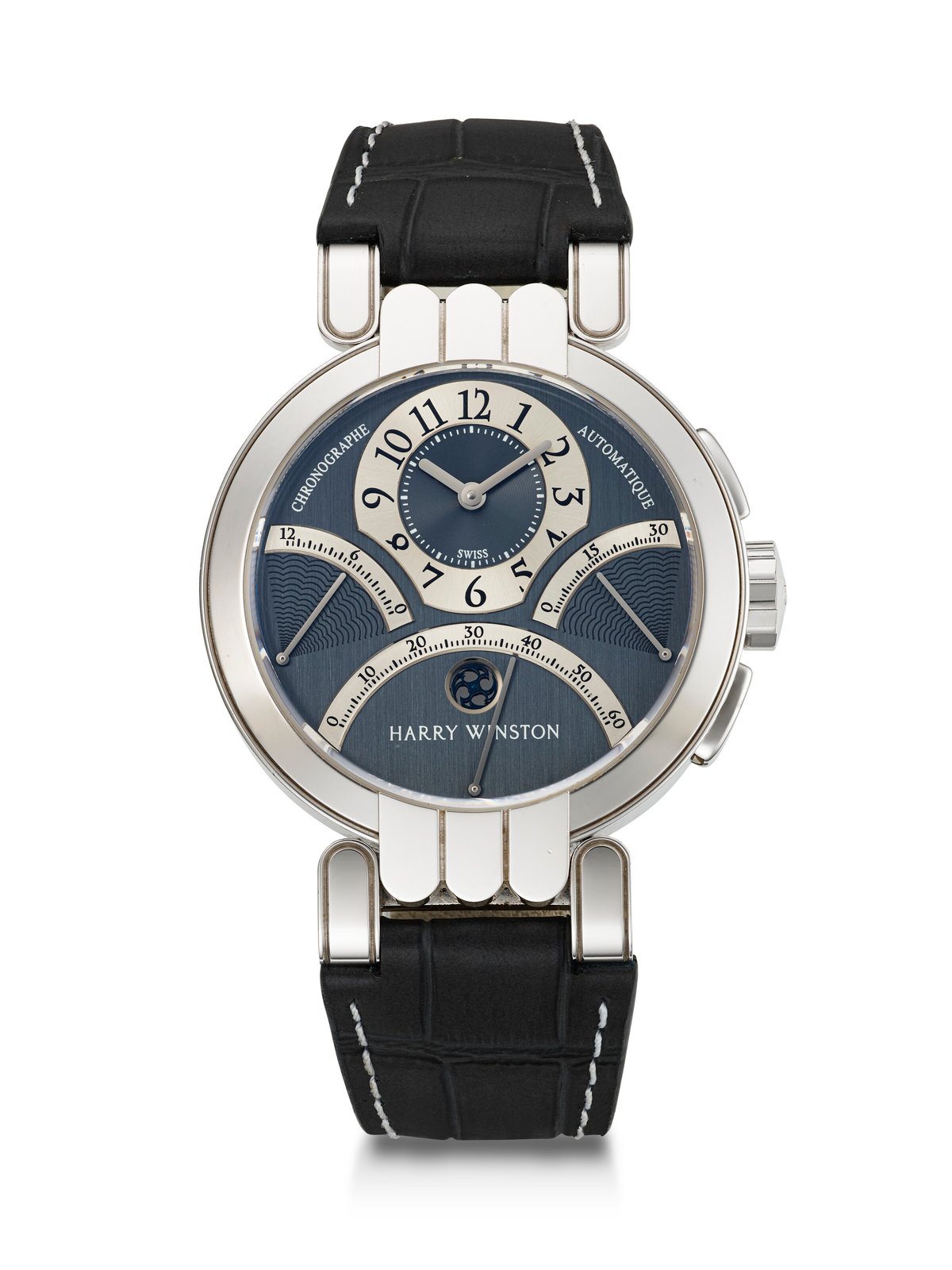
The first thing one notices about the 200/MCRA39WL.W is the case design. The lugs feature the iconic three-arch motif, a direct reference to the neoclassical arched entrance of Harry Winston's flagship salon on Fifth Avenue in New York. These aren't just decorative; they serve to integrate the strap into the case in a way that minimizes the gap between the watch and the wrist. This architectural approach ensures that despite its complexity, the watch feels like a singular, cohesive object on the arm.
Dial Dynamics: The Physics of the Retrograde
The centerpiece of this reference is the retrograde chronograph. Unlike a standard chronograph where hands move in a continuous circle, the retrograde hands on the Excenter travel across an arc. Once they reach the end of their path—60 minutes or 12 hours—they snap back to the starting position in a fraction of a second. This 'snap' is one of the most satisfying tactile experiences in watchmaking.
From a legibility standpoint, there is a learning curve. During my week with the watch, I found that reading the elapsed time required a moment more of concentration than a traditional tri-compax layout. However, the silvered dial, with its varied textures and finishes, provides enough contrast that the blued steel hands remain visible in most lighting conditions. The off-center time display at the top of the dial is surprisingly intuitive; once your brain adjusts to the positioning, it becomes second nature to check the time with a quick glance.
The Movement: A Pedigree of Precision
Under the hood of the 200/MCRA39WL.W beats the Caliber HW1013. This movement is built upon the Frédéric Piguet 1185, a vertical clutch, column-wheel chronograph movement that has been used by the likes of Audemars Piguet, Vacheron Constantin, and Blancpain. The choice of this base movement is a testament to Harry Winston's commitment to quality during this era.
The addition of the retrograde module adds a layer of mechanical complexity that is rarely seen in daily-wear watches. The vertical clutch ensures that the chronograph hand starts without the 'jump' often seen in lateral clutch movements. During my testing, the chronograph was engaged for several hours each day to time everything from meeting durations to espresso extractions. The power reserve, while modest at 40 hours, proved sufficient for a watch that is worn daily. If you plan to rotate this with other pieces, a watch winder is highly recommended to keep the retrograde module synchronized.
Real-World Wearability: Seven Days on the Wrist
Monday through Friday, the Excenter lived under the cuff of various dress shirts. Its 12mm thickness is thin enough to avoid catching on the fabric, a common annoyance with modern 'oversized' chronographs. The white gold case has a stealthy quality; to the uninitiated, it could be stainless steel, but the weight reminds the wearer of its precious nature. This 'stealth wealth' aspect is perfect for the sophisticated collector who doesn't need to shout about their acquisitions.
On the weekend, the watch transitioned to a more casual setting. While it lacks the water resistance for a trip to the pool, it looked perfectly at home with a cashmere sweater and dark denim. The lack of luminous material on the dial does limit its utility in dark environments, such as a theater or a late-night dinner, but the polished surfaces of the hands catch even the smallest amount of ambient light.
The Verdict for the Modern Collector
The Harry Winston Excenter 200/MCRA39WL.W is a bridge between two worlds. It offers the prestige of a legendary jewelry house with the mechanical soul of a high-end manufacture. For the collector who values design, history, and the sheer mechanical theater of a retrograde display, it is a compelling choice. While it requires more care than a standard steel sports watch, the rewards of wearing a piece of architectural history are well worth the effort.
In an era where many luxury watches are starting to look the same, the Excenter stands out as a bold reminder of what is possible when a brand dares to be different. It is a watch that rewards the close observer and provides a daily dose of mechanical wonder to its owner.