The King of Diamonds Goes Mechanical
Harry Winston founded his jewelry company in New York in 1932. Over the decades, the brand became synonymous with exceptional diamonds and high society. The 'King of Diamonds' dressed the necks and wrists of royalty, Hollywood stars, and captains of industry. But the watch world is a different beast. In the late 1990s and early 2000s, Harry Winston began to invest seriously in haute horlogerie, acquiring a manufacture and launching ambitious collections. The Opus series, a collaboration with independent watchmakers, put the brand on the map for mechanical innovation. But the Histoire de Tourbillon series, launched in 2009, was something else entirely: an annual showcase of the tourbillon in increasingly complex forms.
The seventh edition, released in 2016, arrived at a moment when Harry Winston was under the Swatch Group umbrella (the acquisition was completed in 2013). This gave the brand access to immense resources and manufacturing expertise. The Histoire de Tourbillon 7 reflects that: it is a polished, confident piece that combines traditional high horology with a distinctive aesthetic. It is also a testament to the brand's commitment to mechanical art, even as it continues to be known primarily for diamonds.
The Histoire de Tourbillon Series
The Histoire de Tourbillon series is not a single watch but a family of limited-edition pieces, each year pushing the boundaries of tourbillon design. The first edition featured a bi-axial tourbillon. The third edition, for example, was a triple tourbillon with three independent cages. The seventh edition continues this tradition with a bi-axial tourbillon—two concentric cages rotating on different axes—coupled with a 24-hour indicator and a power reserve display. It is a complex piece, but it is also one of the more legible and wearable entries in the series.
Each Histoire de Tourbillon is produced in extremely limited numbers, typically 20 to 30 pieces. This exclusivity is part of the appeal. These are not watches you see in every boutique. They are collector's items, often sold before they even reach a display case. The seventh edition, with its 20-piece run, is no exception.
Design and Presence
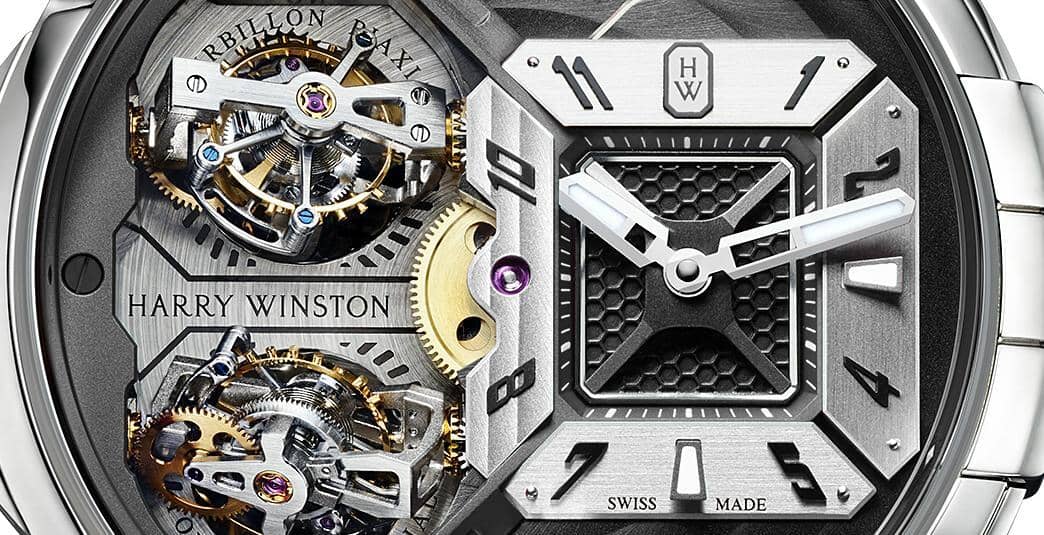
The first thing you notice about the Histoire de Tourbillon 7 is the dial. Or rather, the lack of a traditional dial. The watch is openworked, with a sapphire crystal covering a three-dimensional landscape of movement components. At the center, the bi-axial tourbillon dominates, its two cages rotating at different speeds. Around it, you can see the bridges, gears, and the power reserve indicator. At 12 o'clock, there is a 24-hour indicator, a subtle nod to the brand's global clientele. The overall effect is technical and futuristic, yet also strangely elegant. The white gold case, at 45mm in diameter, gives it a substantial presence without being overly bulky. The lugs are curved, and the alligator strap integrates smoothly, making it more wearable than you might expect.
The finishing is exceptional. The bridges are hand-beveled, the screws are polished, and the surfaces are a mix of brushed and mirror-polished finishes. Harry Winston has not skimped on the details. The case itself is a study in restraint: no diamonds, no engravings, just clean lines and a smooth bezel. This is a watch that lets the mechanism speak for itself. It is a confident design, and it works.
Movement and Complications
The Histoire de Tourbillon 7 is powered by a manual-winding mechanical movement, developed by Harry Winston's haute horlogerie department. The caliber is a proprietary design, and while the brand does not widely publish every technical detail, the key specifications are known. It features a bi-axial tourbillon, meaning the tourbillon cage rotates on two axes, averaging out positional errors more effectively than a traditional single-axis tourbillon. The power reserve is rated at 55 hours, which is respectable for a high-complication piece. The frequency is 18,000 vibrations per hour (2.5 Hz), a traditional beat rate that allows for a clear view of the tourbillon's rotation.
In addition to the tourbillon, the watch has a 24-hour indicator and a power reserve display. The 24-hour indicator is useful for travelers, though it is not a true GMT. The power reserve indicator is a practical touch, reminding you to wind the watch. The movement is not COSC-certified, which is typical for high-complication pieces; the focus is on mechanical artistry rather than chronometric certification. The finishing is haute horlogerie: hand-bevelled bridges, polished steel components, and a complex architecture that is visible from both the front and the back (the caseback has a sapphire crystal).
Wrist Feel
At 45mm, the Histoire de Tourbillon 7 is a large watch. But it wears smaller than its dimensions suggest. The curved lugs hug the wrist, and the alligator strap is supple and comfortable. The white gold case has a pleasant heft, but it is not overly heavy. The watch sits well on a medium-to-large wrist, though those with smaller wrists may find it overwhelming. The openworked dial means there is no solid dial to reflect light, so the watch can appear darker and more subtle than a diamond-set piece. It is a watch that feels special every time you put it on.
One thing to note: the bi-axial tourbillon is visually mesmerizing, but it can be a distraction. You may find yourself staring at it instead of checking the time. The lack of a traditional dial also means legibility is not its strong suit. The hands are skeletonized, and against the busy background, reading the time takes a moment. This is not a watch for quick glances. It is a watch for contemplation.
Accuracy and Daily Life
Given the complexity of the tourbillon, you might expect mediocre accuracy. In reality, the watch performs well for a high-complication piece. The bi-axial tourbillon helps with rate stability, and the 18,000 vph frequency is traditional but capable of good precision. Real-world accuracy is likely within -10 to +15 seconds per day, which is acceptable for a piece of this nature. However, it is not a daily driver in the traditional sense. It is not water-resistant to any meaningful degree (the exact rating is not published, but it is not a sports watch), and it is not shock-resistant. You would not wear it to the gym or while gardening. It is a watch for special occasions, for the office, and for evenings out.
Daily life with the Histoire de Tourbillon 7 requires some care. You need to wind it manually every 55 hours or so. The power reserve indicator helps, but you must remember to wind it. The alligator strap is not designed for water, so you should avoid wearing it in the rain. And the white gold case is soft, so it will scratch if you are not careful. But these are minor inconveniences for a watch that offers so much visual and mechanical pleasure.
Occasions
This is not a versatile watch. It is a formal piece, best paired with a suit or a tuxedo. It can work with smart casual, but it is too flashy for a t-shirt and jeans. It is a dress watch, a collector's watch, a special occasion watch. It is not a travel watch, despite the 24-hour indicator, because it is not robust enough for the rigors of travel. It is not a sports watch. It is a watch for the boardroom, the charity gala, and the collector's dinner. It is a conversation starter, and it deserves an occasion that matches its gravitas.
Investment Value and Ownership
The Harry Winston Histoire de Tourbillon 7 was released with a price on request, and it is safe to assume it was in the mid-six-figure range. Today, it is a limited edition of 20 pieces, which gives it a certain scarcity value. However, the secondary market for Harry Winston high complications is thin. Unlike Patek Philippe or Audemars Piguet, Harry Winston does not have a deep bench of collectors who trade these pieces regularly. That means liquidity is low. If you buy one, you should do so because you love it, not because you expect to flip it for a profit. The trend is likely stable to slightly depreciating in the short term, but the long-term outlook for limited-edition haute horlogerie is positive. Auction history is sparse; these pieces rarely come up for public sale. When they do, they tend to sell within their estimates.
Service is another consideration. The watch should be serviced every five to seven years, and it must be done by Harry Winston or a Swatch Group high-horology center. The cost is not publicly disclosed, but expect it to be significant—likely several thousand dollars. This is part of the ownership experience for any high-complication piece.
Comparisons
If you are in the market for a multi-axis tourbillon, there are a few alternatives. The Greubel Forsey Double Tourbillon 30° is a more extreme take on the concept, with a tilted tourbillon and a much higher price. The Jaeger-LeCoultre Reverso Tribute Gyrotourbillon is another option, offering a more classical aesthetic and the iconic Reverso case. The Breguet Tourbillon Extra-Thin Automatique is a more traditional choice, with a focus on elegance rather than openworked complexity. The Ulysse Nardin Freak Vision is a futuristic piece that pushes the boundaries of materials and design. The Harry Winston sits somewhere in the middle: it is more ornate than the Breguet, more wearable than the Greubel Forsey, and more traditional than the Ulysse Nardin.
As for homages, there is no direct homage to the Histoire de Tourbillon 7. The closest you can get is a generic openworked tourbillon from a brand like Seagull or Parnis. These watches cost a few hundred dollars and offer a visible tourbillon, but they are not in the same league in terms of finishing, reliability, or exclusivity. They are a fun way to experience the tourbillon aesthetic, but they are not a substitute.
Pros and Cons
Pros: Extreme mechanical complexity; limited to 20 pieces; distinctive openworked design; excellent finishing; comfortable on the wrist despite its size.
Cons: Very high price; limited daily wearability; opaque secondary market; legibility is not ideal; service costs are high.
Final Verdict
The Harry Winston Histoire de Tourbillon 7 is a remarkable piece of mechanical art. It is not for everyone—it is too expensive, too flashy, and too impractical for most. But for the collector who appreciates high horology and wants something that stands out from the usual Patek and AP crowd, it is a compelling choice. It is a watch that rewards close inspection and offers a daily reminder of what human hands can achieve. If you have the means and the passion, it is worth seeking out. Just don't expect it to be a liquid asset.