The Zenith of Mechanical Theater
In the world of high horology, there are watches that tell time, and then there are watches that narrate the story of physics. The Harry Winston Histoire de Tourbillon 8 (HdT 8) belongs firmly in the latter category. Since the inception of the Histoire de Tourbillon series in 2009, Harry Winston has used this collection as a dedicated laboratory for exploring the most complex iterations of the tourbillon. While the Opus series was about collaboration with independent watchmakers, the HdT series is about the brand’s internal technical prowess, backed by the industrial might of the Swatch Group.
For the sophisticated collector, the HdT 8 represents a specific era of watchmaking where 'bigger was better'—not just in terms of case size, but in terms of mechanical ambition. The watch features two biaxial tourbillons, a feat that requires immense energy management and precision. In this analysis, we will deconstruct the HdT 8 from a technical, aesthetic, and financial perspective to determine its place in a modern luxury watch portfolio.
Technical Deep Dive: The HW4503 Caliber
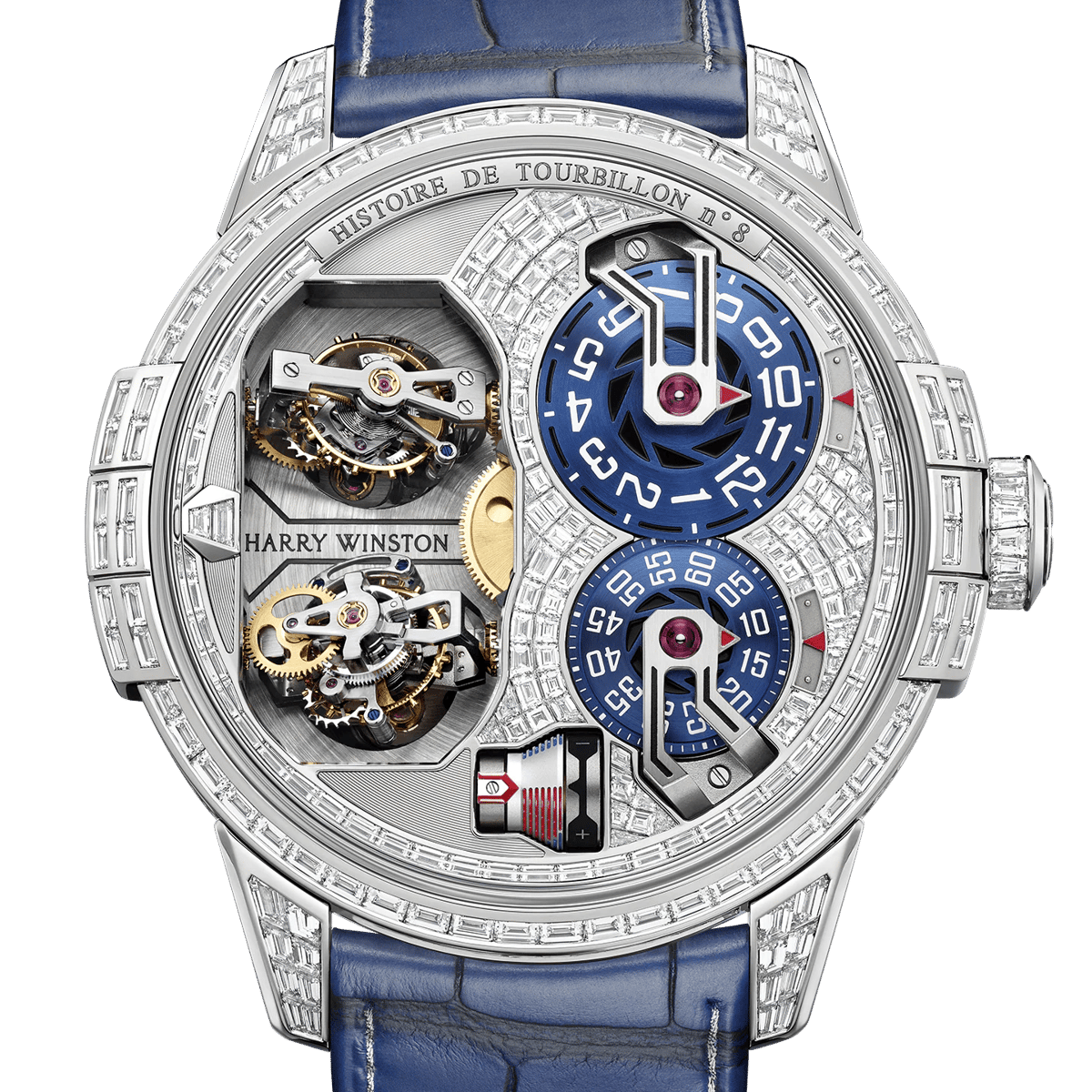
The heart of the HdT 8 is the Caliber HW4503. This is not a movement designed for mass production; it is a bespoke engine consisting of 482 components, 117 of which are jewels. The primary draw is the dual biaxial tourbillon setup. Each tourbillon consists of two cages: an inner cage that rotates once every 45 seconds and an outer cage that rotates once every 75 seconds. These cages are positioned at an angle to each other, ensuring that the balance wheel never remains in a single position for long, thereby canceling out the effects of gravity more effectively than a standard tourbillon.
What sets the HdT 8 apart from its predecessors is the spherical differential. This component sits between the two tourbillons and acts as a mechanical 'average.' It takes the rate of each regulator and combines them, providing a single, more stable output for the time display. This is a high-level solution to chronometric variance and is a hallmark of truly elite watchmaking. The power reserve stands at 55 hours, which is impressive given the massive amount of energy required to drive four tourbillon cages simultaneously.
Aesthetic and Architecture
The design of the HdT 8 is unapologetically bold. The case, fashioned from 18k white gold, measures 51mm in diameter. This scale is necessary to house the two massive tourbillon assemblies, which are visible through the large sapphire apertures. The time is displayed on the right side of the dial via two rotating discs: a jumping hour disc and a trailing minute disc. This 'digital' style of timekeeping allows the tourbillons to remain the focal point of the visual experience.
The finishing is exemplary. The bridges are NAC-treated, giving them a dark, modern look that contrasts beautifully with the polished steel of the tourbillon cages. In the red variant (Reference HCOMDT51WW002), the use of red aluminum for the tourbillon bridges and dial accents adds a layer of aggressive modernity that appeals to a younger, sportier demographic of collectors. The anthracite version (Reference HCOMDT51WW001) is more sober and architectural, emphasizing the raw mechanical beauty of the movement.
The Market Context: Scarcity vs. Liquidity
From an investment standpoint, the HdT 8 must be viewed through the lens of extreme scarcity. With only 20 pieces in existence, this is a 'low-velocity' asset. You will not find this watch on the shelves of a secondary dealer in every major city. Instead, acquisitions typically happen through private brokers or high-end auction houses like Christie’s or Phillips.
In the current market, the HdT 8 has seen a stabilization in value. After an initial depreciation from its $625,000 MSRP—typical for most grand complications—it has found a floor in the $380,000 to $480,000 range. For a buyer, this represents an opportunity to acquire a piece of 'Haute Horlogerie' at a significant discount from retail, with the knowledge that the limited supply protects against further major drops. In a world where stainless steel sport watches can reach six figures, the intrinsic value of a white gold, dual biaxial tourbillon at $400,000 is objectively high.
Investment Verdict: The 'Hold' Strategy
My recommendation for the HdT 8 is a 'Hold.' We are currently seeing a resurgence in interest for 'neo-vintage' and modern complications as collectors tire of the ubiquity of integrated bracelet sport watches. The HdT series is the spiritual successor to the Opus line, which has already seen a significant uptick in collectibility. As the market continues to mature and collectors seek out genuine mechanical innovation, the HdT 8 is well-positioned to appreciate.
The key to the HdT 8’s value lies in its provenance as part of the Harry Winston story. Under the Swatch Group, Harry Winston has access to the best movement designers in the world, and the HdT series is the purest expression of that access. For a collector with a long-term horizon (10+ years), the HdT 8 is a blue-chip asset that offers both mechanical satisfaction and a high degree of exclusivity.
Conclusion
The Harry Winston Histoire de Tourbillon 8 is a tour de force of modern watchmaking. It is a watch that ignores the trends of 'thinness' and 'discretion' in favor of a raw, powerful display of engineering. While its size makes it a niche choice for wearability, its technical specifications and rarity make it a formidable entry in any serious horological portfolio. For those who value the 'theater' of the tourbillon, there are few watches that can compete with the HdT 8.