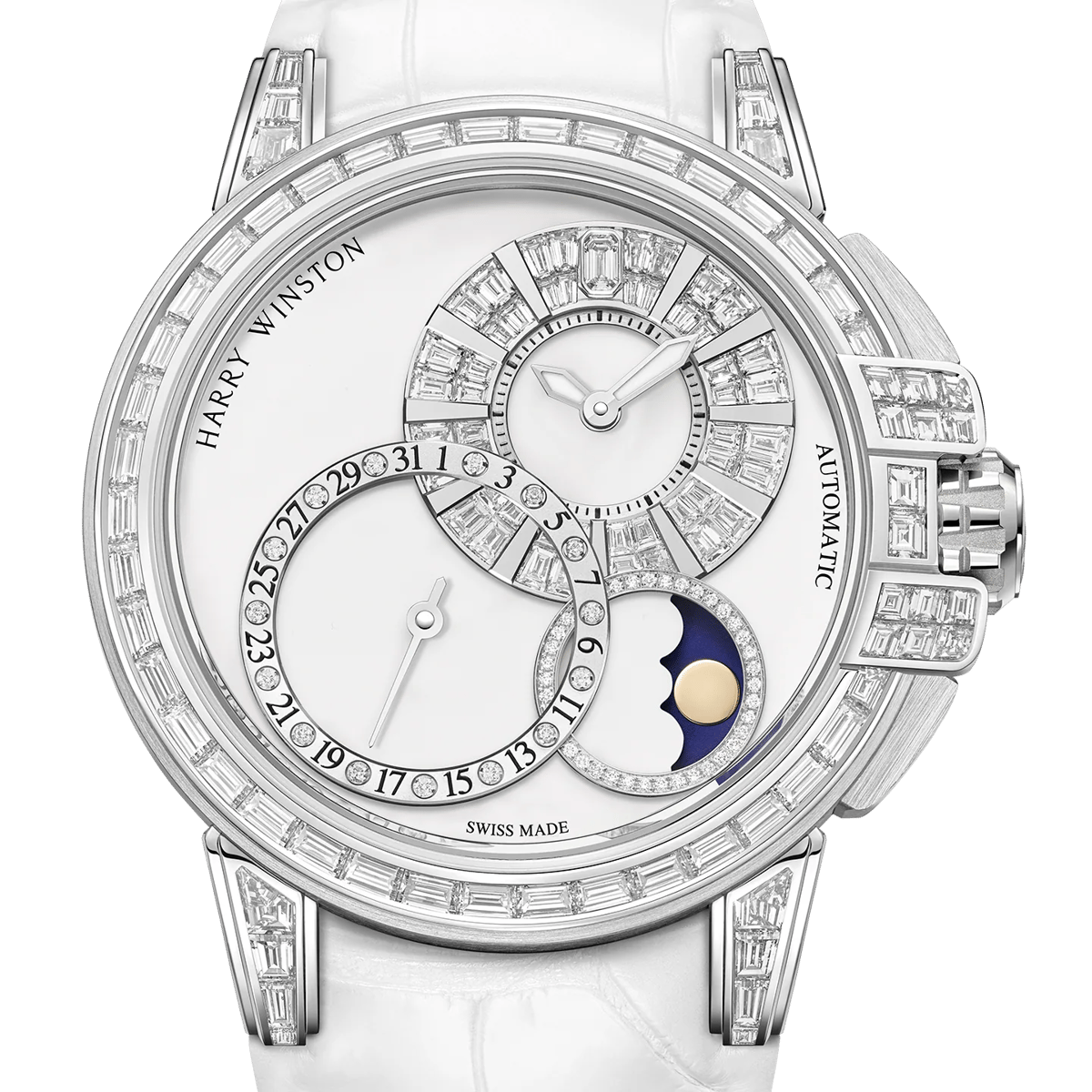
This review treats the watch as what it is: a high-jewelry moonphase with a sports-luxury case and a jewelry-house name. It is not a chronometer play, not a hype piece and not a liquidity instrument. The question is whether the object is good enough to justify the capital, and whether the secondary market offers a sensible entry.
Brand context: diamonds first, watches second
Harry Winston was founded in 1932 in New York. The house built its reputation on exceptional diamonds and high jewelry, not on serial watch production. Its watch collections, including Ocean, Premier and Opus, have produced serious horology, but the brand's center of gravity remains jewelry. That matters for the Ocean Date Moon Phase Baguette because the baguette bezel is not an accessory; it is the reason the watch exists.
In the secondary market, Harry Winston watches are often priced against the jewelry value of their materials rather than against a deep collector community. That is not a criticism of the product. It is a warning about exit liquidity. The collector who buys this watch should be comfortable with the idea that the next buyer may be a jewelry client rather than a watch collector. That buyer cares about sparkle, condition, completeness and brand prestige. They may not care about movement finishing or auction comparables.
The Ocean collection itself is Harry Winston's modern sport-luxury line. It has the rounded case language and the kind of wrist presence that suits both tailoring and evening wear. The Date Moon Phase is one of the more romantic expressions in the line, and the Baguette version pushes it firmly into high-jewelry territory. That positioning is coherent: Harry Winston is not trying to beat Patek at watchmaking. It is trying to be Harry Winston.
Movement and technical brief
The Ocean Date Moon Phase Baguette is an automatic watch with a date and moon-phase complication. Harry Winston does not publish a complete technical sheet for this baguette variant, and the brand treats the piece as a jewelry object first. We have therefore left the exact caliber, power reserve, frequency and jewel count out of the numeric specification rather than substituting a generic figure. What can be said is that the watch is not presented as a chronometer, and there is no COSC certification to lean on for marketing.
That is acceptable in this context. A baguette-set moonphase is not bought for rate performance. If you want a daily chronometer, there are better-owned options at a fraction of the price. If you want a moonphase with high-jewelry presence, the movement only needs to be reliable and serviceable. The complication layout is the practical part of the watch: the date and moonphase are legible without turning the dial into a dashboard. The moonphase in particular gives the dial a focal point that plain gold cannot match.
The movement should be judged on reliability and service support rather than on architecture. Harry Winston's public materials do not describe this variant as an in-house manufacture movement, and the brand does not market it as a technical showpiece. That is fine. The watch is a jewelry object with a mechanical heart. If you need a full technical dossier before you buy, this is not the piece for you.
Case, dial and the baguette setting
The Ocean case is the right host for the baguette treatment. It has a rounded, almost cushion-like profile that gives the diamonds a frame without making the watch look like a bracelet. The case is gold, the crystal is sapphire, and the watch is supplied on a leather strap with a pin buckle. There is no lume, which is correct for a jeweled dress-sport piece. This is not a watch you take diving; it is a watch you take to dinner.
The baguette bezel is the headline. Baguette diamonds require matched stones, careful calibration and a setting that does not crowd the case. Harry Winston's credibility here is real. The brand has spent decades working with stones at the highest level, and the Ocean Date Moon Phase Baguette benefits from that expertise. The visual effect is sharper and more architectural than a round-diamond bezel. It catches light in planes rather than points, which makes the watch read as jewelry from across a room and as a watch up close.
The dial is best understood as a background for the complications and the bezel. The date and moonphase are arranged to keep the face balanced, and the overall look is cleaner than many high-jewelry calendars. The baguette setting does not leave much room for visual clutter, and Harry Winston has resisted the temptation to over-decorate the dial. That restraint is a point in the watch's favor. The dial is not the star; the bezel is. The watch knows that.
On the wrist
The Ocean Date Moon Phase Baguette wears more comfortably than its appearance suggests. The Ocean case has a soft, rounded profile, and the leather strap keeps the package from feeling like a metal bracelet. The baguette bezel adds visual mass, but it does not make the watch feel top-heavy in the way a thick gem-set sports watch can. On the wrist, the watch sits close and reads as a dress-sport piece rather than a formal jewel.
The comfort story is helped by the strap. A leather strap on a gold case is a classic combination for a reason: it distributes weight, it ages with the wearer, and it makes the watch easier to wear with tailoring. The pin buckle is traditional and keeps the profile low. The trade-off is that leather is a consumable. If you wear the watch often, you should budget for strap replacement, and you should keep the original strap if you care about completeness.
The watch does not have the wrist presence of a Royal Oak Offshore or a modern chronograph. It has something more specific: jewelry presence. The baguette bezel catches light in a way that plain gold cannot, and the moonphase gives the dial a focal point. It is not a stealth piece. If you want a watch that disappears under a cuff, this is not it. If you want a watch that rewards a close look and a well-lit room, it is.
Accuracy and daily ownership
Because the watch is not chronometer-certified, day-to-day accuracy should be judged as a conventional Swiss automatic rather than a precision instrument. Expect normal positional variation, and do not expect quartz-like consistency. The moonphase and date add setting chores if the watch sits in a safe for long periods. A winder is useful, but not mandatory. The more important ownership point is that the watch should be serviced by someone who understands both the movement and the diamond setting.
For a collector, accuracy is secondary here. The watch is a wearable jewelry object with a romantic complication. If you are the kind of buyer who checks rate on a timegrapher every month, you will likely be happier with a chronometer-certified dress watch. If you want a moonphase that looks like it belongs in a jewelry house, the Ocean Date Moon Phase Baguette makes sense.
Occasions and wrist presence
The watch is best suited to formal and dress occasions, but it is not so fragile that it cannot be worn daily by a careful owner. It works with a suit, a dinner jacket, or a well-cut casual outfit. It is less at home in sport or travel contexts where a baguette bezel is simply the wrong tool. The leather strap and gold case set the tone: this is an evening-leaning piece that can cross into daytime wear if you dress with intent.
Wrist presence is high. I would rate it 4/5. The baguette bezel and moonphase give the watch a lot of visual information, and the Harry Winston name carries recognition among jewelry clients even if it does not carry the same weight among watch collectors. It is not a loud watch in the way a diamond-encrusted sports watch can be, but it is unmistakably expensive. That is the point. The watch is designed to be noticed by people who know jewelry, not by people who know bezel measurements.
Reference variants and family context
The baguette version sits at the top of the Ocean Date Moon Phase family. The non-baguette Ocean Date Moon Phase is the reference to price against: same complication set, same Ocean case language, but without the baguette bezel. It is the more rational watch for a collector who wants the design without the jewelry premium. The baguette version is for the buyer who wants the setting, the sparkle and the occasion.
Within the wider Ocean family, Harry Winston has produced dual-time, biretrograde and tourbillon models. These are siblings rather than direct substitutes. The dual-time is more travel-oriented; the biretrograde is more technical; the tourbillon is a halo piece. The Date Moon Phase Baguette is the jewelry-forward moonphase in the line. That positioning is clear and coherent.
Exact reference numbers for this baguette variant are not consistently published in public materials. Collectors should verify the reference, metal, dial configuration and diamond setting with Harry Winston or a specialist dealer before transacting. Do not rely on a generic Ocean Date Moon Phase reference if the bezel is baguette-set. The diamond content changes the value proposition.
Comparables and alternatives
The closest luxury comparables are jeweled moonphases from Patek Philippe, Chopard, Piaget and Vacheron Constantin. A Patek Philippe Complications Moon Phase is the benchmark for brand liquidity and collector acceptance; it will cost more and hold value better, but it will not have the same baguette-driven jewelry presence. Chopard's Imperiale Moon Phase offers a softer jewelry profile and a lower secondary premium. Piaget's Limelight Stella is a dress-jewelry moonphase with strong brand recognition among jewelry buyers. Vacheron Constantin's Egerie Moon Phase is a high-jewelry alternative with stronger watch-collector credibility.
The honest comparison is not another watch; it is a piece of jewelry. If you are choosing between this watch and a diamond bracelet, the watch gives you a complication and a brand with watchmaking history. If you are choosing between this watch and a Patek moonphase, the Patek is the better financial instrument. The Harry Winston is the more distinctive object. That is the trade.
For buyers who want the look without the capital commitment, there are affordable moonphase and jewelry watches from fashion and entry-luxury brands. They do not replicate the baguette setting or the Ocean case, but they deliver the evening-watch brief at a fraction of the price. That is not a substitute for a collector; it is a useful reminder that the Harry Winston is priced for its materials and its name, not for its complication alone.
Investment case
The investment case is weak. Harry Winston watches do not have the auction depth of Patek Philippe, Audemars Piguet or Rolex, and jeweled models are especially dependent on the taste of a narrow buyer pool. The baguette premium is an aesthetic cost, not a liquid asset. In practice, that means a retail buyer should expect a significant mark-to-market loss on exit. A pre-owned buyer has a better chance of preserving capital, but even then the watch should be bought because it will be worn.
Demand cycles matter here. Jeweled watches tend to track luxury jewelry demand more closely than watch-collector demand. That means they can be strong in periods of jewelry-led wealth creation and weak when buyers rotate toward steel sports watches or independent horology. The Ocean Date Moon Phase Baguette is not a model that benefits from the current taste for integrated bracelets and hype releases. It is a niche object with a specific audience.
Our working view is that the Ocean Date Moon Phase Baguette trades at a discount to retail in the secondary market, with condition, completeness and diamond quality driving the spread. The watch is not a major auction lot, and there is no meaningful auction history for this specific reference. That is not a reason to avoid it; it is a reason to negotiate hard and to avoid underwriting the purchase as an investment.
The hold-versus-sell judgment is straightforward. If you bought at retail, you are already underwater on a mark-to-market basis. If you bought pre-owned at a disciplined price, hold it if you wear it. Sell it if you need liquidity, if the strap and service costs are becoming a burden, or if you are chasing a more liquid grail. Do not sell it into a soft market simply because another brand is hotter. The buyer for this watch is not a hype buyer; it is a jewelry client who wants the object.
Service and ownership cost
Service should be handled through Harry Winston or a brand-authorized center. The movement is one issue; the baguette setting is another. A general watchmaker may be able to service the calibre, but the diamond setting should be left to specialists. That limits your options and usually increases cost. We have left the service interval and approximate cost blank because Harry Winston does not publish a standard figure for this variant. Ask for a written service estimate before you buy, especially if the watch is outside warranty.
Strap replacement is the other ownership cost. Leather straps wear out, and a gold pin buckle should be transferred to the new strap. Keep the original buckle and any service papers. Completeness matters in the secondary market, even for a watch with a narrow buyer pool. A full set with the original strap, buckle and paperwork will always be easier to sell than a loose watch.
Final verdict
The Harry Winston Ocean Date Moon Phase Baguette is a beautiful object and a difficult investment. It succeeds as high jewelry with a useful complication, and it fails as a store of value when compared with the best watchmaking brands. Buy it pre-owned, buy it because you will wear it, and treat the baguette premium as the cost of the look. Do not buy it at retail expecting Patek-like liquidity.
For the right collector, that is enough. The watch has a specific charm: it is a moonphase from a jeweler, not a jeweler's version of a watch. That distinction is worth something, just not the same something as a balance sheet.