The jeweler who builds complications
Harry Winston opened in New York in 1932 and became the American jeweler of record, famous for the Hope Diamond and for setting stones with a restraint that flattered rather than shouted. The watch division established itself in Geneva and, from the late 2000s, the Ocean collection gave the brand a sport-luxury platform for serious complications.
That history matters when you put this watch on. It is not a tool watch with a tourbillon added as an afterthought, and it is not a jewellery piece with a movement inside. It sits in the narrow space between: a jeweller's idea of a travel watch, with the finishing standards of a high-jewellery house applied to a case that is meant to be worn on a Tuesday.
Case and dial: the Ocean language
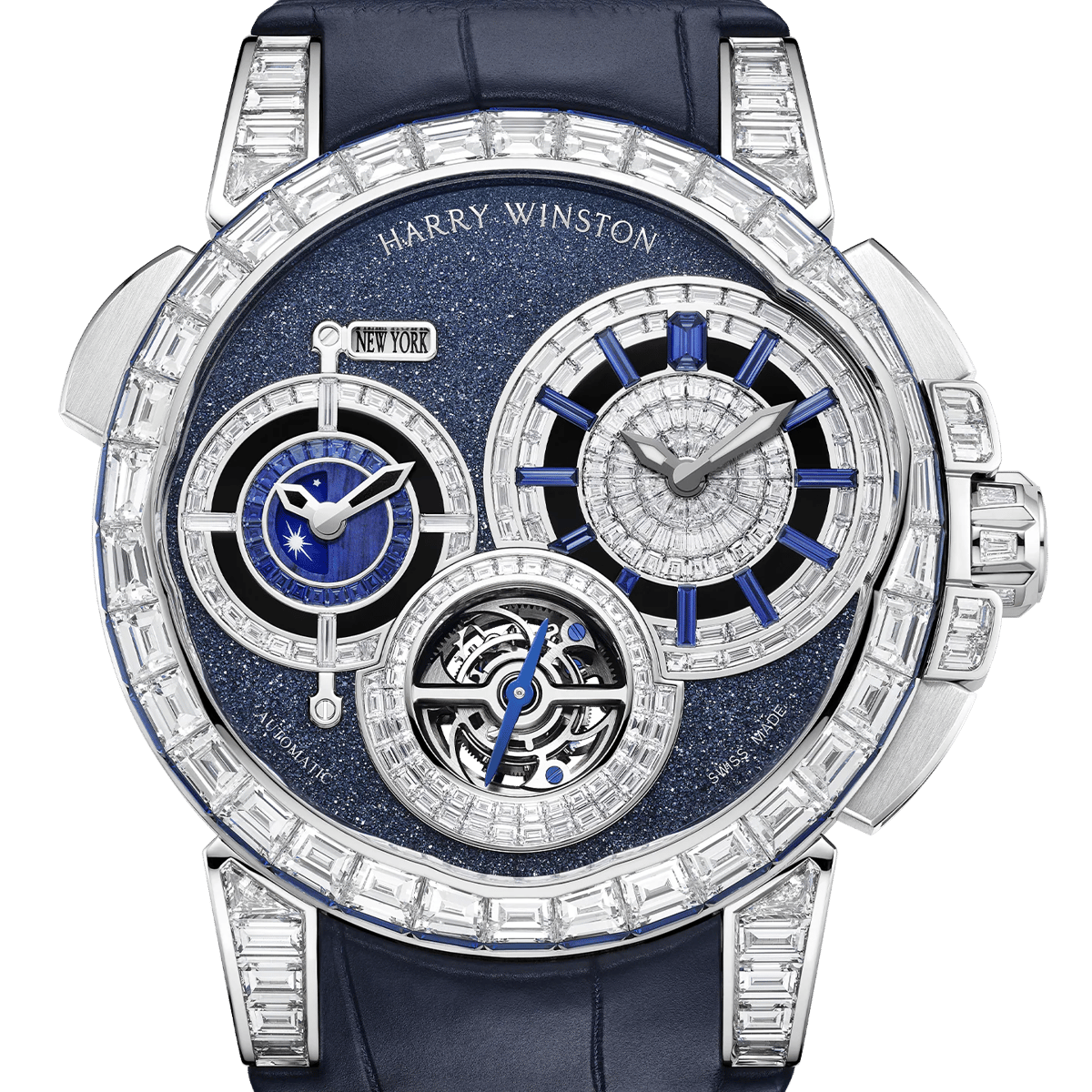
The Ocean case is the most recognisable thing about the watch. Broad, polished, with the lugs sweeping down and back rather than straight out, it is a case designed to sit into the wrist rather than perch on top of it. The bezel is smooth and unfussy — no diamonds here, no engraved reference numbers — and the whole thing reads as gold first and complication second, which is the correct order for a Harry Winston.
The dial is where the two complications negotiate their peace. The tourbillon sits at six o'clock in an open aperture, its cage visible and in motion, and the world-time ring wraps around the outer edge with the GMT indication integrated into the same space. It is a lot of information, and the reason it works is that the tourbillon gives the eye a single place to land. Look at the dial and you see the cage first, then the hours and minutes, then — only if you ask — the secondary zone.
Finishing is what you would expect from a maison that spends its days looking at stones. The applied indices are faceted, the hands are polished and sharp, and the caseback shows a movement with hand-bevelled bridges and a tourbillon cage that is clearly meant to be admired. It is the sort of watch that rewards a loupe, which is an odd thing to say about a travel watch and entirely appropriate for this one.
The tourbillon, the GMT and the world ring
Let us be honest about the tourbillon. In a wristwatch, on a wrist that moves, it does not deliver the chronometric miracle that Abraham-Louis Breguet designed it for. What it delivers is theatre — and, in this case, a genuinely beautiful one, because the cage is large, legible and placed where you can see it while you are actually wearing the watch rather than only when you take it off.
The GMT and world-time functions are the useful half of the equation. The world-time ring gives you a reference city set and the GMT hand tracks a second zone against it, which is exactly what you want on a long-haul trip: one glance tells you whether it is a reasonable hour to call home. The catch is that the ring is small and the city names are finely printed, so you need decent light and a moment of concentration. This is not a watch you read while running for a train.
The movement is a Harry Winston manufacture tourbillon caliber rather than an outsourced ébauche, with the GMT and world-time functions integrated into the same architecture. Harry Winston does not market this reference as COSC-certified, and you should not expect chronometer-paper consistency; what you should expect is modern manufacture performance with a tourbillon doing its regulatory work in the background.
On the wrist: a week of wear
This is a heavy watch, and it is meant to be. The case is gold and generously proportioned, finished with the kind of mirror polish that makes you aware of your own wrist. What saves it from being a burden is the case architecture: the lugs sweep down and back, so the watch sits into the wrist rather than sitting on top of it, and the alligator strap is supple enough that it breaks in within a couple of days.
Balance is the clever part. Tourbillons at six o'clock usually push visual weight to the bottom of the dial, and a world-time ring usually pushes it to the outer edge. Here the two gestures pull against each other, and the result is a dial that feels composed rather than crowded. The watch never felt top-heavy, and it never rotated around my wrist the way a heavy piece on a thin strap can.
The deployant clasp is the one thing I would change. It is secure and well made, but the fold is deep, and on a warm wrist it leaves a mark by the end of a long day. If you are between strap holes, size slightly loose rather than slightly tight and let the clasp sit forward of the wrist bone.
Presence is a five out of five. It is a gold, high-complication Harry Winston with a tourbillon aperture, and people notice. What is more interesting is that it does not feel flashy in the way a diamond-set piece would; the presence comes from the dial architecture, not from sparkle, which makes it far easier to wear to a dinner where you are not the guest of honour.
Legibility and daily usability
In daylight, the watch is excellent. The hands are broad enough to find instantly, the indices are faceted and catch light, and the tourbillon aperture doubles as an orientation point at the bottom of the dial. Reading the time takes no effort at all, which is the test that matters.
Low light is a different story. There is no lume, and the world-time ring is small and finely printed. In a restaurant or a car at night you will read the hours and minutes without trouble and you will not read the cities at all. That is an acceptable trade for a dress-adjacent complication piece, but it is worth knowing before you buy one and expect it to function as a travel tool in every condition.
The rest of daily life is easy. The crown is large enough to grip, the functions set in a logical order, and the watch is thin enough at the wrist — thanks largely to that lug architecture — to slide under a shirt cuff without a fight.
Accuracy
A tourbillon with a world-time module is not a chronometer in the everyday sense, and this reference is not COSC-certified. Expect modern manufacture performance — within a handful of seconds a day in normal wear — but do not expect quartz-like consistency, because the tourbillon is a regulating device, not a cure for positional variation.
Over my week it ran with the kind of steady, unremarkable accuracy you want from an expensive watch: no drama, no drift, no reason to reset it mid-week. If you travel across time zones, reset the hour hand as instructed and let the movement settle for a day before you form an opinion.
Where it fits
This is a travel watch for people who travel well. It is at home on a long-haul flight, in a hotel bar in a city where you do not speak the language, and at a formal dinner where a steel sports watch would feel underdressed. It is not a beach watch, not a gym watch and not a one-watch collection.
It is also, unexpectedly, a daily watch — provided your daily life involves a desk rather than a workshop. The gold case will pick up hairline scratches, and the high polish will show them, but that is the price of wearing a polished gold watch every day and it is a price most owners pay happily.
Ownership: service and value
A tourbillon with a world-time module should go back to Harry Winston or an approved Swatch Group service centre; independent watchmakers will often decline the module work, and the ones who accept it will not have the parts. Budget for brand-level service costs and plan on longer turnaround than a simple three-hand watch.
On value, be clear-eyed. Jeweler-brand grand complications trade at a steep discount to original retail and recover slowly. Pre-owned examples of this reference sit in a wide band depending on metal, dial and completeness, and the trend is depreciating rather than appreciating. Buy it because you want to wear it; if you want a store of value, there are other watches for that and you already know their names.
Alternatives
If you want the tourbillon-plus-second-zone idea with more mechanical theatre and less wrist-friendliness, the Greubel Forsey GMT is the obvious comparison. If you want the world-time complication without the tourbillon and with a far clearer city ring, the Patek Philippe World Time is the reference. If you want a travel complication that wears thinner and quieter for a fraction of the money, the Jaeger-LeCoultre Master Geographic does the job beautifully. And if you simply want a gold sport case with a grand complication and similar presence, the Breguet Marine Royale is worth a look.
What none of them offer is the specific pleasure of this watch: a jeweller's dial architecture, a large and legible tourbillon cage, and a case that sits into the wrist instead of on top of it.
Verdict
The Ocean Tourbillon GMT Worldtimer is a better watch than its jeweller reputation suggests. It wears low, reads clearly in daylight, and gives you a tourbillon you can actually live with rather than one you keep in a safe. The world-time ring is genuinely useful on a trip and the finishing rewards a close look.
It is not a value proposition and it will not hold money. But as a travel-flavoured complication piece from a maison with real watchmaking behind the vitrines, it earns its place on the wrist — and after a week, I was not ready to take it off.