Harry Winston Project Z15 Review: The Jewel House’s Sports Watch, Reconsidered
Harry Winston is not the first name that comes to mind when collectors discuss modern sports watches. The house is synonymous with diamonds, red-carpet jewelry and the Hope Diamond, not with rubber straps and matte alloy cases. That is exactly why the Project Z line matters. It is Harry Winston’s attempt to translate its jewelry-house DNA into a sporty, everyday wristwatch, and the Project Z15 is the fifteenth chapter in that story.
The Project Z15 is not a blue-chip liquidity play. It does not have the auction depth of a Patek Philippe Nautilus or the dealer network of an Audemars Piguet Royal Oak. What it has is rarity, a distinctive Zalium case and a modern automatic movement with a useful power reserve. For the collector who already owns the obvious luxury sports watches, it is a genuinely different object.
This review separates the wearer’s case from the investor’s case. The Project Z15 is compelling on the wrist and awkward in a portfolio. Understanding that split is essential before you chase one down.
Manufacture history: from diamonds to Zalium
Harry Winston was founded in New York in 1932. The house built its name on exceptional diamonds, high jewelry and a clientele that treated watches as an adjunct to jewelry rather than the main event. That history still shapes how collectors see the brand. Harry Winston is a jeweler that makes watches, not a watchmaker that happens to sell jewelry.
The Project Z line changed that perception at the turn of the millennium. Launched in 2001, it introduced Zalium, a zirconium-aluminum alloy that is lighter than steel and more resistant to scratches than many conventional case materials. The line became Harry Winston’s laboratory for sporty design, unusual materials and a more aggressive, modern aesthetic. The Project Z15 continues that lineage under Swatch Group ownership, which has given the brand greater industrial stability while preserving its jewelry-house identity.
The Z15 is not a heritage reissue. It is a contemporary sports watch with a jewelry-house signature. That makes it interesting to collectors who want something outside the usual steel-sports-watch script.
Movement: Caliber HW3302
The Project Z15 is powered by the Harry Winston caliber HW3302, an automatic winding movement with a 68-hour power reserve and a frequency of 28,800 vibrations per hour. It drives central hours, minutes and seconds plus a date display. The architecture is modern and practical: a weekend-proof reserve, a familiar beat rate and a layout that supports daily wear rather than exhibition-style spectacle.
The movement is not COSC-certified, and Harry Winston is not a fully integrated movement manufacturer. The HW3302 is best understood as a proprietary caliber produced with a specialist partner. That is not a criticism by itself. Many luxury brands operate this way, and the result can be reliable and serviceable. But collectors should be honest about what it means: you are not buying the kind of movement finishing or manufacture pedigree that justifies a premium on its own. You are buying a competent automatic with a useful reserve, wrapped in a rare case.
Finishing is clean and functional rather than exhibition-grade. If you are the kind of collector who turns the watch over to study anglage and black-polished bridges, this is not the piece for you. If you care about winding feel, rate stability and a movement that does not demand constant attention, the HW3302 fits the brief.
Case, dial and specifications
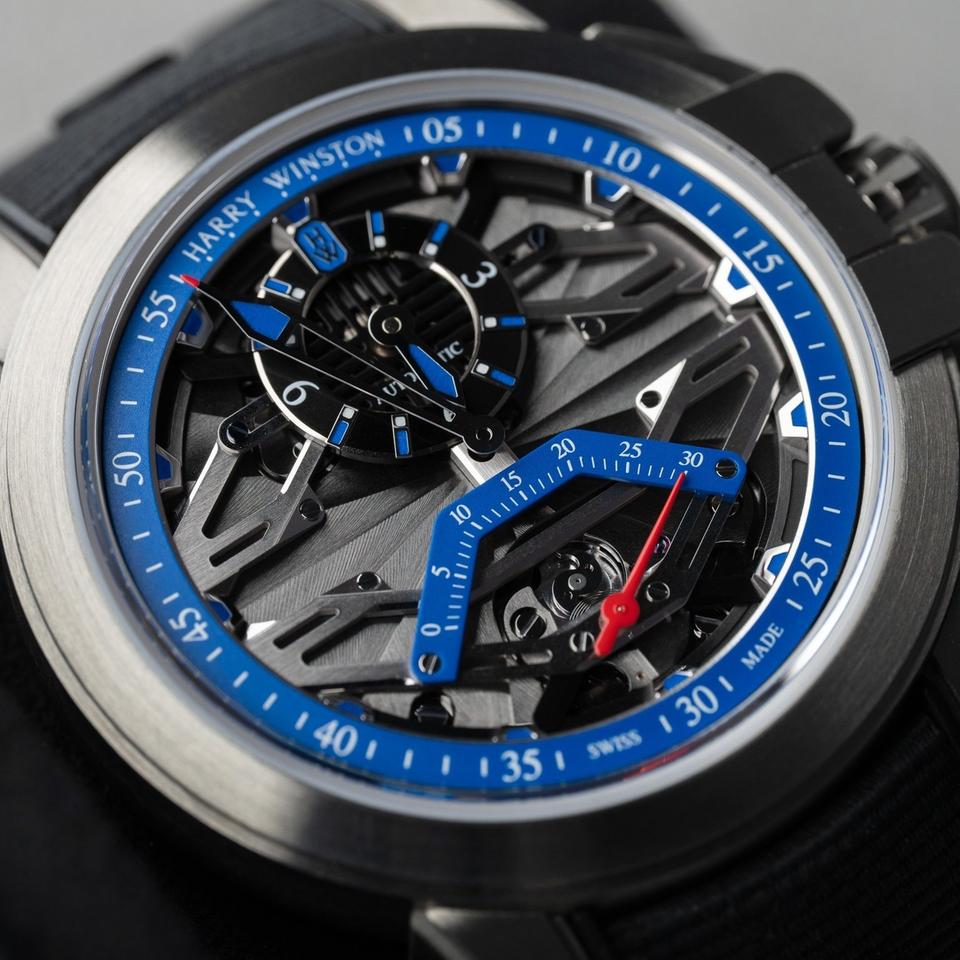
The case is Zalium, a zirconium-aluminum alloy that gives the watch its distinctive matte grey tone. Zalium is the defining material of the Project Z line, and it remains the main reason to consider the Z15 over a conventional steel sports watch. The alloy is light, corrosion-resistant and visually softer than polished steel, which makes the watch feel more tool-like than jewelry-like.
The crystal is sapphire, the lume is Super-LumiNova, and the watch is fitted on a rubber strap with a folding clasp. The dial is blue and carries the date function. The overall design is architectural rather than classical: angular lugs, a sculpted case profile and a dial that uses depth and applied elements to create a modern, three-dimensional look. It is not a minimalist watch, and it is not trying to be.
Harry Winston does not publish every dimension consistently across markets for this reference, so this review avoids quoting case diameter, thickness or water resistance as if they were universal facts. What matters is how the watch wears, and that is where the Z15 makes its strongest case.
Wrist feel: light, balanced and easy to forget
Zalium is the story here. It is noticeably lighter than steel and warmer in tone than titanium, with a matte finish that keeps the watch from feeling precious. On the wrist, the Project Z15 reads as a compact sports watch rather than a piece of jewelry; the case sits close, the rubber strap integrates cleanly, and there is little top-heaviness. The broad dial and sculpted lugs give it presence, but the lightness means you can forget you are wearing it.
Collectors who expect precious-metal heft will be surprised. Those who wear watches on bracelets all day will appreciate the absence of wrist fatigue. The rubber strap is comfortable in heat and humidity, and the folding clasp keeps the watch secure without the bulk of a full bracelet. It is a watch that works with a polo shirt, a travel jacket and a casual Friday outfit. It is not a formal watch, and it does not pretend to be.
The one caveat is strap dependence. The Z15 is not a watch that transforms dramatically with a leather strap change; the case and rubber strap are designed as a package. If you want a luxury sports watch that moves easily between swim trunks and a suit, this is not the most versatile option. If you want a purpose-built casual sports watch with a distinctive material story, it is exactly right.
Accuracy and daily reliability
There is no chronometer certification, so do not expect COSC-grade paperwork. Real-world examples should run within roughly minus five to plus ten seconds per day when healthy, and the 68-hour reserve helps stability through a weekend off the wrist. As always, buy the individual example and verify timing before purchase.
The automatic movement is practical rather than obsessive. It winds smoothly, sets easily and offers a date function that is useful without dominating the dial. The 68-hour reserve is a genuine advantage for a watch that may sit in a rotation for a few days. It is not a travel watch with a GMT or world timer, but it is a reliable daily companion for someone who wants one watch to do most things.
Occasions and wrist presence
The Project Z15 is best suited to sport, daily wear and travel. It is too casual for black-tie and too distinctive for a conservative office, but it works well with smart casual clothing. The rubber strap and light case make it a natural choice for weekends, holidays and active days. It is not a dive watch and should not be treated as one, but it is robust enough for normal daily life.
Wrist presence is moderate. The matte Zalium case and blue dial draw a second look, but the watch lacks the instant recognition of a Royal Oak or Nautilus. That is part of its appeal. It is a stealth-wealth sports watch for people who know Harry Winston’s watch line, not a status symbol that announces itself across the room. On a scale of one to five, I would rate wrist presence at 3.5 out of 5: distinctive enough to reward the wearer, restrained enough to avoid feeling loud.
Reference variants and family context
The Project Z15 is primarily known as a single launch configuration: Zalium case, blue dial and rubber strap. Harry Winston has explored different dial and strap combinations across the Project Z family, but the Z15 is not a model with a deep catalogue of variants. That simplicity is a virtue for collectors who want a clear, coherent design rather than a maze of special editions.
Within the family, the Z15 sits alongside earlier Project Z references such as the Z14, Z13, Z12, Z10 and Z8. Each generation has pushed the material and design story in a slightly different direction. The Z15 is not the most extreme Project Z, nor the most complicated. It is one of the more wearable and better-balanced entries in the line.
Other notable Harry Winston models include the Ocean, Premier, Avenue and Histoire de Tourbillon. The Ocean is the closest sibling in spirit: a sporty, modern watch with a jewelry-house finish. The Premier is more classical, the Avenue is more architectural, and the Histoire de Tourbillon is a high-complication showpiece. The Z15 sits in the middle of that range as a rare, casual sports watch with a strong material identity.
Similar watches and alternatives
The obvious alternatives are the blue-chip luxury sports watches. The Audemars Piguet Royal Oak Selfwinding is the default choice, with stronger resale, a more recognizable bracelet and a deeper collector base. The Hublot Classic Fusion offers a similarly bold, material-led approach with a broader dealer network and a more divisive design. The Chopard Alpine Eagle is another jeweler-adjacent sports watch with integrated bracelet style and better liquidity.
None of those watches replicates the Project Z15’s Zalium case or its specific jewelry-house weirdness. That is the point. If you want the safest luxury sports watch, buy the Royal Oak. If you want something that feels different on the wrist and does not follow the crowd, the Z15 earns a look.
For collectors who want the look without the price, there are affordable alternatives. The Tissot PRX Powermatic 80 offers an integrated-bracelet sports watch experience for a fraction of the cost. The Seiko Prospex SPB143 is a robust dive-style watch for tool-watch lovers. The Casio Edifice EFR-S108D delivers a clean, angular case language at a budget price. None of them is a true homage to the Project Z15, but they serve a similar daily-wear brief.
Investment value: a wearer’s watch, not a portfolio piece
Harry Winston does not position the Project Z15 as an investment, and the market agrees. Retail pricing is quote-based in many markets, and public transaction data is thin. The brand’s watch line does not have the resale depth of Patek Philippe, Audemars Piguet or Rolex. Project Z models are rare, but rarity without demand does not create liquidity.
The trend is best described as depreciating. Buyers who pay retail should expect to absorb a meaningful loss if they sell. Pre-owned examples can represent better value, but they are not easy to find because the production run is small and the collector base is niche. There is no major auction history for the Project Z15, and it is unlikely to become an auction darling. This is not a watch you buy to flip.
The hold recommendation is straightforward: buy it as a wearer, not as an investment. If you can source a pre-owned example at a steep discount to retail, the value proposition improves. At retail, you are paying for rarity, Zalium construction and a jewelry-house signature. Those are real pleasures, but they are not financial guarantees.
Service and ownership
Service should be handled by Harry Winston or an authorized Swatch Group service center. Independent access to parts is limited, and the Zalium case and proprietary movement mean that unauthorized service carries risk. Service intervals should follow Harry Winston’s guidance for the individual watch, and costs are quote-based rather than published as a flat fee.
Ownership is best suited to collectors who are comfortable with a niche brand and a limited service network. If you need a watch that any competent watchmaker can service locally, this is not the right choice. If you are willing to work through authorized channels and plan for longer service lead times, the experience should be manageable.
Pros and cons
The pros are clear. The Zalium case is light and distinctive, the 68-hour power reserve is genuinely useful, and the watch is rare on the wrist. It offers a jewelry-house alternative to the usual steel sports watch suspects, and the rubber strap makes it comfortable for daily wear.
The cons are equally clear. Resale value is weak compared with blue-chip sports watches, the service network is limited, and the movement lacks chronometer certification. Brand recognition in horology trails Harry Winston’s jewelry reputation, which means you may end up explaining the watch more often than you expect.
Final verdict
The Project Z15 is a compelling curiosity for the collector who already owns the blue-chip sports watches and wants something different. It wears well, looks unlike anything else in the jewelry-house genre, and has a useful modern movement. It is not an investment-grade asset; buy it pre-owned, wear it hard, and treat the depreciation as the cost of owning a rare Harry Winston sports watch.
If you are shopping purely for resale protection, walk away. If you are shopping for a lightweight, distinctive, conversation-starting sports watch with a real material story, the Project Z15 deserves a place on your shortlist. It is a watch for the collector who values the unusual over the obvious.