A jeweller's idea of a sports watch
Harry Winston does not need a sports watch. That is the first thing worth understanding about the Ocean. The house built its name on diamonds of historic consequence — the Hope, the Jonker, the Taylor-Burton — and spent most of the twentieth century dressing the people who owned them. A rubber-strapped chronograph is, on paper, a strange inheritance.
And yet since 2007 the Ocean has been the collection through which Harry Winston argues with the rest of Swiss watchmaking. Not primarily through complications, though it has those in abundance. Through case architecture. The Ocean is one of the very few luxury sports watches whose silhouette is genuinely unrecognisable from across a room — a bezel interrupted by three polished claws that reach over the crystal, a case flank cut with the same logic a setter applies to a mounting, and, on the sport references, a case carved from Zalium.
This review covers the Ocean as a family: what the architecture actually is, what movements sit inside, how it wears, and whether a jeweller's sports watch is worth owning today.
The house behind the case
Harry Winston opened in New York in 1932. The story is well known and worth compressing: a jeweller who bought estates and historic stones and then made a point of giving the most famous of them away, most notably the Hope Diamond to the Smithsonian in 1958. That instinct — acquisition as public gesture — shaped the brand's self-image for decades.
Watchmaking came relatively late and, for a long time, relatively quietly. The house produced dress watches in the 1990s that were beautifully finished and entirely conventional, and it was not until the 2000s that Harry Winston began treating horology as a serious second discipline rather than a courtesy to jewellery clients. The launch of the Ocean in 2007 was the moment that changed. It arrived at exactly the right moment: the integrated-bracelet sports watch boom was well underway, and every maison with a design history was attempting a piece of it. Most of them produced a Royal Oak derivative. Harry Winston produced something else.
In 2013 the watchmaking division joined The Swatch Group. That mattered more than the press release suggested. It gave Harry Winston access to serious industrial capacity, to movement production, and to a global service network the collection badly needed. The Ocean of the last decade is a materially better-supported product than the one that launched in 2007.
Case architecture: three claws and a metal you cannot buy elsewhere
Start with the bezel, because the bezel is the argument. The Ocean's bezel is not a ring. It is a structure, interrupted by three polished claws that rise from the surface and fold over the edge of the sapphire. The effect is asymmetric without being chaotic — the dial reads slightly off-balance, in the way a well-set stone can be off-balance and still correct. Those claws are a direct translation of the prong: Harry Winston's setters spent a century designing metal whose job was to disappear into a stone, and here that instinct is inverted so the metal becomes the subject.
The case flank continues the theme. Where most sports watches round their flanks for comfort, the Ocean facets them, creating a hard shoulder that runs from bezel to caseback in planes rather than curves. The strap is integrated into that flank rather than pinned to conventional lugs, which is why there is no visible gap between case and strap and why the watch sits as low and close as it does.
Then there is Zalium. Harry Winston's proprietary alloy, a zirconium base, was introduced on the Project Z line before migrating to the Ocean, and it is the single most distinctive material decision in the collection. The house positions it as harder and more scratch-resistant than titanium while remaining lighter than steel. In the hand, that translates to a grey that sits between gunmetal and anthracite — darker and flatter than titanium, with none of the warmth of gold. It does not patinate the way bronze or raw titanium does. It looks, five years in, very much as it looked on day one, which is either the great virtue or the small disappointment of the material, depending on your taste.
Gold and titanium variants exist across the family, and the dressier references move to alligator. But Zalium is the version that matters. It is what makes the Ocean an object rather than simply a watch.
The movement question
Here the Ocean family divides, and buyers should understand the split before they shop.
The straightforward sport references — the three-hand Sport and the Sport Chronograph — run on robust Swiss automatics built from supplied ébauches. This is not a criticism. A well-chosen ébauche, properly regulated and decently finished, is exactly what a sports watch of this type should carry: serviceable, proven, and predictable. The finishing is what you would expect at this level — broad polished bevels on the bridges, circular graining visible through the sapphire caseback, and a rotor that has been decorated rather than merely machined. Frequency is 4 Hz on the majority of these movements, and power reserve sits somewhere in the forty-to-seventy-hour window depending on which caliber is fitted.
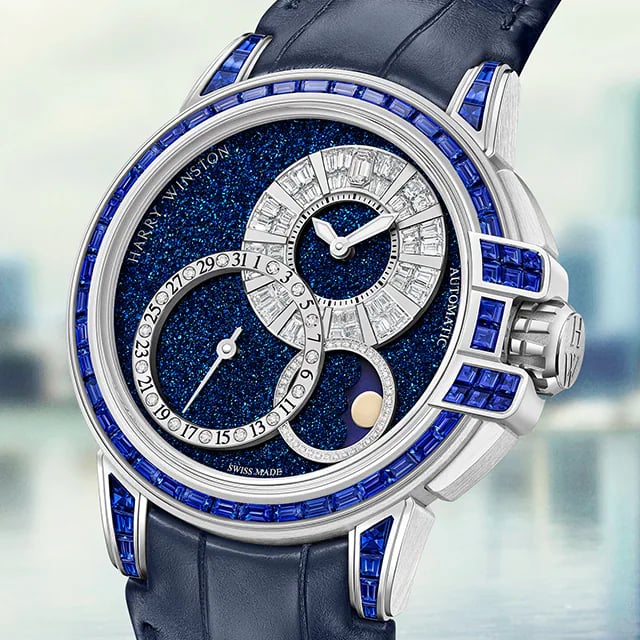
The complicated references are a different proposition. The tourbillon, the retrograde displays, the more elaborate calendar work — these come from Harry Winston's own manufacture in Geneva, and they represent the house's real horological ambition. The Ocean Biretrograde in particular uses its retrograde day and date arcs to solve a design problem rather than to decorate: sweeping hands that snap back to zero give the dial a kinetic quality that a conventional subdial cannot, and it suits the asymmetric bezel perfectly.
What you will not find is chronometer certification as a marketing pillar. Harry Winston does not lean on COSC the way some houses do. That is neither a virtue nor a failing; it simply means the buyer should evaluate accuracy empirically rather than by certificate.
On the wrist
The Ocean wears like a piece of jewellery that happens to tell time, which is entirely the point. Zalium is the reason. The alloy is lighter than steel and carries a cool, anthracite tone that reads almost like a treated surface rather than a metal. On the rubber strap the watch sits close to the wrist with very little top-heaviness, because the strap is integrated into the case flank rather than pinned to protruding lugs. There is no gap, no daylight under the case, no rattle.
The trade-off is the bezel. Those three polished claws are raised, and they catch on cuffs and shirt sleeves in a way a flat bezel never will. On a formal shirt this is a minor friction; on a knit it is a genuine annoyance. The case is also deliberately architectural rather than smooth — the flank is faceted, not rounded — so it feels more present against the wrist than the weight suggests. It is comfortable for a full day, but it is not a watch you forget you are wearing.
Balance is the surprise. A case with this much visual mass on top could easily feel top-heavy, and it does not. Credit the integration and the lightness of the alloy in equal measure. What you notice instead is the bezel: the claws are the first thing the eye finds and the last thing the sleeve forgives.
Accuracy and daily life
A well-regulated automatic should settle into roughly minus three to plus eight seconds per day in normal wear, with the usual variation between wrist time and resting position. Harry Winston makes no unusual accuracy claims for the Ocean and none should be assumed. The complicated references — retrograde displays in particular — are more sensitive to shock and to infrequent wear, and benefit from being kept on a winder rather than repeatedly reset.
Buyers of pre-owned Oceans should budget for a regulation as part of the first service. A decade-old example that has never been timed will almost certainly be running wide, and the cost of putting it right is trivial next to the cost of living with it.
Water resistance varies across the family and is specified per reference. Treat the sport models as the water-friendly end of the range and the alligator-strapped complicated pieces as splash-resistant at best. This is not a dive watch despite the name.
The family
The Ocean Sport Chronograph is the purest expression of the brief: Zalium case, chronograph, rubber, sports intent. It is the reference that most fully commits to the architecture and the one that makes the strongest case for the collection as a whole.
The Ocean Sport is the same idea reduced to three hands and a date, and it is the most wearable daily option. The Ocean Dual Time adds a second zone and moves to leather. The Ocean Biretrograde is where the collection becomes genuinely interesting horologically, using retrograde arcs for day and date in a way that complements the asymmetric bezel rather than fighting it. The Ocean Tourbillon is the flagship and the rarest. The Ocean Lady takes the same case language and executes it in mother-of-pearl and diamonds, and it is one of the few gem-set sports watches that does not look like an afterthought.
Owning one
Here is the honest part. Harry Winston watches depreciate. The Ocean Sport Chronograph, which retailed in the mid-teens of thousands of dollars, trades in the secondary market at a substantial discount to that figure, and there is no realistic scenario in which that reverses. The brand's auction record for this collection is effectively nonexistent. Liquidity outside the major markets is thin.
That is not a reason to avoid the watch. It is a reason to buy it correctly. A buyer who pays secondary-market money for an Ocean is getting genuine design authorship — a case no other manufacture produces, in a material no other manufacture uses — for less than the cost of a well-specified steel chronograph from a brand with a tenth of Harry Winston's design conviction. That is a good trade.
Servicing must go through authorised channels. Zalium case sealing and proprietary components mean that even a competent independent watchmaker can handle the movement but should not be asked to handle the case. Budget for it as part of ownership rather than as an unpleasant surprise.
Verdict
The Ocean is the rare luxury sports watch that earns its design premium rather than merely charging it. Harry Winston built a case that is genuinely its own — the claws, the Zalium, the faceted flank — and then declined to water it down across nearly two decades of references. It is not a value-holding purchase and it was never meant to be. It is a piece for a collector who has already owned the obvious watches and wants something with authorship.
On that basis, the Ocean Sport Chronograph is one of the more quietly interesting buys in the secondary market. Buy the case. Everything else follows.