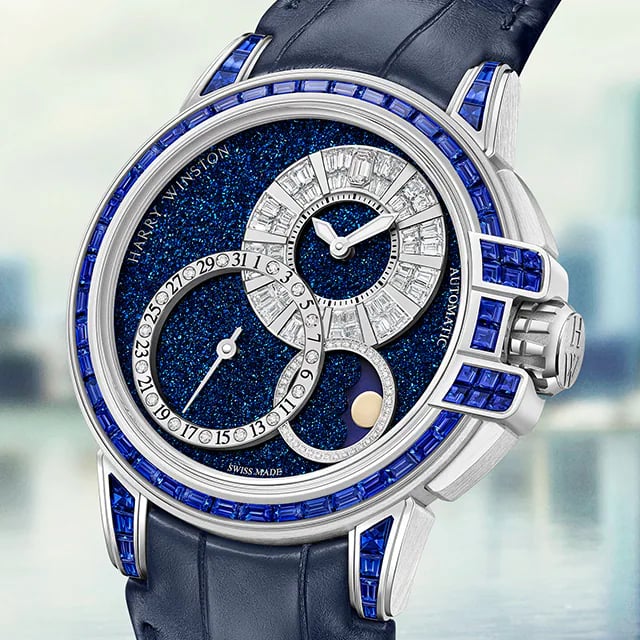
What the Ocean Collection Is
The Ocean Collection is Harry Winston's sports-luxury line. It includes sportier references with cleaner dials and rubber or leather straps, dressier biretrograde and moon-phase pieces, and haut-de-gamme variants such as tourbillons. Some references lean into diamond-setting and mother-of-pearl; others are more restrained. That variety is important because the Ocean is not one watch. It is a family of watches united by a polished case silhouette, a jewelry-house approach to finishing, and a name that promises more athleticism than most examples deliver.
For a young collector, the appeal is obvious. A Royal Oak or Nautilus is everywhere. The Ocean is not. It has the polished bezel, the faceted lugs, and the kind of dial furniture that reads as jewelry from across a room. It also has the Harry Winston name, which carries weight in the auction room and on the red carpet even if it is less familiar on the trading floor of a watch forum.
Brand History in Brief
Harry Winston was founded in New York in 1932 and built its reputation as a jeweler to the wealthy and famous. The brand is often called the King of Diamonds, and that heritage is not marketing fluff: it explains why an Ocean watch feels the way it does. The watchmaking side is based in Geneva and has produced serious complications, but the Ocean is still a jeweler's watch at heart. The collection exists to put that jewelry sensibility on a wrist in a form that can be worn with a suit, a cocktail dress, or a cashmere sweater.
Harry Winston's watch business became part of the Swatch Group in 2013. That ownership has not turned the Ocean into a mass-market product. Production remains small, distribution is selective, and the watches still feel like objects made in limited numbers for people who care more about finish than about spec-sheet bragging rights.
Movement and Complications
The Ocean family does not use one movement. Depending on the reference, you will find automatic calibers with date, retrograde day and date displays, chronograph modules, GMT or dual-time functions, moon phases, and in the most expensive variants, tourbillons. Harry Winston does not present the collection as a single-movement family, and collectors should not treat it as one. The exact caliber, power reserve, and frequency depend on the specific watch. I have left the movement figures general here because quoting one reference's specification for the whole collection would be misleading.
What can be said is that the automatics are finished to a luxury standard. The movements are not the primary attraction in the way a high-beat chronograph or an in-house tourbillon might be for a movement obsessive. The Ocean is a watch you buy for the case, the dial, and the way it wears. The movement is expected to be reliable and appropriately finished, but it is not the reason to choose this collection over a more technically focused alternative. Harry Winston does not uniformly submit the Ocean to COSC chronometer certification, so buyers should expect a well-regulated luxury automatic rather than a guaranteed chronometer certificate.
Case, Crystal, Strap, and the Missing Numbers
The cases are the heart of the Ocean experience. They are polished, faceted, and often set with diamonds on the bezel or lugs. The crystal is sapphire, which is standard at this level and appreciated on a watch that will spend time under shirt cuffs. The straps are usually leather, sometimes rubber on the sportier references, and the clasps are typically deployants. The presentation is luxurious, but it is not built for a life of rock climbing. Diamond-set bezels are jewelry first. They can handle a dinner, a desk, and a city weekend. They should not be worn to the beach without thought, and they should not be used to open a bottle.
One of the frustrating parts of researching the Ocean is that Harry Winston does not publish a single set of external dimensions across the collection. Case diameter, thickness, lug-to-lug, and water resistance vary by reference, and in some cases the brand does not make every figure easy to verify. I have left those numeric fields empty rather than substitute a typical value from another watch. If you are buying a specific Ocean, ask the seller or authorized dealer for the exact measurements of that reference. Do not assume that one Ocean wears like another. The collection spans dressy pieces and sportier pieces, and the difference on the wrist is real.
On the Wrist
The first thing you notice is the polish. The case catches light in a way that makes the watch feel more expensive than many of its peers. The second thing you notice is the weight. Gold and platinum references have a density that feels reassuring on a strap, but they also remind you that this is not a lightweight titanium sports watch. On leather, the Ocean sits close to the wrist and slides under a cuff more easily than its jewelry presence suggests. The deployant clasp helps with that, though it also adds a small hard point under the wrist that some wearers notice after a long day.
Comfort depends heavily on the reference and the strap. The dressier Ocean models are happiest on alligator or calf leather, and the strap choice changes the personality more than you might expect. A dark leather strap makes the watch feel formal and slightly old-world. A rubber strap pushes it toward resort wear. The case is not a thin dress watch, and it is not a rugged sports watch. It is a polished jewelry object with a crown, and it wears best when you let it be that. If you are looking for a watch that disappears on the wrist, this is not it. If you want a watch that makes a cuff look better, it is.
The lume situation is also worth stating plainly. Many Ocean references have no meaningful lume, and the diamond-set and mother-of-pearl dials are not designed for reading in the dark. This is not a night watch. It is a candlelight watch. That is not a criticism if you understand the brief, but it is a real limitation for anyone who wants one watch to do everything.
Accuracy and Daily Life
Real-world accuracy will vary by reference and by how the watch has been treated. Because the Ocean is not uniformly COSC-certified, I would not promise chronometer performance across the board. A healthy automatic from a luxury house should keep time well enough for daily wear, but the exact rate is something you should measure on your own wrist over a week. Ask for a timing report if you are buying pre-owned, and factor a service into the price if the watch has been sitting in a safe.
Daily life with an Ocean is a study in compromises. It is beautiful in meetings and at dinner. It is less comfortable in the gym, on a building site, or in a swimming pool. The polished case shows fingerprints and micro-scratches. The diamond bezel is not a bumper. The leather strap will wear faster than a bracelet. None of this is a dealbreaker. It is simply the cost of choosing a jewelry watch over a utility watch. The owner who understands that will enjoy the Ocean more than the owner who expects it to be a Submariner with better manners.
Occasions
The Ocean is strongest in formal and dressy settings. It looks excellent with a suit, a dark shirt, or an evening dress. It can work as a daily watch for someone with a desk job and a taste for polish, especially in a less diamond-heavy reference. It is a good travel watch if you are going to cities rather than beaches, and it can handle a smart-casual weekend. It is not a true sports watch in the way a Royal Oak Offshore or a modern dive watch is. The name says Ocean; the reality says dinner reservation.
Reference Variants and Family Context
Within the Ocean family, the biretrograde models are the most distinctive. They use retrograde displays for day and date, giving the dial a jewelry-like asymmetry that is more interesting than a standard three-hand layout. The sportier Ocean references tone down the diamond setting and push the watch toward daily wear. The dual-time and moon-phase variants add useful complications for travelers and romantics. The tourbillon references sit at the top of the range and are best understood as collector pieces rather than daily watches. Because reference numbers and specifications vary by market and production period, buyers should verify the exact reference with Harry Winston or a trusted dealer rather than rely on a generic collection description.
The Ocean also sits alongside Harry Winston's Premier, Midnight, Project Z, and Historic New York collections. The Premier and Midnight lines are more traditionally dressy. Project Z is the more overtly technical and sporty side of the brand. The Ocean is the bridge: a jewelry watch with a sports silhouette, designed for people who want both presence and a crown.
Similar Watches
If you are considering an Ocean, you are probably also looking at the Audemars Piguet Royal Oak, the Patek Philippe Nautilus, the Chopard Happy Sport, the Piaget Polo, and perhaps a gold Rolex Datejust. Each offers a different balance of jewelry, sport, and serviceability. The Royal Oak and Nautilus have stronger secondary markets and more established collector networks. The Happy Sport is more playful and more overtly jewelry-focused. The Polo is a cleaner, more architectural take on the sports-luxury idea. The Datejust is the safer daily watch, with a service network that is vastly easier to navigate. The Ocean's advantage is rarity and a more overt jewelry finish. Its disadvantage is that it is harder to sell and harder to service.
Value, Service, and Investment
The Ocean is not an investment watch. Retail prices are high, pre-owned prices are often significantly lower, and liquidity is thin compared with the major Swiss sports-luxury names. That is not a reason to avoid the watch if you love it. It is a reason to buy carefully. The best value is usually found in the pre-owned market, where a well-preserved example can be had for a fraction of its original retail price. Diamond-set and complicated references hold value differently from simpler pieces, but the general trend is depreciation rather than appreciation. Auction records are limited, and the model does not have the deep collector history of a Nautilus or a Royal Oak.
Service is another consideration. Harry Winston watches are best serviced through the brand or a Swatch Group-authorized center. Independent watchmakers may be able to work on the movement, but parts access can be limited, and diamond-set cases require care. Service intervals vary by reference and usage, and costs are not cheap. If you are buying pre-owned, ask for service records. A full service can easily become a meaningful percentage of the purchase price on an older or complicated Ocean.
Final Verdict
The Harry Winston Ocean Collection is a beautiful, slightly contradictory watch family. It promises sport but delivers jewelry. It promises rarity but asks for patience at resale. It is at its best when worn as a polished, distinctive, evening-leaning daily watch by someone who values finish over spec sheets. If that is you, the Ocean is worth seeking out, especially pre-owned. If you want one watch to do everything without worry, look elsewhere.
Buy it for the way it makes a cuff look, for the diamond-light on the bezel, and for the fact that you will not see another one at every dinner. Do not buy it as an investment, a dive watch, or a rugged daily beater. The Ocean is a jewelry watch with a crown, and it is most honest when you let it be exactly that.