Introduction: The Cut That Wants to Be Taken Seriously
The Hermès Cut is the French luxury house's latest attempt to carve out a serious slice of the watch market—literally. With a case that looks like someone took a bite out of a perfect circle, this piece is unapologetically design-first. But in a world where hype cycles and resale charts dictate what lands on a trust-fund baby's wrist, does the Cut make the cut? Or is it just another pretty accessory to match your Birkin?
Launched in 2023, the Cut is Hermès' answer to the integrated-bracelet sports watch trend, but with a twist only a fashion house could pull off. It's not trying to be a Royal Oak or a Nautilus. It's trying to be a Hermès—and that means selling a lifestyle as much as a timepiece. The question for young collectors with disposable income isn't whether it's a good watch; it's whether it's a good buy.
Spoiler: if you're looking to flip, look elsewhere. But if you want a conversation starter that screams 'I have a trust fund and a stylist,' the Cut might be exactly what your wrist has been missing.
Brand History: From Harnesses to Horology
Hermès was founded in 1837 as a harness workshop in Paris, and over nearly two centuries it has become a global luxury empire known for leather goods, silk scarves, and now watches. The brand entered watchmaking seriously in the 1970s, but it wasn't until the 2000s that it invested in in-house movements through a partnership with Vaucher Manufacture Fleurier. The Cut is part of Hermès' modern push to be taken seriously as a watchmaker, not just a fashion label.
Unlike traditional Swiss maisons, Hermès approaches watchmaking from a design perspective first. The Cut's cut-out case is a perfect example: it's a bold aesthetic statement that no traditional watchmaker would dare to make. That's both its strength and its weakness in the collector market.
Movement: The H1912 In-House Caliber
Powering the Cut is the Hermès H1912 automatic movement, developed in collaboration with Vaucher Manufacture Fleurier. It's a robust three-hand caliber with a date complication, offering a 50-hour power reserve and a frequency of 28,800 vibrations per hour. The movement features 28 jewels and is decorated with circular graining and Côtes de Genève, visible through the sapphire caseback.
While not COSC-certified, the H1912 is a reliable workhorse that should keep time within +/- 10 seconds per day in real-world conditions. For a fashion-house watch, that's perfectly acceptable. The movement is in-house in the sense that Hermès owns the design and production through its partnership, which adds a layer of horological credibility.
Specs and Wrist Feel: Comfort Meets Quirk
The Cut measures 36mm in diameter, 10.5mm thick, and 44mm lug-to-lug. The case is stainless steel with a sapphire crystal and a water resistance of just 30 meters—so don't take it swimming. There's no lume on the dial, which is a deliberate choice to keep the design clean. The integrated steel bracelet flows seamlessly from the case and is secured with a deployant clasp.
On the wrist, the Cut wears like a dream if you have a smaller wrist or prefer a more understated presence. At 36mm, it's unisex but leans slightly feminine by modern standards. The integrated bracelet is comfortable for all-day wear, and the slim profile slides under a shirt cuff with ease. The lack of micro-adjustment on the clasp might annoy those between link sizes, but overall it's a very wearable piece.
Accuracy: What to Expect Day to Day
Expect real-world accuracy of around +/- 10 seconds per day. The H1912 is not chronometer-certified, but it's a well-regulated movement that should keep time within acceptable limits for a fashion-house watch. If you're used to a Rolex or Omega, you'll notice the difference, but for a piece you'll wear to brunch, it's fine.
Occasions and Wrist Presence
The Cut is best suited for daily wear, dress occasions, and formal settings. It's not a sports watch, so leave it at home for the gym or the beach. Wrist presence is a 3.5 out of 5—it's subtle but unmistakably Hermès. The cut-out case and integrated bracelet draw the eye without dominating a room. It's a quiet flex for those who know.
Reference Variants and Family
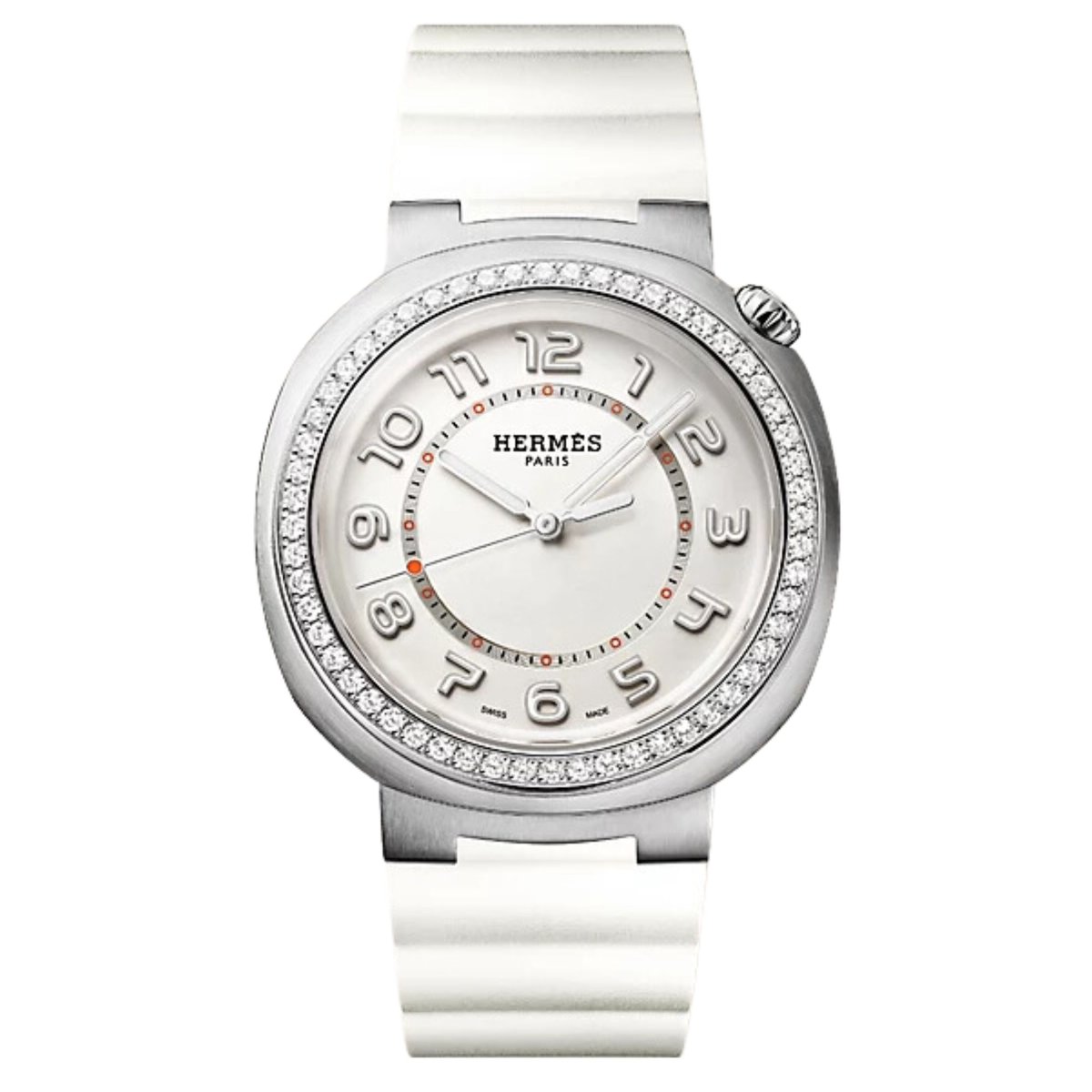
The Cut is available in several dial colors: silver (ref. W403190WW00), blue (W403191WW00), black (W403192WW00), and a diamond-set version (W403193WW00). All share the same case and bracelet. This is the first generation of the Cut line, so there are no predecessors or siblings yet.
Other Hermès Watches Worth Knowing
If the Cut doesn't do it for you, Hermès offers other notable models: the Arceau (a classic round watch with asymmetrical lugs), the Cape Cod (a square case with a maritime vibe), the Heure H (a bold H-shaped case), and the Slim d'Hermès (a minimalist dress watch with an in-house ultra-thin movement). Each has its own personality, but the Cut is the most contemporary and fashion-forward.
Similar Watches: The Competition
The Cut competes with other luxury fashion-house watches and design-first pieces. The Cartier Santos de Cartier offers an integrated bracelet and a distinctive case shape but with stronger horological pedigree. The Chanel Boy.Friend has a similar unisex appeal and design-first philosophy. The Bulgari Serpenti is a jewelry-inspired watch that prioritizes aesthetics over traditional watchmaking, much like the Cut.
Homages: Budget Alternatives
There are no direct homages to the Cut's cut-out case, but if you want the integrated-bracelet vibe without the Hermès price tag, the Tissot PRX ($650) and Citizen Tsuyosa ($450) are excellent budget options. They won't fool anyone into thinking you're wearing a Hermès, but they capture a similar aesthetic at a fraction of the cost.
Investment Value: The Trust-Fund Reality Check
Here's the hard truth: the Hermès Cut is not an investment. MSRP is $6,500, and you can expect to see pre-owned examples selling for $4,500 to $5,500 within the first year—a depreciation of 20-30%. There's no hype cycle, no waiting list, and no auction history to speak of. The trend is firmly depreciating.
For a trust-fund baby, that might not matter. You're buying a Hermès watch to match your Hermès bag, not to flip for profit. But if you're even slightly concerned about resale value, put your money into a Rolex or a Patek. The Cut is a flex, not a financial instrument.
Service and Maintenance
Hermès recommends servicing the Cut every 5 years, with an approximate cost of $500. You can use an independent watchmaker, but authorized service centers will maintain warranty and resale value. The H1912 movement is not exotic, so parts and expertise are readily available.
Pros and Cons
Pros:
- Distinctive cut-out case design that stands out
- Comfortable integrated bracelet with deployant clasp
- In-house automatic movement with 50-hour power reserve
- Strong brand cachet and luxury appeal
Cons:
- Low water resistance (30m) limits versatility
- Limited resale value and no hype cycle
- No lume, making it less practical in low light
- 36mm size may feel small for larger wrists
Final Verdict
The Hermès Cut is a fashion-forward statement piece that will turn heads at brunch but won't appreciate in value. Buy it if you want a Hermès on your wrist and don't care about flipping. Otherwise, put your trust fund into a Rolex.