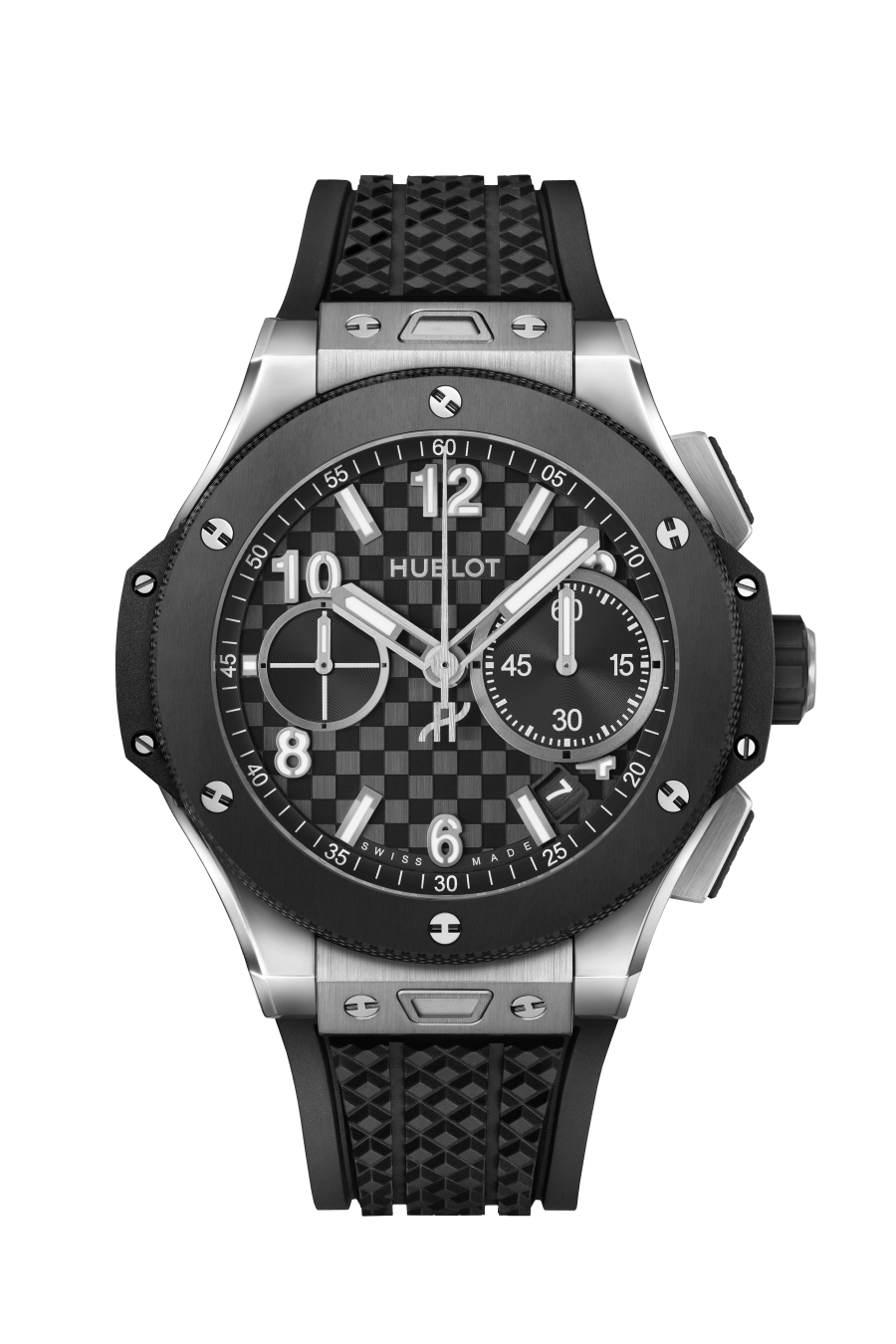
There is a version of the Hublot Big Bang that makes sense to people who don't like Hublot. It is not the 45mm Unico, and it is not the 44mm original from 2005. It is the 42mm Big Bang Unico — the watch Hublot now frames as the Big Bang Original Unico, a deliberate callback to the model that started the argument two decades ago, rebuilt around the brand's own chronograph movement and shrunk to something a person can realistically wear five days out of seven.
The formula is unchanged and unapologetic: a sandwich case with contrasting finished layers, six H-shaped screws through the bezel, a skeletonised dial that shows you the movement rather than hiding it, and a rubber strap fused to the case by Hublot's own quick-release hardware. What has changed is the proportion. At 42mm the Big Bang stops being a statement piece you bring out on Saturdays and starts behaving like a daily watch — with one very real caveat around height.
This is a wear review, not a spec-sheet recital. We spent a week with the titanium reference 421.NX.1170.RX — the plainest, least expensive and, I would argue, best-judged version — wearing it to the office, on a plane, to a dinner, and through the sort of week where a watch gets knocked on doorframes. Here is what survives.
The Big Bang, edited down
The original Big Bang was a provocation. Steel, ceramic and rubber in one case, priced like a precious-metal watch, worn by people who had no interest in the polite conventions of Swiss horology. It worked because it was coherent: the design said exactly what the brand wanted to say, and it said it loudly.
The problem, twenty years on, is that the provocation has aged. A 44mm Big Bang on a modern wrist reads as costume rather than confidence. Hublot's answer with the 42mm Unico was not to soften the design but to scale it — keep every signature element, remove a couple of millimetres, and let the case do the talking on a wrist that isn't the size of a dinner plate.
What you get is a watch that still looks like a Big Bang at three metres but no longer feels like one when you bend your wrist. That sounds like a small thing. It is, in practice, the whole point.
Case and finishing
The titanium case is the star of this reference. Hublot's finishing language is deliberately industrial — brushed surfaces, micro-blasted flanks, polished bevels used sparingly as accents rather than as the main event. The three-layer sandwich construction gives the case a visible depth that most sports chronographs don't bother with, and the six H-screws are functional in the sense that they hold the bezel down, though nobody is pretending they're there for any reason other than the look.
Titanium changes the character more than you'd expect. The King Gold version is a piece of jewellery; the Black Magic ceramic is a stealth object. The titanium sits between them — it has a slightly grey, matte quality that keeps the shine down and makes the watch read as a tool rather than an ornament. It also picks up hairline scratches on the polished bevels fairly quickly, which is worth knowing if you're the sort of person who notices.
Water resistance is rated to 100 metres, which is more than enough for swimming and exactly what you'd expect at this price. The crown is screw-down and well protected by the crown guards; the two chronograph pushers are large, easy to find by feel, and screw-down on some references but not this one, which is a small daily convenience.
Dial and legibility
Skeletonised dials are usually a legibility disaster. The Big Bang Unico avoids that fate through sheer contrast discipline: the hands are broad, filled with Super-LumiNova, and outlined in a way that separates them from the movement behind. The hour markers are applied and float above the openworked plate, casting just enough shadow to read cleanly.
The two-register layout — running seconds at nine, a 60-minute chronograph counter at three — keeps the centre of the dial comparatively clear, and the date window at three is small, black-on-black, and easy to ignore, which is the highest compliment you can pay a date window on a watch like this.
It is not a legible watch in the way a Speedmaster is legible. At a glance in low light you get the time; you don't get the time and the chronograph reading and the date simultaneously. But for something with this much visible machinery, it's remarkably usable, and the lume is strong enough that a dark hotel room isn't a problem.
The one genuine annoyance is the dial furniture around the chronograph counter, which is busy enough that reading elapsed minutes requires a beat of concentration. If you actually use a chronograph — timing a pour-over, a lap, a parking meter — you'll learn it. If you don't, you'll never notice.
The Unico movement
The HUB1280 is the second generation of Hublot's in-house Unico chronograph, and it is the reason this watch exists as more than a design exercise. It's a column-wheel, horizontal-clutch flyback chronograph with roughly 354 components, 43 jewels, a 4 Hz beat rate and a 72-hour power reserve.
What matters on the wrist is the feel. The pushers are firm and progressive, with a clean, mechanical break rather than the mushiness you get from a modular chronograph built on top of a base movement. The flyback function — press the reset pusher while the chronograph is running and it snaps to zero and restarts instantly — is genuinely useful and genuinely satisfying, and it's the sort of thing you find yourself using for no reason at all.
Finishing is micro-blasted and industrial. There is no hand-bevelling competition happening here, and Hublot isn't pretending otherwise. If you want anglage and black-polished steel, this is the wrong watch; if you want a movement that looks like it belongs in a machine, this is exactly right. The sapphire caseback gives you a clear view of the rotor and the column wheel, and the openworked dial means you're looking at the movement from the front too.
It is not COSC-certified, and Hublot doesn't market it as a chronometer. That's an honest position rather than a marketing failure — this is a high-complication movement built for character, not for laboratory certificates.
On the wrist
Here's the part that matters. The 42mm Unico is the first Big Bang I've worn that didn't feel like a wrist-mounted event. The titanium case is light — noticeably lighter than the steel and ceramic siblings — and the lugs curve down steeply enough that the watch sits close to the wrist bone rather than hovering above it. The rubber strap is soft, tapers properly, and the deployant folds flat, so there's no lump under the wrist when you type.
The caveat is height. This is a tall watch, and no amount of clever lug geometry hides it. On a 7-inch wrist it reads as substantial but not absurd; on anything under 6.5 inches it will start to feel like a hockey puck, and the caseback will leave a mark after a long day. The weight distribution is good — the movement sits low in the case, so it doesn't tip forward — but you are always aware you're wearing it. That's the trade for the layered case construction and the depth of the Unico movement, and it's a trade Hublot has clearly decided is worth making.
Balance is the other thing worth mentioning. The watch doesn't rotate on the wrist, the strap doesn't stretch out over a week, and the deployant clasp is well shaped enough that it disappears. For a watch with this much visual mass, it's surprisingly well behaved once it's on.
A week of real wear
Monday: shirt cuff. This is the test most sports chronographs fail. The Unico doesn't slide under a slim cuff — nothing this tall will — but it doesn't catch either, and the rubber strap means there's no bracelet rattle against a desk. It reads as a deliberate choice rather than an accident.
Wednesday: a flight. The 72-hour reserve means you can take it off on Friday night and put it back on Monday morning without resetting anything, which is more useful than it sounds. The lume got me through a dark cabin, and the date was correct because I'd actually bothered to set it.
Friday: dinner. This is where the titanium version earns its keep. Against a dark shirt the matte case and black dial disappear into the outfit in a way the gold version absolutely does not. It's not a dress watch and it never will be, but it doesn't embarrass itself.
Saturday: a swim, then a playground with a small child. 100 metres of water resistance and a rubber strap mean you don't think about it. The case picked up a scuff on the polished bevel. I noticed. Nobody else did.
Sunday: nothing. It sat on the nightstand and kept running.
Accuracy
The HUB1280 is not COSC-certified, and Hublot doesn't market it as a chronometer, so expectations should be set accordingly. In practice, examples we've tracked run in the region of +2 to +6 seconds per day, which is entirely respectable for a 4 Hz flyback chronograph with this much going on.
The flyback reset snaps back cleanly and the pushers have a firm, mechanical feel without excessive travel. Expect the rate to drift slightly if you leave the chronograph running for hours — as with any horizontal-clutch design, running the seconds hand constantly adds drag and eats into the 72-hour reserve.
Straps and the One Click system
Hublot's One Click system is one of the genuinely good ideas in modern watchmaking and it's a big part of why this watch works as a daily. Press the two triggers on the underside of the lugs and the strap comes off — no tools, no scratched lugs, no trip to the boutique. A spare leather strap turns the Unico into something you can wear to a wedding; the rubber it ships on handles everything else.
The deployant clasp is titanium on this reference and folds flat, which matters more than it sounds. Cheap deployants sit proud of the wrist and create a pressure point; this one doesn't. The rubber itself is soft enough to be comfortable from day one, with no break-in period and no odour retention issues in a week of hot-weather wear.
What it costs and what it's worth
At retail the titanium Big Bang Unico sits in the low-to-mid twenties in US dollars, which puts it in direct competition with the Royal Oak Offshore and the Zenith Defy El Primero 21. On the secondary market it trades considerably lower — you can find clean examples in the mid-teens, and that's where the value argument gets interesting.
Because here's the honest truth about Hublot resale: it depreciates. The Big Bang Unico loses a meaningful chunk of retail the moment it leaves the boutique, and the titanium base model is the least collectible variant in the range. That's bad news if you bought at retail and good news if you're buying now. At mid-teens, you're getting a full in-house flyback chronograph with a 72-hour reserve, a titanium case and a design that still turns heads — for less than the price of a steel Daytona at grey-market levels.
Buy it to wear. Don't buy it as an asset. If you want a Big Bang that holds value, you're looking at the wrong brand and the wrong model, and no amount of limited-edition marketing changes that.
Alternatives worth considering
If you want the same silhouette with a stronger resale story, the Audemars Piguet Royal Oak Offshore 42mm is the obvious rival — it costs more, holds value better, and has a bracelet option the Hublot doesn't really match. If you want the openworked look without the Hublot baggage, the Zenith Defy El Primero 21 gives you a 1/100th-second chronograph and a more technical personality. And if you want the sport-luxury feel with an integrated bracelet, the Girard-Perregaux Laureato Chronograph is the quiet choice.
What none of them offer is the specific thing the Big Bang does: a case that looks like it was designed by someone who was told no and did it anyway.
The verdict
The Big Bang Original Unico at 42mm is the version of this watch that finally works as a daily wearer: light, legible, mechanically serious, and loud in a way that's been toned down just enough. It is not a watch for small wrists, and it is not an asset. But as a thing to actually put on every morning, it's the most convincing argument Hublot has made in years.
Wear it for a week and you stop noticing the screws. That's the highest praise I can give a Big Bang.