The Big Bang: A Horological Supernova
In the narrative of modern watchmaking, there are 'before' and 'after' moments. Before 2005, Hublot was a niche brand known for a singular, albeit clever, idea: putting a gold watch on a rubber strap. After 2005, Hublot became a global phenomenon, a lifestyle brand that transcended the glass cases of Geneva boutiques to find a home in the lyrics of Jay-Z and on the wrists of the world's most elite athletes. That pivot point was the Big Bang.
The Big Bang Original, specifically the Reference 301.SB.131.RX, is the distilled essence of that transformation. It was the brainchild of Jean-Claude Biver, the man who saved Blancpain and revitalized Omega. Biver understood that the new generation of luxury consumers didn't want their grandfather’s watch. They wanted something that felt like the cars they drove and the cities they lived in—complex, multi-material, and unapologetically technical.
The Art of Fusion: Case and Construction
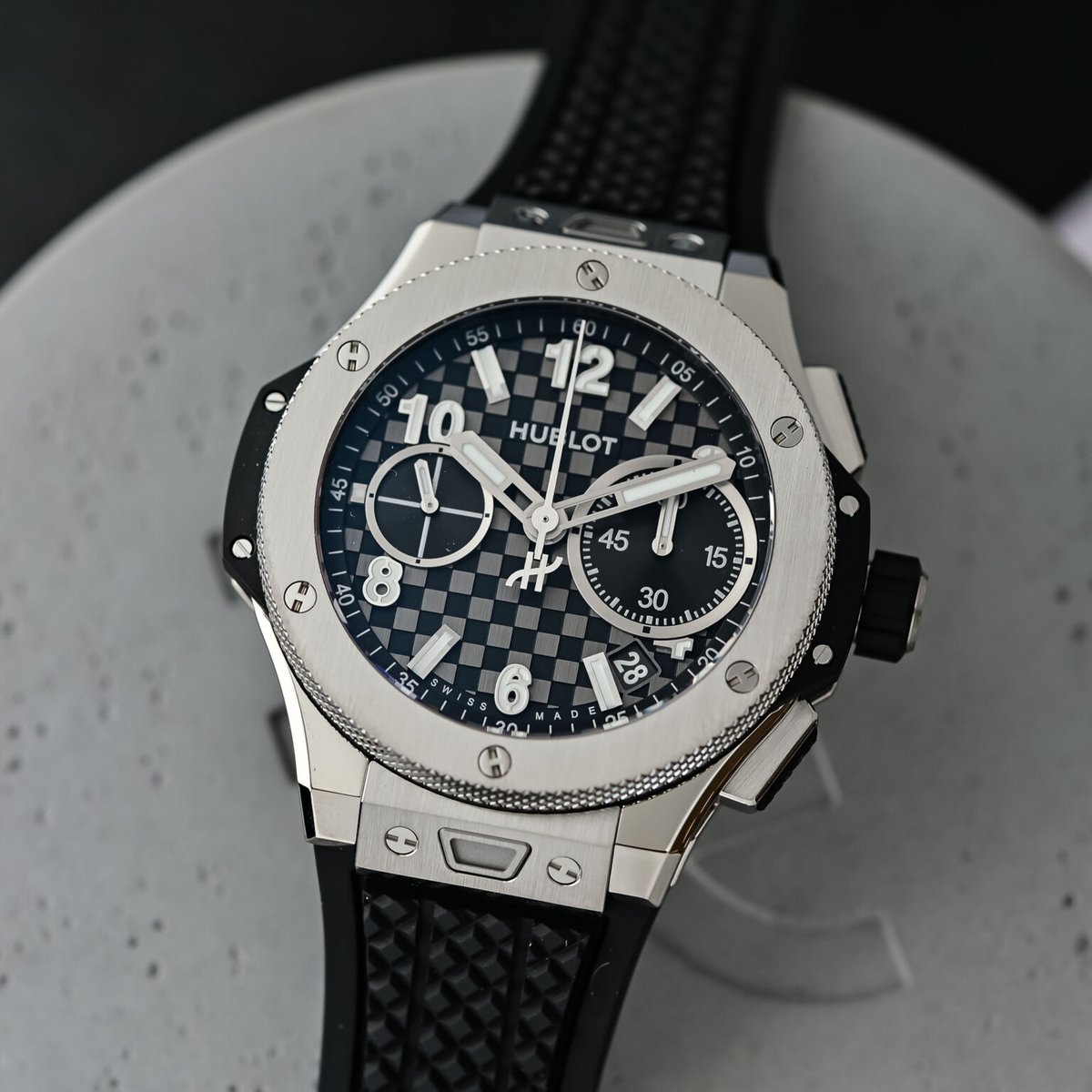
The 'Fusion' in Hublot’s philosophy isn't just a marketing buzzword; it’s a literal description of how this watch is built. The 44mm case of the Big Bang Original is a 'sandwich' construction, a departure from the traditional monoblock or three-part cases of the past. It utilizes over 70 individual components, including a stainless steel core, lateral Kevlar inserts, and a black ceramic bezel secured by six H-shaped titanium screws.
This modularity allows Hublot to play with textures and colors in a way few other brands can. The contrast between the brushed steel, the polished ceramic, and the matte black resin inserts creates a visual depth that photos rarely capture. The ceramic bezel is a particular highlight; it is virtually scratch-proof, ensuring that the part of the watch most prone to 'desk diving' marks remains pristine for decades.
The lugs are sharply angled, integrating seamlessly into the signature structured rubber strap. This integration is key to the watch's wearability. While a 44mm watch with a 14.5mm thickness sounds daunting on paper, the lack of traditional protruding lugs means the effective 'footprint' on the wrist is much smaller than a 44mm Panerai or IWC Big Pilot.
The Dial: Carbon Fiber and Depth
The dial of the 301.SB.131.RX features a stamped carbon fiber pattern that catches the light in a rhythmic, holographic fashion. It’s a nod to the automotive world, specifically the high-performance racing machines that share Hublot’s obsession with weight-to-strength ratios. The sub-dials for the chronograph (30-minute counter at 3 o'clock, 12-hour counter at 6 o'clock, and running seconds at 9 o'clock) are sunken, providing a three-dimensional landscape.
Legibility is surprisingly high for such a busy design. The rhodium-plated hands and applique hour markers are generously filled with Super-LumiNova, and the red central chronograph seconds hand provides a necessary pop of color, making the timing function easy to track at a glance. The date window, tucked between 4 and 5 o'clock, is color-matched to the dial, a small but appreciated detail that maintains the symmetry of the face.
The Movement: The Reliable HUB4100
Inside the Big Bang Original beats the Caliber HUB4100. For the technical purists, it’s important to note that this is not an 'in-house' Unico movement—those would come later in Hublot's evolution. Instead, the HUB4100 is based on the tried-and-true ETA 7753 (or Valjoux 7750) architecture. While some might criticize the use of a third-party base at this price point, there is an undeniable advantage to this choice: reliability.
The 7753 is a tractor of a movement. It is robust, easy to service, and capable of maintaining excellent chronometric performance over long periods. Hublot dresses the movement with a custom tungsten rotor and perlage finishing, visible through the sapphire crystal caseback. With a 42-hour power reserve and a 4Hz beat rate, it provides the smooth sweep and tactile 'wobble' that chronograph enthusiasts have come to love.
Cultural Impact and Wrist Presence
To wear a Big Bang is to make a statement. It is a watch that has been worn by everyone from Usain Bolt to Kylian Mbappé. It represents a shift in horology where the watch became an extension of one’s personal brand. In the mid-2000s, the Big Bang was the 'it' watch, and unlike many trends, it has managed to maintain its status as a foundational pillar of the luxury sports category.
On the wrist, the presence is undeniable. It feels like a piece of high-tech equipment. The rubber strap, a hallmark of the brand since 1980, is perhaps the most comfortable in the industry. It is vanilla-scented (a quirky Hublot tradition), resistant to sweat and salt water, and features a robust deployant clasp that balances the weight of the 44mm head perfectly.
Investment and Collectibility
When discussing Hublot, the conversation often turns to value retention. While Hublot does not typically see the same secondary market appreciation as 'The Holy Trinity' (Patek, AP, Vacheron), the Big Bang Original has reached a level of price stability that makes it a safe entry point for collectors. On the pre-owned market, these pieces often trade between $7,500 and $9,500, which is a significant value proposition considering the MSRP of over $13,000.
For the savvy collector, the Big Bang Original is a 'buy and hold' because it represents the genesis of the modern Hublot brand. As the vintage market begins to look toward the 'neo-vintage' era of the early 2000s, the first-generation Big Bangs are increasingly being recognized as the icons they are.
Final Verdict
The Hublot Big Bang Original is not a watch for everyone, and that is precisely why it is successful. It is a polarizing, loud, and technically fascinating timepiece that challenged the status quo. If you are looking for a watch that blends seamlessly into the background, look elsewhere. But if you want a piece that embodies the 'Art of Fusion,' a watch that defined an era of luxury and continues to hold its own against the giants of the industry, the Big Bang Original is a formidable choice.
It is the watch that proved Jean-Claude Biver’s theory: that in the world of luxury, the greatest sin is not being loud—it’s being boring. And the Big Bang is anything but boring.