Introduction
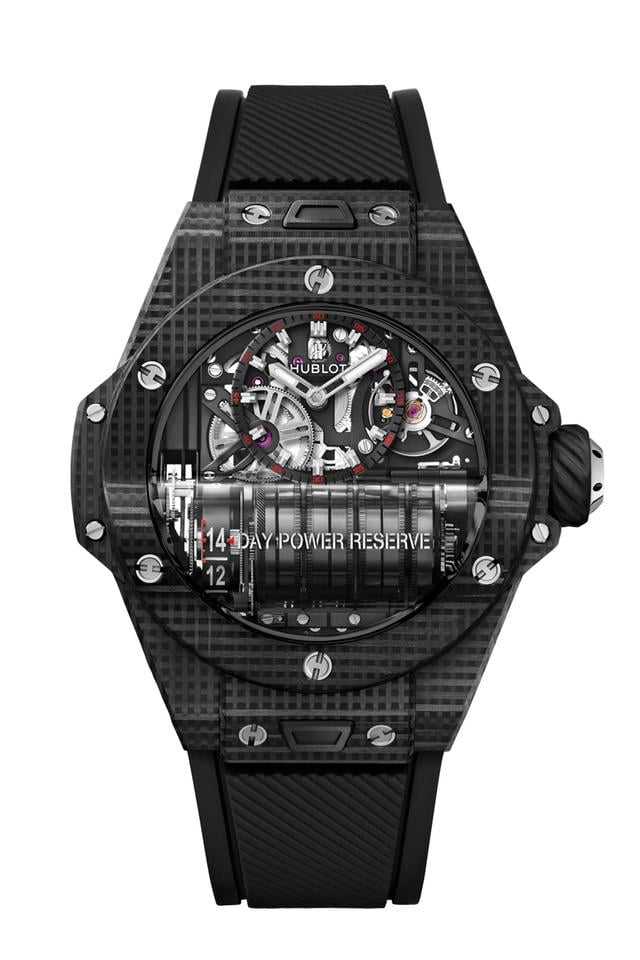
Hublot's Masterpiece collection exists for a single purpose: to make the movement the main event. The MP-11, reference 911.QD.0123.RX, is the purest expression of that brief in the current catalogue. Where most high-horology pieces tuck their engineering behind a dial, the MP-11 turns it outward — seven barrels stacked in a linear series, a fortnight of autonomy, and a skeletonised architecture you read like a blueprint.
This is not a watch for the collector who prizes subtlety. It is a watch for the collector who wants to understand the machine at a glance. The barrels march down the centre of the case like a spine; the balance sits above them; a power-reserve indication tells you how much of the fortnight remains. Everything about the layout is deliberate, and almost nothing about it is conventional.
The reference 911.QD.0123.RX clothes that movement in titanium with a black rubber strap — the MP-11 at its most distilled. It is a statement of intent from a brand that built its identity on provocation, and it rewards a close reading of both its architecture and its finishing.
The Manufacture: Hublot's Fusion Doctrine
Hublot was founded in Nyon in 1980 by Carlo Crocco, whose first watch paired a gold case with a natural rubber strap — the original 'fusion' gesture, and a genuinely radical idea at a time when rubber was considered strictly utilitarian. The brand's early identity was built on that contrast: precious metal against industrial material, dress watch form against sport-watch pragmatism.
Jean-Claude Biver took the helm in 2004 and codified what became the Art of Fusion philosophy, culminating in the 2005 Big Bang and a subsequent build-out of in-house movement manufacturing. That manufacturing capability is central to understanding the MP-11: this is not a decorated ébauche dressed up in an aggressive case. The HUB9011 is a Hublot-calibre engine, developed in-house to solve a specific architectural problem.
The MP-11 belongs to the Masterpiece line, the division where Hublot pushes its most extreme engineering — the same family that produced the MP-05 LaFerrari and the MP-09 Tourbillon Bi-Axis. If the Big Bang is the brand's commercial spine, the Masterpiece pieces are its research lab, and the MP-11 is the most wearable of that experimental breed.
Movement: Seven Barrels, One Linear Idea
The HUB9011 is a manual-winding calibre built around a single, stubborn idea: distribute an enormous power reserve across multiple mainspring barrels arranged in a linear series rather than the conventional parallel stack. Seven barrels are mounted vertically through the case, connected so that their combined energy delivers fourteen days — 336 hours — of autonomy. The barrels are not hidden. They are the dial.
Architecture
What makes the MP-11 legible is the way the movement's layout maps directly onto the watch's visual identity. The barrel train runs down the centreline of the case, the balance wheel sits at the top of the movement, and a power-reserve indication lets the wearer track how much of the fortnight remains. Because the barrels are mounted vertically, the watch has an unusually deep, sculptural quality; you are looking into the movement rather than at a decorated plate.
The engineering logic is straightforward once you accept the premise. Spreading the reserve across seven barrels means each mainspring carries a manageable share of the load, and the series arrangement keeps torque delivery relatively even as the watch unwinds. That is why a 14-day movement can still hold a stable rate toward the end of its reserve — the barrels are not fighting one another for dominance the way a poorly designed multi-barrel system can.
Finishing
Hublot's finishing here is more disciplined than its reputation sometimes suggests. The skeletonised bridges are sandblasted and anthracite-treated, giving them a matte, technical surface that contrasts with the polished bevels on their edges. The beveling is hand-applied and visible under a loupe; the barrels themselves are finished rather than left raw. It is not the hand-frosted, inward-angling school of traditional Geneva finishing, but it is coherent: the aesthetic is industrial precision, and the execution supports that intent.
At 28,800 vph, the balance beats at a conventional modern frequency, which keeps timekeeping predictable and the visual rhythm of the escapement satisfying to watch. The movement is not COSC-certified, and Hublot does not position it as a chronometer — a detail worth noting for buyers who equate price with certification.
Case and Dial: Engineering as Theatre
The MP-11 is cased in titanium at 45mm, a dimension that puts it firmly in statement territory. The case is satin-finished with polished bevels, and the bezel carries Hublot's signature H-shaped titanium screws — six of them, functioning as both fastening and visual signature. Sapphire crystal is used front and back, so the movement is visible from every angle, and the caseback reveals the barrel assembly from beneath.
The dial is essentially open-worked: there is no conventional dial plate, only a chapter ring and skeletonised hands reading against the movement itself. This is the MP-11's central proposition — you do not glance at it to read the time, you look into it and the time happens to be there. The hour and minute hands are openworked to avoid obscuring the barrels, and there is no lume to speak of, which tells you everything about the watch's intended use. It is a piece for the desk and the dinner table, not the dive boat.
The vertical barrel stack gives the case a strong visual centreline, and the whole composition reads as architecture rather than decoration. It is a design that could only exist because the movement demanded it — the case is shaped around the calibre, not the other way around.
On the Wrist
At 45mm the MP-11 is a presence, not a wallflower. The case is broad and the bezel prominent, but titanium keeps the mass in check, so the watch reads large without feeling heavy. The barrels run vertically down the case, which gives the piece an unusually tall visual centreline; on the wrist that translates into a sculptural object that commands the forearm rather than nestling into it.
The integrated rubber strap is the saving grace for daily wear. Hublot's end-link folds cleanly into the case, the deployant clasp sits flat, and the rubber conforms quickly. It is comfortable for a watch of this size, provided you accept that it will never disappear under a tailored cuff. The MP-11 is designed to be seen, and it behaves accordingly.
Balance is better than the dimensions might suggest, because the movement's mass is central and the strap integration distributes the weight evenly around the wrist. It is not a watch you forget you are wearing — quite the opposite — but it is a watch you can wear for a full day without resentment.
Accuracy and Ownership
The HUB9011 is not COSC-certified, and Hublot does not market it as a chronometer. In practice, a well-regulated example runs within a handful of seconds per day, with the usual position-dependent variation. The long 14-day reserve is a genuine asset for rate stability: because the mainsprings unwind slowly across seven barrels, torque delivery stays relatively even, and the rate does not sag noticeably as the reserve drops.
The caveat is the winding ritual. This is a manual-wind movement, and you will be at the crown roughly every two weeks. Owners who enjoy that interaction will find it satisfying; those who expect automatic convenience should look elsewhere. The winding action itself is smooth, and the power-reserve indication removes the guesswork that usually accompanies a long-reserve manual watch.
Servicing should go through Hublot's authorized network. The seven-barrel architecture is not a movement for the independent generalist — it demands factory-trained technicians and factory parts. Prospective owners should factor that into the total cost of ownership rather than treating service as an afterthought.
Value and Market
The MP-11 launched at roughly $95,000, and that figure sets the tone for the conversation. This is haute horlogerie pricing, and like most high-horology Hublot pieces, it softens on the secondary market. Titanium examples typically trade in the $60,000-$80,000 range depending on condition, completeness, and timing; the model appears more often through specialist dealers than at headline auction, and there is no meaningful auction record to anchor expectations.
That depreciation is not a criticism of the watch — it is simply how the segment behaves. Buyers who want the MP-11 experience should buy it for the architecture and the wrist presence, not as a store of value. Those who approach it as a collectible should be patient and let the secondary market do its work.
What the price buys is genuinely uncommon: a 14-day, seven-barrel movement that you can read from the outside, in a case that is wearable thanks to titanium. There are very few watches at any price that make engineering this legible, and that specificity is the MP-11's real value proposition.
Verdict
The MP-11 is Hublot at its most honest: engineering as theatre, executed with real finishing discipline. It is not a rational purchase, and it does not pretend to be one. For the collector who wants a movement they can read like a drawing and a wrist presence that refuses to whisper, the reference 911.QD.0123.RX is a compelling, uncompromising statement.
It asks for commitment — the winding, the size, the price — and it repays that commitment with one of the most legible pieces of movement architecture in modern watchmaking. Approach it on those terms and it delivers exactly what it promises.