Manufacture history: Hublot and the Masterpiece line
Hublot was founded in 1980 by Carlo Crocco, and from the beginning it was a brand interested in fusion. The early Hublot watches combined rubber straps with gold cases, a combination that was radical at the time and became a signature. The Big Bang, introduced in 2005, turned that fusion into a global language: industrial design, bold proportions, and a willingness to mix materials that other houses treated as incompatible.
The Masterpiece collection, usually shortened to MP, is Hublot at its most experimental. These are not volume products. They are laboratory pieces, often produced in tiny numbers, with movements that are designed around a concept rather than a conventional dial layout. The MP-05 LaFerrari, with its 50-day power reserve, and the MP-11, with its seven barrels and 14-day reserve, are the clearest examples. The MP-14 Origin continues that lineage. It is a piece that could only come from a brand that treats movement architecture as a form of theatre.
Movement: HUB9014 and the flying tourbillon
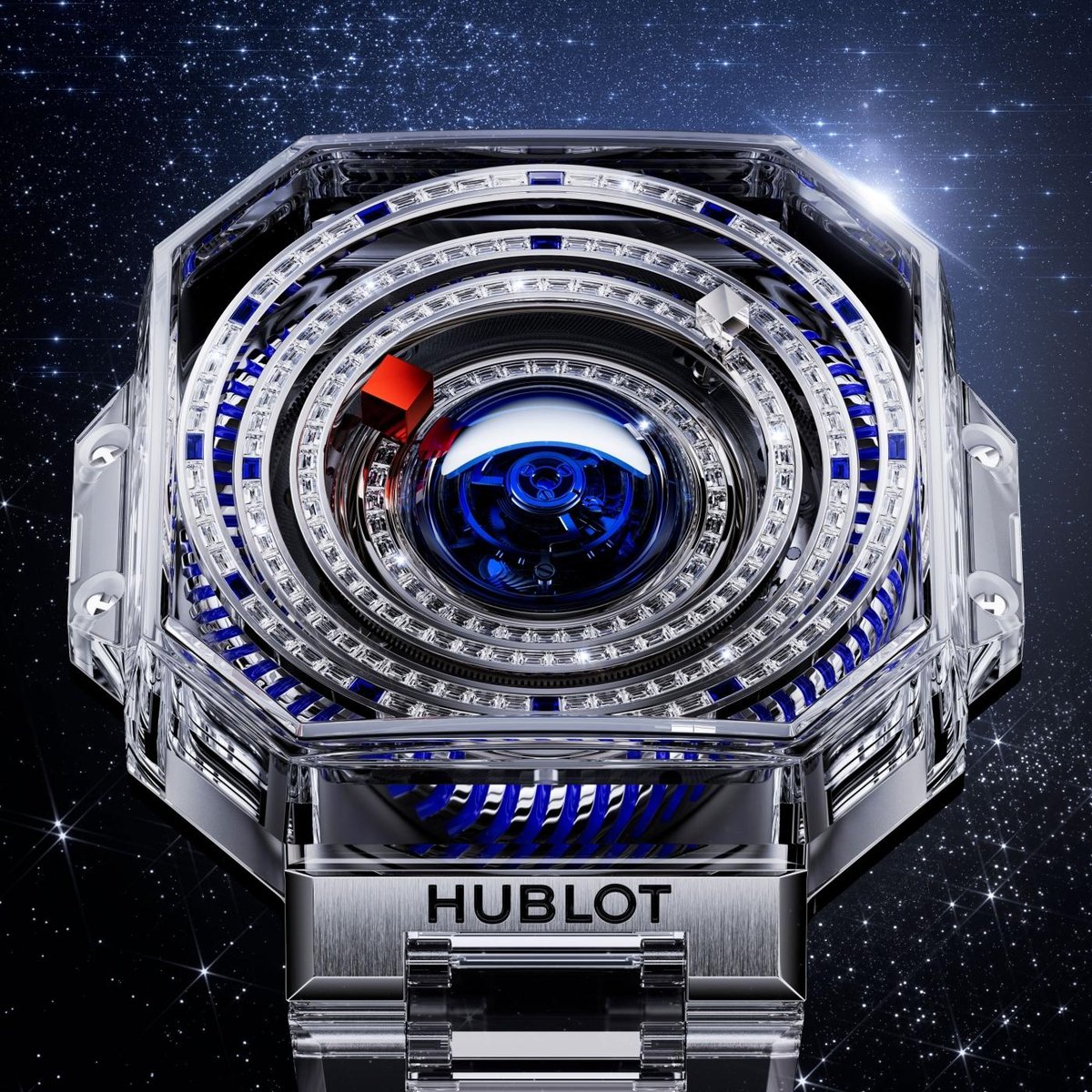
The MP-14 Origin is powered by the HUB9014, a hand-wound calibre developed in-house by Hublot. The movement is openworked, with a flying tourbillon and a power-reserve indication. The ten-day power reserve is a practical asset. It means the watch can be wound once a week and left alone, and it gives the owner a generous margin before the tourbillon stops. The HUB9014 is not COSC-certified, and that is not the point. The point is the architecture: the tourbillon cage is suspended, the mainplate is reduced to a skeleton, and the power reserve is displayed as a mechanical scale rather than a discreet aperture.
Finishing is consistent with the MP line. The bridges and mainplate are microblasted, with polished bevels that catch the light as the watch moves. The wheels are openworked, and the barrel is visible. The HUB9014 is not a movement that hides its work. It is a movement that expects to be inspected. The hand-wound format is appropriate here. An automatic winding system would add bulk and visual noise to a calibre that is already dense with information. Winding the watch is part of the ritual, and the crown is designed to be used.
The flying tourbillon is the focal point. It is not a subtle complication. It sits within the openworked landscape, and its rotation is visible from the dial side. The cage is finished with polished edges and a fine sense of depth. The tourbillon is not there to improve accuracy in a wristwatch; it is there to demonstrate mechanical mastery. Hublot understands this, and the MP-14 Origin treats the tourbillon as a sculptural element as much as a regulating device.
Case, dial, and strap
The MP-14 Origin is housed in a titanium case. Titanium is the right choice for a watch of this complexity. It reduces mass without reducing presence, and it gives the case a technical, slightly matte character that suits the movement. The case is sculpted rather than simple. It has the layered, architectural quality that defines the MP line, with a profile that seems to hold the movement rather than contain it. The sapphire crystal is shaped to follow the case, and it gives an unobstructed view of the calibre.
The dial is skeletonised, which means there is no conventional dial at all. The hours and minutes are read from openworked hands against a background of bridges and wheels. Legibility is secondary to architecture. This is not a criticism; it is a design brief. The MP-14 Origin is a watch for collectors who enjoy reading a movement. The hands are finished with enough contrast to be functional, but the user should expect to look twice. The power-reserve indication is integrated into the openworked layout, and the tourbillon occupies a central place in the visual field.
The watch is fitted with a rubber strap. Hublot's relationship with rubber goes back to the founding of the brand, and it remains the correct choice for a piece like this. The strap is integrated into the case profile, and the deployant clasp keeps the watch secure. Rubber also gives the MP-14 Origin a more casual, wearable character. It would be a mistake to put a formal leather strap on this watch. The MP-14 Origin is not a dress watch that happens to be complicated; it is a technical object that can be worn with formal clothing if the wearer has the confidence.
On the wrist: feel and presence
The MP-14 Origin is not a subtle watch. It is a sculptural object with a movement that demands attention. On the wrist, the titanium case keeps the weight reasonable, and the rubber strap curves comfortably around the wrist. The case is wide and layered, and it sits with a strong sense of occasion. This is not a watch that disappears under a cuff. It is a watch that announces itself. The openworked dial and flying tourbillon mean that the wearer will catch the movement in motion throughout the day, and that is part of the appeal.
Comfort is good for a watch of this complexity, but it is not a daily driver in the conventional sense. The crown is accessible, the strap is supple, and the deployant clasp is secure. The balance is surprisingly wearable. Hublot has learned how to make large, architectural watches sit properly on the wrist, and the MP-14 Origin benefits from that experience. Still, the watch is a statement piece. It is best worn with intention, not absent-mindedly.
Accuracy and daily use
The HUB9014 is a hand-wound flying tourbillon, and it is not COSC-certified. Day-to-day accuracy should be assessed over a period of wear, and the owner should expect a few seconds per day rather than chronometer-grade precision. The tourbillon is a regulating device, but its main purpose here is mechanical expression. The ten-day power reserve means the watch can be wound once a week, and maintaining a consistent winding routine will help stability. As with any tourbillon, the watch should be serviced by Hublot's authorized network.
Daily use is possible, but it requires care. The watch is not designed for sports or rough treatment. It is a collector's piece, and it should be treated as such. The sapphire crystal is resistant to scratches, and the titanium case is durable, but the movement is complex and exposed. The MP-14 Origin is a watch for the office, the collector's dinner, and the occasional formal event. It is not a watch for the gym.
Occasions and wrist presence
The MP-14 Origin works in formal and dress contexts if the wearer is comfortable with a watch that is more interesting than the suit. It is also a natural collector's piece for evening events and watch gatherings. It is not a sports watch, and it is not a travel watch in the practical sense. Its presence is maximal: five out of five. The watch is designed to be seen, and the movement is designed to be discussed.
Reference variants and family context
The MP-14 Origin is a limited edition of 50 pieces, and the reference 914.NJ.0100.JX.9941 is the titanium and rubber configuration. Hublot has not created a broad range of dial variants for this model; the MP-14 Origin is a focused release. In the wider MP family, the MP-11 is the closest sibling in spirit, with its long power reserve and openworked architecture. The MP-09 Tourbillon Bi-Axis is another tourbillon-focused Masterpiece, and the MP-05 LaFerrari remains the most extreme expression of Hublot's movement-first philosophy.
Other notable Hublot models include the Big Bang Unico, the Classic Fusion, and the Spirit of Big Bang. These are the brand's commercial pillars. The MP-14 Origin sits above them as a halo piece, a demonstration of what Hublot can do when it is not constrained by volume.
Comparable watches
Collectors considering the MP-14 Origin will also look at the Richard Mille RM 74-02, which shares the openworked tourbillon aesthetic and the sculptural case language. The Ulysse Nardin Freak is another movement-first design, with a different approach to the regulating organ. The Greubel Forsey Double Tourbillon 30° is a more traditional high-horology alternative, and the Jacob & Co. Astronomia Tourbillon is a more theatrical one. Each of these watches appeals to the same collector: someone who wants the movement to be the main event.
Investment value and service
The MP-14 Origin is a limited edition, and that scarcity supports its collector appeal. However, the market for six-figure Hublot Masterpiece pieces is thin. These are not liquid assets. The watch should be bought because the owner loves the architecture, not because it is expected to appreciate. Pre-owned data is limited, and auction history is minimal. The trend is stable rather than appreciating. Service must be performed by Hublot's authorized network, and the cost will reflect the complexity of the movement. This is not a watch for the collector who wants a simple ownership experience.
Pros and cons
Pros: the movement-first architecture is genuinely exceptional; the flying tourbillon and ten-day power reserve are meaningful complications; the titanium case and rubber strap make the watch more wearable than its complexity suggests; the limited edition of 50 pieces gives it collector cachet.
Cons: legibility is secondary to spectacle; the watch is not a daily driver for most collectors; service costs and the limited service network are real considerations; the price puts it in competition with more established high-horology names.
Final verdict
The Hublot MP-14 Origin is a successful Masterpiece because it is uncompromised. It does not try to be a conventional watch. It is a titanium sculpture with a hand-wound flying tourbillon at its centre, and it asks the wearer to engage with the movement. For the right collector, that is exactly the point. It is not the most versatile watch in the world, and it is not an investment for the faint-hearted. But as a piece of mechanical architecture, it is compelling.