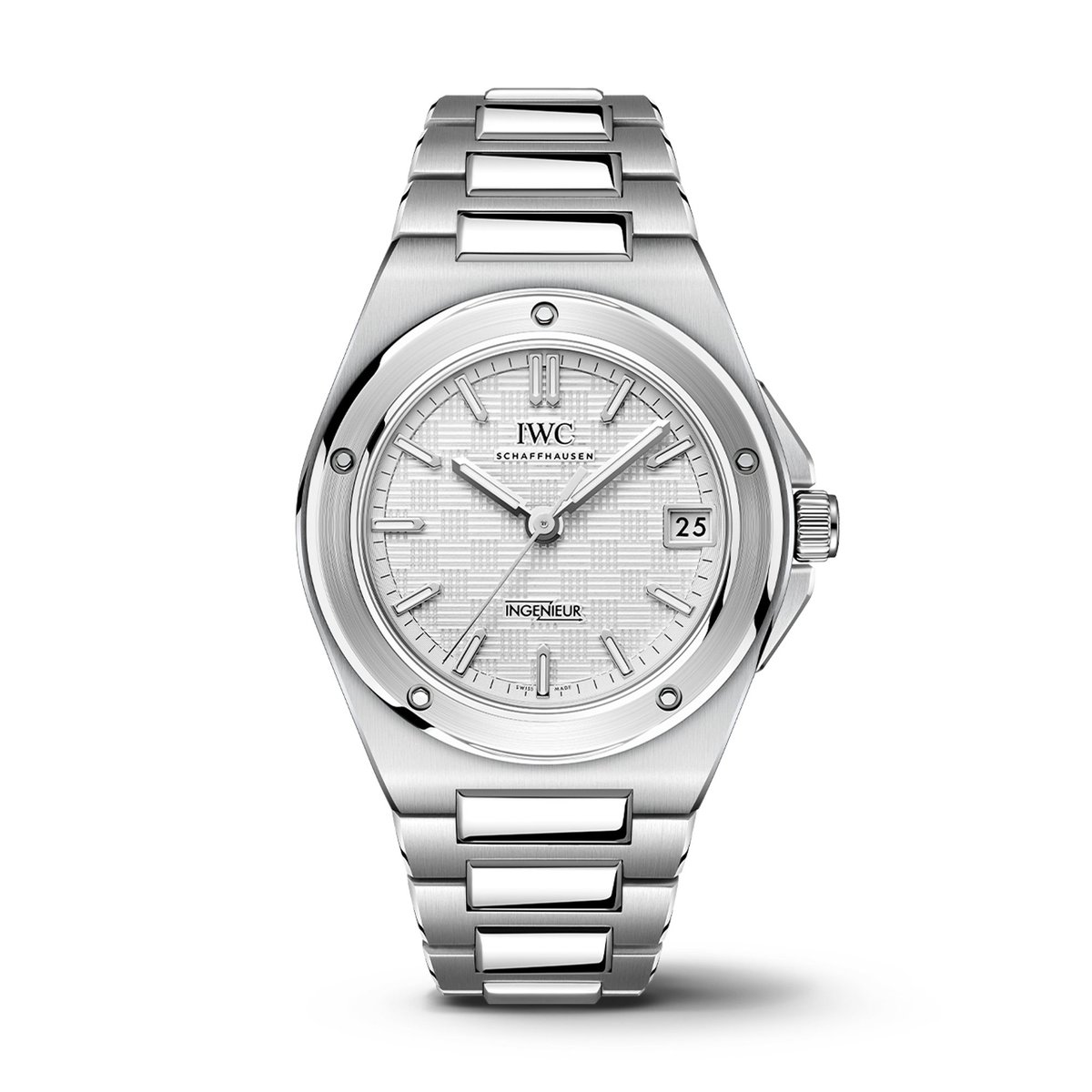
The Ingenieur, Sized for Real Wrists
For most of the last half-century, the IWC Ingenieur has been a watch that looked better in photographs than it felt on the wrist — at least for anyone without a 7.5-inch wrist. Gérald Genta's 1976 design was bold, angular, and unapologetically chunky, and when IWC relaunched the modern Ingenieur Automatic 40 in 2023, it kept that presence. The result was a beautiful object that many collectors admired from a distance. The new Ingenieur Automatic 35 changes that calculus. By shrinking the case to 35mm, IWC has produced an Ingenieur that actually disappears into daily wear — and in doing so, it may have built the most broadly wearable version of the watch yet.
I spent a week with the steel-and-black reference, wearing it to the office, on a couple of flights, and through a weekend of errands and dinners. This is a wear-focused review: what the 35mm case does for comfort, how the integrated bracelet behaves over a full day, and whether the smaller dimensions compromise the things that make an Ingenieur an Ingenieur.
A Short History of an Angular Icon
IWC was founded in Schaffhausen, Switzerland, in 1868, and the Ingenieur name first appeared in 1955 as a response to the era's fascination with anti-magnetic tool watches. The line's defining moment came in 1976, when Gérald Genta — the designer behind the Royal Oak and the Nautilus — reimagined the Ingenieur as the SL, reference 1832. That watch introduced the integrated bracelet, the octagonal bezel with five visible screws, and the flat, architectural case that still defines the family.
The modern revival arrived in 2023 with the Ingenieur Automatic 40, a faithful but refined take on the Genta formula. It was well received, but its 40mm case and substantial wrist presence limited its audience. The Automatic 35, introduced in 2024, is IWC's answer to that feedback: the same design language, scaled down for smaller wrists and for anyone who prefers a watch that sits quietly under a cuff.
Case and Bracelet: The Integrated Formula, Refined
The 35mm stainless steel case keeps the Ingenieur's signature geometry: the round bezel with five recessed screws, the flat-topped lugs that flow directly into the bracelet, and the sharply defined case flanks. What changes at this size is proportion. The bezel occupies more of the dial's visual real estate relative to the case, which gives the watch a slightly more jewel-like, dressy character than its 40mm sibling. It reads as an integrated sports watch, but a discreet one.
The bracelet is the star. IWC's H-link design is beautifully articulated, with polished center links and brushed outer links, and it tapers gently toward the clasp. The butterfly folding clasp is secure and low-profile, and the links are small enough that the bracelet drapes rather than perches. Over a week, I never once felt the need to adjust it mid-day. That is the highest compliment you can pay an integrated bracelet.
Finishing is what you expect at this price: crisp brushing on the case flanks and bracelet, polished bevels, and a sapphire crystal with anti-reflective coating on both sides. The solid caseback keeps the movement hidden, which is consistent with the Genta original and helps keep the watch slim.
Dial and Legibility: Clean, Confident, Slightly Formal
The black dial on my test watch is a deep, matte-to-satin black that shifts subtly with the light. Applied baton indices are faceted and catch the light, and the hands are simple, broad, and easy to read at a glance. There is a date window at 3 o'clock — a practical addition that keeps the watch in daily-wear territory without cluttering the dial.
Legibility is excellent. The contrast between the black dial and the polished hands and indices is strong, and the date is readable without a loupe. The lume is adequate rather than spectacular; it glows well enough to read the time in a dark room but won't win any endurance contests. For a watch that will spend most of its life in daylight, that is a fair trade.
The silver-plated dial variant is the dressier option, and the 18k 5N gold version turns the Ingenieur into a genuine luxury statement. All three share the same applied-index layout and the same restrained, architectural feel.
Movement: Caliber 32111 and the Five-Day Week
Inside is IWC Caliber 32111, an automatic movement with a five-day (120-hour) power reserve running at 28,800 vibrations per hour. IWC designates it a manufacture caliber, though it is understood to be based on a Sellita ébauche that IWC modifies and finishes to its own specification. That is not a criticism — the 32111 is a proven, robust workhorse, and the 120-hour reserve means you can take the watch off on Friday and pick it up on Wednesday without resetting it.
Because the caseback is solid, the movement's finishing is academic. What matters in daily use is reliability and serviceability, and on both counts the 32111 is a sensible choice. The date function is quick-set, and the crown operates with a firm, precise feel. There is no COSC certification, but IWC regulates its movements to its own standards, and real-world performance was solid.
On the Wrist: The Case for Smaller
This is where the Automatic 35 earns its keep. At 35mm, the case sits flat and centered on a 6.5-to-7-inch wrist, with no overhang and no tendency to rotate. The bracelet's articulation means the watch hugs the wrist rather than floating on top of it. The weight is noticeable but not burdensome — enough to remind you it's there, not enough to annoy you by mid-afternoon.
The integrated bracelet is the key. Because the first link pivots close to the case, the watch wraps around the wrist instead of sitting on it like a puck. I wore it under a shirt cuff, with a T-shirt, and with a jacket, and it never felt out of place. That versatility is the whole point of a 35mm integrated sports watch, and the Ingenieur nails it.
If you have a larger wrist — say 7.5 inches or more — the 35mm case may read as small, and the 40mm Automatic remains the better choice. But for the majority of wearers, and especially for anyone who has ever wanted an Ingenieur but found the 40mm too much watch, the 35 is the Goldilocks option.
Accuracy: What to Expect Day to Day
Over a week of mixed wear, my test watch ran within a few seconds per day — comfortably inside the range you would expect from a well-regulated modern automatic. I did not measure it on a timegrapher, but wrist-checked against a reference clock, it held steady. The 120-hour reserve means that even if you alternate it with other watches, it will still be running when you come back to it. For a daily wearer, that is a meaningful convenience.
Versatility: One Watch, Many Rooms
The Ingenieur Automatic 35 is one of those rare watches that genuinely works across contexts. On the steel bracelet with a black dial, it is sporty enough for jeans and a T-shirt, refined enough for a suit, and unobtrusive enough for travel. The 100-meter water resistance means you don't have to baby it, and the sapphire crystal is effectively scratch-proof in normal use. It is not a dress watch in the traditional sense, but it is dressy enough for most occasions short of black tie.
The Three Flavors
IWC offers the Automatic 35 in three distinct flavors. The steel-and-black reference is the everyday hero — understated, versatile, and the one I would choose for a single-watch collection. The steel-and-silver-plated version brightens things up and leans more formal; it pairs beautifully with a suit but shows smudges more readily. The 18k 5N gold reference is the outlier: same case geometry, but rendered in solid gold with a matching gold dial and bracelet. It is a statement piece, and priced accordingly.
Value and Investment
The steel Ingenieur Automatic 35 sits at the lower end of IWC's integrated-bracelet lineup, with an MSRP in the region of $9,000 (the gold version is substantially more). That places it in direct competition with the Rolex Datejust 36, the Chopard Alpine Eagle 36, and the Girard-Perregaux Laureato 38, and below the Audemars Piguet Royal Oak 37 and Vacheron Constantin Overseas 35.
On the secondary market, steel Ingenieurs have held value reasonably well, though they are not investment pieces in the way that a Royal Oak or Nautilus can be. Expect pre-owned examples to trade in the high four figures to low five figures, with the gold version commanding a premium. Buy it because you want to wear it, not because you expect it to appreciate.
Service and Ownership
IWC recommends servicing every five to seven years, and authorized service centers are the safest route given the movement's Sellita base and IWC's parts policy. Independent watchmakers can service the caliber, but access to genuine parts favors the authorized channel. Budget for service as part of ownership; it is not a watch you can neglect indefinitely.
The Competition
The most obvious alternative is the Rolex Datejust 36, which offers a date, a cyclops, and Rolex's unmatched residuals, but lacks the integrated-bracelet drama. The Chopard Alpine Eagle 36 is the closest spiritual rival — another integrated steel sports watch with a textured dial and a similar price point. The Girard-Perregaux Laureato 38 offers a Genta-adjacent design with a slightly larger case. And for those who want the Genta look on a budget, the Tissot PRX 35mm delivers a surprising amount of the same visual language for a fraction of the price.
Who Is It For?
The Automatic 35 is for the collector who has admired the Ingenieur from afar but found the 40mm too imposing. It is for the wearer with a 6-to-7-inch wrist who wants an integrated sports watch that doesn't dominate the arm. It is for anyone who values a five-day power reserve and a bracelet that actually articulates. It is not for the collector who wants maximum wrist presence or the flipper looking for the next Royal Oak. But for the rest of us, it is a genuinely compelling daily wearer.
Verdict
The IWC Ingenieur Automatic 35 is the Ingenieur that most people should buy. It preserves everything that makes the design special — the screws, the integrated bracelet, the architectural case — while fixing the one thing that held the 40mm back for many wearers: size. It is comfortable, legible, versatile, and beautifully finished. If you have been waiting for an Ingenieur that feels like a daily watch rather than an occasion watch, this is it.