IWC Ingenieur Automatic 42 Review: Genta's Steel Icon, Made Modern
The Ingenieur Automatic 42 is IWC's most convincing attempt in years to make a luxury integrated-bracelet watch that feels technical rather than nostalgic. Reference IW328901, the black-dial steel model, is the one most collectors will encounter: a 42 mm stainless steel case, 10.8 mm thick, 100 m water resistant, and a five-day automatic inside. It is not a reissue in the costume sense. It is a modern watch that borrows the geometry of Gérald Genta's 1976 Ingenieur SL and then updates the engineering.
That distinction matters. The original Ingenieur was a tool watch for people who valued anti-magnetic protection and clean design. The new 42 keeps the bezel with its five recessed screws, the flat profile, and the integrated bracelet, but it also brings a sapphire display back, a date, and a movement with a 120-hour power reserve. The result is a watch that can be worn daily without ceremony, yet still has enough architectural detail to reward a close look.
This review covers the steel IW328901, but the same core package appears in silver, green and titanium variants. The headline is simple: IWC has built a precise, comfortable, genuinely wearable Genta-derived watch. The question is whether the price and the movement specification justify it against the Royal Oak, Laureato, Alpine Eagle and Overseas.
Manufacture history and the Ingenieur line
IWC Schaffhausen was founded in 1868 by Florentine Ariosto Jones, an American engineer who moved to Switzerland to combine American industrial methods with Swiss watchmaking. The company has long positioned itself at the intersection of technical watchmaking and clean design, from the Portugieser to the Mark series pilot's watches. The Ingenieur arrived in 1955 as a technical anti-magnetic watch, aimed at engineers and scientists working near magnetic fields. Its name was not decorative; it described the intended user.
The integrated-bracelet Ingenieur SL arrived in 1976, designed by Gérald Genta. That watch gave the line its most recognizable silhouette: a flat, angular case, a bezel with five recessed screws, and a bracelet that flowed directly from the case. The new Ingenieur Automatic 42 is not a literal re-edition. It is a modern interpretation of that language, with a 42 mm case, a slim profile, and a movement that meets contemporary expectations for autonomy. IWC has kept the five-screw bezel and the H-link bracelet, but the execution is cleaner and more wearable than a pure vintage revival.
Movement: Calibre 32111
The Ingenieur Automatic 42 uses IWC Calibre 32111, an automatic movement with a 120-hour power reserve, a frequency of 28,800 vph (4 Hz), 21 jewels and a date display. IWC describes it as an IWC-manufactured movement, and the display back shows Côtes de Genève on the bridges and perlage on the base plate. The architecture is modern and pragmatic: a long mainspring delivers five days of autonomy, which means the watch can be set down on Friday and still be running on Monday. The 4 Hz balance is a sensible choice for stability and serviceability.
The date is the only complication. That is not a criticism; the Ingenieur is a daily watch, and a date at 3 o'clock is useful without disturbing the dial. The movement is not COSC-certified, and IWC does not market this reference as a chronometer. In practice, owners should expect a few seconds per day of variation, with the usual caveat that individual examples and wearing habits vary. The five-day reserve is the more meaningful technical feature here: it makes the watch easy to live with and reduces the fuss of frequent winding.
Finishing is appropriate to the price. The bridges are decorated, the rotor is visible, and the display back gives the watch a mechanical dimension that the closed casebacks of some rivals lack. It is not haute horlogerie finishing, and it does not pretend to be. It is clean, industrial and consistent with the Ingenieur's technical brief.
Case, dial and bracelet
The steel case measures 42 mm in diameter and 10.8 mm in thickness, with 100 m water resistance. The crystal is sapphire, and the caseback is also sapphire. The bezel retains the five recessed screws that define the Ingenieur, but the case is less aggressive than the original SL. The lines are crisp, the bezel is flat, and the transition into the bracelet is the main event. This is an integrated design in the proper sense: the bracelet is not an accessory, it is part of the architecture.
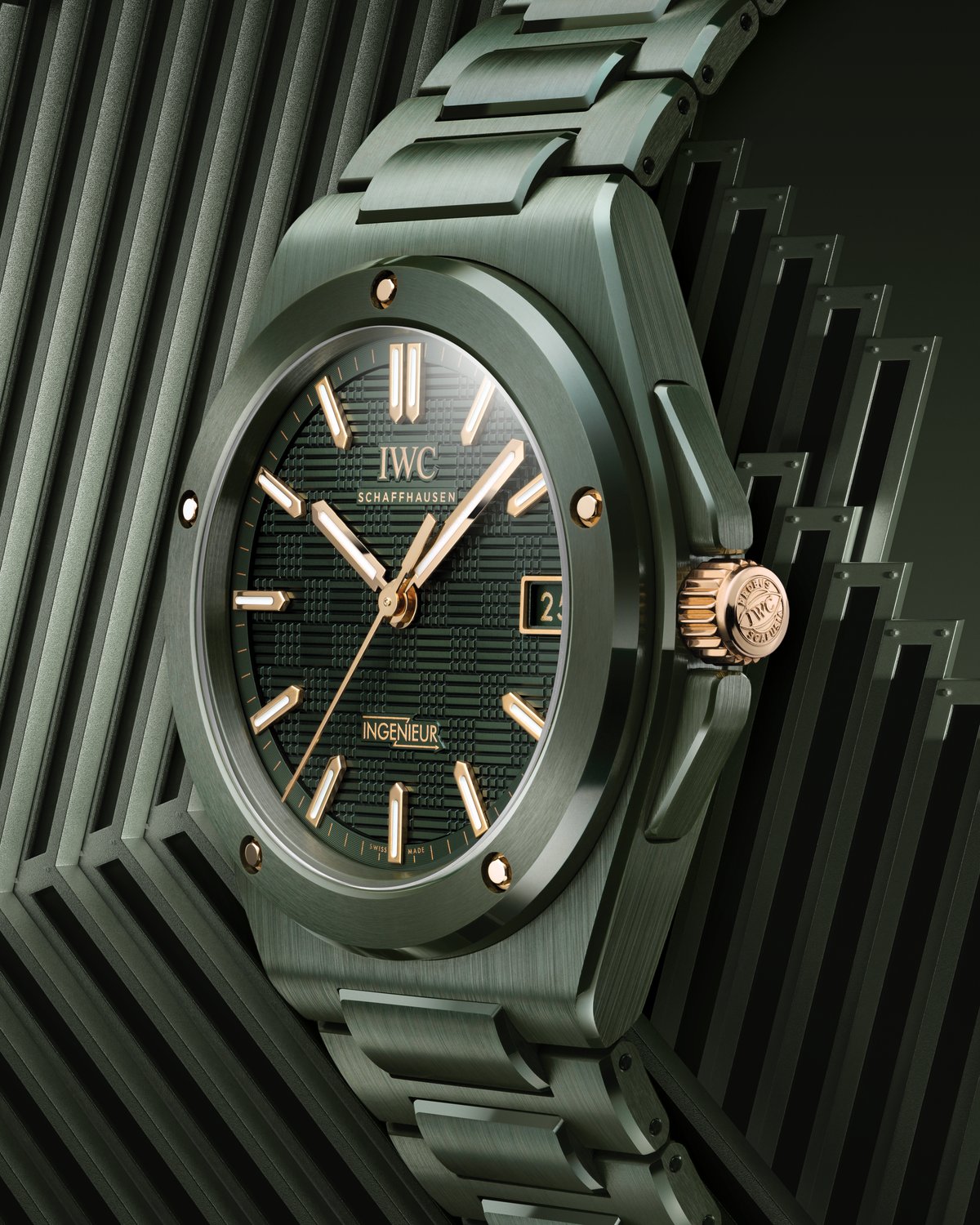
The black dial is restrained. Applied markers and hands carry Super-LumiNova, and the date sits at 3 o'clock in a matching black disc. The dial has enough depth to avoid looking flat, but it does not rely on texture or drama. The silver-plated variant is brighter and more formal; the green adds color; the titanium model is lighter and more muted. The black steel reference is the most versatile and the one that best matches the tool-watch origins of the name.
The bracelet is the strongest argument for the watch. It is a stainless steel integrated bracelet with a folding clasp, and the links are finished with a mix of brushing and polishing that catches light without becoming flashy. The integration means the watch sits close to the wrist, and the lack of conventional lugs makes it feel more compact than a 42 mm measurement might suggest. The trade-off is that strap changes are not part of the program. This is a bracelet watch, and IWC has designed it that way.
On the wrist
On the wrist, the Ingenieur Automatic 42 reads as a compact 42 mm because the bracelet drops away immediately from the case. The 10.8 mm height keeps it under a cuff, and the flat caseback sits comfortably against the wrist. The steel version has a substantial feel, but it is not top-heavy. The bracelet articulates well, and the clasp is secure. For a watch with this much visual architecture, it is surprisingly easy to forget you are wearing it.
The fit is the key. Integrated bracelets live or die by the first link and the clasp, and IWC has got both right. The watch does not slide around, and the case does not dig into the wrist. It is comfortable enough for a full day at a desk and secure enough for casual wear. The 100 m water resistance adds practical confidence, even if few owners will take a luxury steel watch into the water.
Accuracy and daily use
The Calibre 32111 is not COSC-certified, so there is no official chronometer guarantee. Real-world accuracy should be judged over weeks rather than days. Expect a stable rate within a few seconds per day, with variation depending on position and activity. The 4 Hz frequency and long power reserve make the watch easy to keep running, and the date is quick to set when needed. The sapphire crystal is resistant to everyday scratches, and the steel case and bracelet will pick up light marks with wear. That is normal for a polished and brushed steel watch, and it is part of the ownership experience.
The five-day reserve is a genuine convenience. It means the watch can be rotated with other pieces without constant resetting. It also makes the Ingenieur a good travel watch: set it, wear it, and it will still be running when you return. The absence of a screw-down crown is not a deal-breaker at 100 m, but owners should still take care when operating the crown near water.
Occasions and wrist presence
The Ingenieur Automatic 42 is a daily watch first. It works with a shirt and jacket, it works with jeans and a T-shirt, and it works as a travel companion. It is sporty enough for casual wear and refined enough for a formal dinner, though it is not a dress watch in the traditional sense. The integrated bracelet gives it a presence that a leather-strap watch cannot match, and the five-screw bezel makes it recognizable to people who know the lineage without shouting for attention.
Wrist presence is 4/5. The watch is noticeable because of the bracelet and the bezel, not because of bulk. It has a confident, architectural look that reads well from across a table. It is not as extroverted as a Royal Oak, and it is not as understated as a simple three-hand steel watch. That middle ground is exactly where the Ingenieur belongs.
Reference variants and family context
The core steel references are IW328901 with a black dial and IW328902 with a silver-plated dial. The green-dial steel model, IW328903, adds a more contemporary color option. The titanium reference IW328904 uses a titanium case and bracelet with a grey dial, which reduces weight and gives the watch a more muted, technical character. All share the 42 mm case, Calibre 32111 and integrated bracelet concept.
Within the Ingenieur family, the current 42 sits alongside the Ingenieur Automatic 40 and the historic references. The original 1976 Ingenieur SL, often identified as Ref. 1832, is the ancestor. The Ingenieur Automatic 40, Ref. IW357001, is a smaller, more traditional alternative. Earlier Ingenieur Automatics such as the Ref. IW322701 show how the line evolved before the current Genta-inspired revival. The 42 is the most direct modern expression of the Genta brief, but it is not the only Ingenieur worth knowing.
Other notable IWC models include the Portugieser Chronograph, the Big Pilot's Watch, the Pilot's Watch Mark XX, the Aquatimer Automatic and the Da Vinci Automatic. Each occupies a different part of the catalog, but the Ingenieur is the one that best combines IWC's technical heritage with a luxury integrated-bracelet silhouette.
Alternatives and homages
The obvious alternative is the Audemars Piguet Royal Oak Selfwinding 41 mm. It is the benchmark Genta integrated bracelet watch, more expensive, more recognizable and more extroverted. The Girard-Perregaux Laureato 42 mm is a closer rival in concept: integrated steel bracelet, angular bezel, automatic movement, and often less expensive on the secondary market. The Chopard Alpine Eagle 41 mm offers a textured dial and a chronometer-rated movement in a similarly sporty package. The Zenith Defy Skyline 41 mm brings a high-frequency movement and a more aggressive technical look. The Vacheron Constantin Overseas 41 mm is the luxury step up, with interchangeable straps and a significant price premium.
For buyers who want the integrated-bracelet look at a lower price, the Tissot PRX Powermatic 80 is the accessible standard, around $675. The Maurice Lacroix Aikon Automatic 42 offers a Genta-adjacent design for around $2,000. The Christopher Ward Twelve is an angular integrated-bracelet option at roughly $1,200. The Casio Edifice EFR-S108D is an affordable steel sports watch with an integrated look and quartz reliability at around $160. None of these is an Ingenieur, but they show how far the integrated-bracelet language has travelled.
Investment value and service
The Ingenieur Automatic 42 launched at a US retail price of $11,700 for the steel black-dial reference. Current retail has moved higher, and the range across steel and titanium variants is roughly $11,700 to $15,200. Pre-owned steel examples have traded in the $8,500 to $10,500 range, which is a meaningful discount to retail. The trend is stable rather than appreciating; this is not a limited-edition hype watch. At or below $10,500 pre-owned, it is a solid long-term hold. At current retail, it is a keeper rather than a quick flip.
There is no major auction history for this reference; it is too recent for meaningful auction data. Service should be handled through IWC's authorized network. The interval and cost depend on wear, water exposure and bracelet condition, so buyers should budget for maintenance without treating it as an annual expense. The sapphire crystal and steel construction are durable, and the movement is designed for everyday use.
Pros and cons
The pros are clear: a five-day 120-hour power reserve, a versatile 42 mm steel case with 100 m water resistance, a well-executed integrated bracelet, and a clear Genta lineage without costume-drama retro. The cons are equally clear: no chronometer certification at this price, a date-only movement that feels modest next to chronometer-rated rivals, aggressive retail pricing, and an integrated bracelet that limits strap changes. The Ingenieur is not trying to be everything. It is a specific answer to a specific question: what should a modern luxury steel integrated watch feel like?
Final verdict
The IWC Ingenieur Automatic 42 is the most coherent modern Ingenieur in years. It is technical, comfortable and quietly confident, with a movement that makes daily wear easy and a bracelet that makes the design work. It is not cheap, and it will not satisfy someone hunting for a Royal Oak alternative on paper. But as a daily-wear Genta-derived design, it is precise, wearable and built with real attention to detail. For the discerning buyer, the pre-owned market is the smarter entry point; at retail, buy it because you want the watch, not because you expect it to appreciate.