Brand context: why an Ingenieur tourbillon makes sense
IWC was founded in Schaffhausen in 1868 by Florentine Ariosto Jones, an American engineer who wanted to combine American production methods with Swiss craftsmanship. The Ingenieur name arrived in 1955 as an antimagnetic tool watch for engineers and scientists. Gerald Genta's 1976 redesign gave it the integrated bracelet and octagonal bezel language that the current collection revives. The modern Ingenieur Automatic 40 brought that language back in a very wearable form, and the Tourbillon 41 sits at the top of the family.
That history matters because the Ingenieur is not a dress watch with a bracelet bolted on. It was designed as a working watch for technical people. The tourbillon is a high-horology complication, but the case and bracelet still carry that tool-watch attitude. The result is a watch that feels less precious than its complication suggests.
Movement: Calibre 82905
The Ingenieur Tourbillon 41 uses the IWC-manufactured Calibre 82905, an automatic movement with a flying tourbillon and a 96-hour power reserve. The frequency is 28,800 vph, and the movement is not COSC-certified. That is not a red flag; IWC regulates its movements in-house, and tourbillons are rarely about certification stamps anyway. The point of the tourbillon is positional stability and visual drama, and the Calibre 82905 delivers both.
The power-reserve display at twelve is genuinely useful. A 96-hour reserve means you can take the watch off on Friday and pick it up on Tuesday without resetting it. The Pellaton winding system is an IWC signature, and it gives the movement a practical, robust feel that suits the Ingenieur name. Finishing is industrial-luxury IWC: clean, precise, and more about architecture than hand-engraved spectacle. You will not find the kind of hand-finished anglage that doubles the price of a small independent, but you will find a movement that looks purposeful and is built to be serviced.
Case, bracelet, and dial
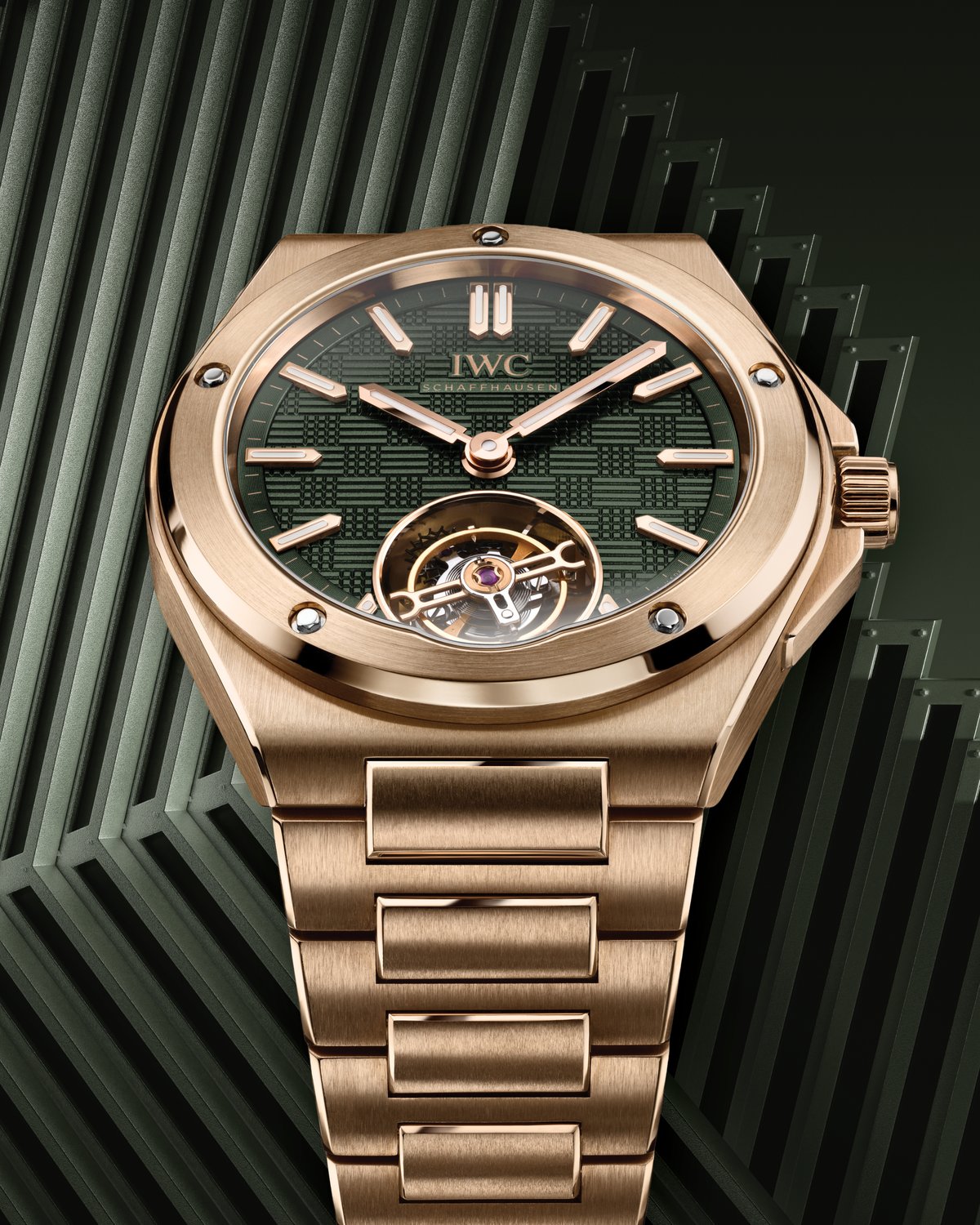
The case is titanium, which is the right choice for this watch. It keeps the mass low and gives the angular Ingenieur shape a slightly more technical feel than steel. The crystal is sapphire, the bracelet is integrated titanium, and the clasp is a deployant. The dial is the familiar black grid pattern, but the tourbillon aperture at six and the power-reserve display at twelve make it a different animal from the Automatic 40.
Legibility is better than you might expect. The hands are broad and carry Super-LumiNova, and the applied markers are easy to read against the dark dial. The tourbillon aperture is a focal point, but it does not swallow the hour markers. The power-reserve display is small but readable at a glance. The grid texture adds depth without turning the dial into a novelty. This is a busy dial, but it is a controlled busy.
The bracelet is the star of the show. The flat links and tapered profile are classic Ingenieur, and the titanium construction makes the watch feel lighter than its broad stance would suggest. The deployant clasp is secure and does not add unnecessary bulk under the wrist. If you have worn the current Ingenieur Automatic 40, you will recognize the fit immediately. If you have not, the short version is that this is one of the most comfortable integrated bracelets in the luxury sports watch market.
On the wrist: a week of real wear
The first thing you notice is the bracelet. The Ingenieur's flat links and tapered profile wrap the wrist rather than sit on top of it, and titanium keeps the whole package from feeling top-heavy. The case is broad and angular, so it reads larger than a round 41mm dress watch, but the articulation at the lugs and the deployant clasp make it easy to find a comfortable fit. I wore it slightly loose, as I do with integrated bracelets, and it stayed put without spinning.
The tourbillon does not upset the balance. The dial is busier than a standard Ingenieur, but the weight distribution feels neutral. The crown is integrated into the caseband and never dug into my wrist. After a week, the watch felt like a sports watch that happened to have a tourbillon, not a tourbillon that had been forced into a sports watch. That is a meaningful distinction.
The watch works with a suit because the bracelet is finely finished and the dial is black. It works with jeans because the case is titanium and the silhouette is sporty. It is not a beach watch, but it is a travel watch in the sense that it slips under a cuff and looks appropriate in most rooms. The tourbillon gives it a party trick, but the bracelet and case give it daily-wear manners.
Accuracy and ownership
IWC regulates the Calibre 82905 in-house and does not submit this reference for COSC certification. In real-world wear, expect a stable rate rather than quartz-like precision. The tourbillon's theoretical benefit is positional stability, but the practical benefit for most owners is visual and emotional. I would judge this watch over a week of mixed wear, not by a single timegrapher snapshot. Keep it away from strong magnetic fields and treat it like the high-horology object it is.
Service should go through IWC authorized service only. A tourbillon is not a movement for a local watchmaker, and the cost will be specialist. I would not buy one without a clear service history or warranty. This is not a watch you buy to abuse; it is a watch you buy to wear carefully and enjoy often.
Occasions and wrist presence
The Ingenieur Tourbillon 41 is more versatile than its price suggests. It is formal enough for a dinner, sporty enough for a weekend, and comfortable enough for daily wear. It is not a gym watch and not a dive watch, but it is a travel watch and a dress watch in the modern sense. The titanium case keeps it from feeling ostentatious, even though the tourbillon is undeniably a luxury signal.
Wrist presence is strong. I would rate it 4.5 out of 5. The broad, confident stance of an integrated-bracelet sports watch is there, and the tourbillon gives the dial a focal point without turning it into a showpiece. It is noticeable, not loud. That is exactly what you want from a high-horology Ingenieur.
Reference, family, and alternatives
The reviewed reference is IW338701, a limited edition in titanium with a black grid dial and integrated titanium bracelet. The flying tourbillon sits at six o'clock, and the power-reserve display sits at twelve. IWC has not turned this into a broad collection; it is a halo piece for the Ingenieur line.
The obvious siblings are the Ingenieur Automatic 40 references IW328901, IW328902, and IW328903, which share the case language and bracelet but run a conventional automatic movement. The older Ingenieur Constant-Force Tourbillon 46 ref. IW590001 is the spiritual predecessor: a larger, more technical tourbillon Ingenieur. The Tourbillon 41 is the wearable modern answer.
IWC's other pillars are the Portugieser Chronograph, the Big Pilot's Watch 43, the Portofino Automatic, and the Aquatimer Automatic. Each has a different job; the Ingenieur Tourbillon 41 is the one that bridges sports-watch wearability and high horology.
If you are shopping in this air, the Audemars Piguet Royal Oak Selfwinding Flying Tourbillon is the obvious comparison. It has the same integrated-bracelet, tourbillon-forward brief, but with more brand heat and a higher secondary-market profile. The Vacheron Constantin Overseas Tourbillon is a more classical take on the luxury sports tourbillon, with an interchangeable-strap system and a softer case profile. The Girard-Perregaux Laureato Tourbillon is another integrated-bracelet sports watch with a tourbillon, often less obvious on the wrist.
For a more affordable integrated-bracelet fix, the Tissot PRX Powermatic 80 is the default choice. It captures the silhouette, not the tourbillon. The Christopher Ward The Twelve offers an angular case, integrated bracelet, and a dial texture that nods to the Genta era. The Maurice Lacroix Aikon Automatic is a more polished integrated-bracelet option with a similar sports-chic attitude. None of them are substitutes for the IWC, but they scratch the same design itch.
Value and service
At $125,000, the Ingenieur Tourbillon 41 is priced like a high complication, not like a standard Ingenieur. Limited availability and the titanium case should help it hold value better than the regular Automatic 40, but this is not a Royal Oak in the auction room. Buy it because you want a wearable tourbillon from IWC, not because you expect a quick flip. Pre-owned examples should trade in the $105,000-$135,000 range in the near term, with stable demand from IWC collectors.
The price buys a titanium integrated-bracelet IWC with a flying tourbillon and genuine daily wearability. It is a collector's high complication rather than a value play, and it should hold better than a standard Ingenieur because of rarity. Service will be specialist and costly, and it should go through IWC authorized service only.
Pros and cons
Pros: the wearable integrated-bracelet package with a flying tourbillon; the titanium case and bracelet keep mass low; the power-reserve display is genuinely useful; and the watch remains legible despite the open tourbillon aperture.
Cons: the price is firmly in high-horology territory; there is no date function; availability is limited; and service will be specialist and costly.
Final verdict
The Ingenieur Tourbillon 41 is one of the few high-complication sports watches that actually behaves like a sports watch on the wrist. It is expensive, limited, and not for everyone, but it delivers the rare combination of daily-wear comfort and genuine horological theatre. If you want a tourbillon you can wear without ceremony, this is a compelling answer.