First Impressions
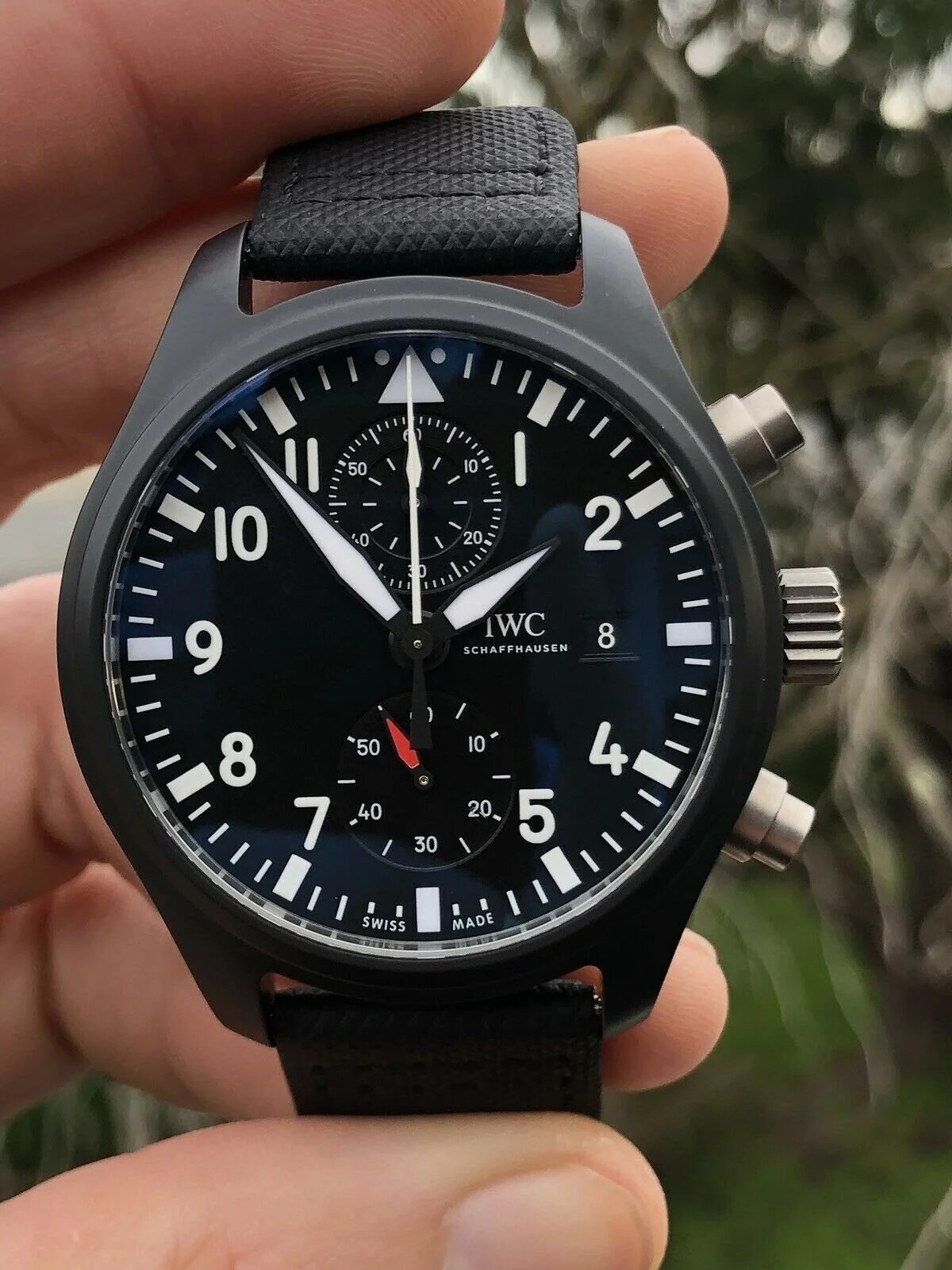
The IWC Pilot's Watch Chronograph Top Gun, reference IW389101, does not whisper. It arrives as a matte black block of zirconium oxide ceramic with white printing so crisp it looks stencilled, and a textile strap that feels closer to webbing than to leather. There is no polished bevel to catch the light, no sunburst dial, no decorative flourish of any kind. This is a watch designed to be read at a glance in bad light, and it succeeds at that better than almost anything else in its price bracket.
I wore it for a full week — desk work, a couple of long drives, a rainy school run, one dinner where it looked entirely out of place and entirely unbothered by that fact. What follows is a wearer's account: how it sits, how it reads, how it holds up, and who should actually buy one.
The Top Gun Name, and Where It Comes From
IWC Schaffhausen was founded in 1868 by the American engineer Florentine Ariosto Jones, who moved to the Swiss town on the Rhine to combine American industrial methods with Swiss hand-finishing. The company's pilot-watch line is nearly as old as aviation itself: IWC produced one of the first purpose-built pilot's wristwatches in the 1930s, followed by the oversized Big Pilot's Watch of the 1940s, built to a military specification that called for a large, legible dial and a soft-iron inner case to shield the movement from magnetic fields.
The Top Gun sub-family arrived much later, in 2007, when IWC became an official partner of the United States Navy's Strike Fighter Tactics Instructor programme — the school known to everyone outside the military as TOPGUN. The first Top Gun watches were chronographs in black ceramic, and the recipe has barely changed since: a scratch-resistant ceramic case, a matte black dial, high-contrast white markings, and a strap that can survive sweat and salt water.
The IW389101 is the current-generation expression of that idea. It replaced the earlier IW389001, swapping the older Calibre 89361 for IWC's in-house Calibre 69380 — a change that matters more to the wearer than it might sound.
Movement: Calibre 69380
Inside is IWC's own Calibre 69380, an automatic chronograph from the manufacturer's 69000 family. It runs at 28,800 vibrations per hour — 4 Hz, the modern standard — and carries a power reserve of 46 hours. That figure is worth pausing on. Forty-six hours means you can take the watch off on Friday evening and it will still be running on Sunday morning; it does not mean you can leave it in a drawer for a fortnight. If you rotate several watches, expect to reset the day and date most Mondays.
The layout is a two-register chronograph. Elapsed hours and minutes share a single counter at 12 o'clock, read off two hands on one subdial, while running seconds live at 6 o'clock. Day and date share an aperture at 3 o'clock. It is a clean, symmetrical arrangement that leaves the outer dial free for the oversized white numerals that make this watch so easy to read.
Operationally, the pushers are firm but not stiff, with a positive click at start, stop and reset. There is no flyback function here, and no column-wheel theatre when you press the top pusher — this is a robust, industrially finished movement built for serviceability rather than for showing off. IWC does not submit this watch for COSC certification, and it does not need to; the brand regulates its movements in-house to its own standards.
One practical note: because the 12 o'clock counter combines elapsed hours and minutes on one register, it can look slightly busy at a glance. If you time things often, you will learn to read it quickly. If you never use a chronograph, you are paying for a complication you will not use.
Case, Crystal and Water Resistance
The case is black zirconium oxide ceramic, a material that is sintered rather than machined and then finished to a matte surface. In daily wear this is the single best argument for the watch. Ceramic does not scratch in the way steel does: keys, door frames, seatbelt buckles and the edges of laptop bags leave no marks. After a week of genuinely careless wear, the case looked exactly as it did out of the box.
The trade-off is brittleness. Ceramic is hard but not tough. A sharp knock against a hard edge — a tile floor, a granite counter, a car door — can chip or crack it, and a cracked ceramic case cannot be polished out; it must be replaced. That replacement is expensive. If you are hard on your watches in a way that involves impacts rather than abrasion, steel or titanium is the smarter choice.
The case measures 44.5 mm across and 15.7 mm thick. Those are honest numbers, and they matter. The caseback is titanium, which saves some weight and sits comfortably against the wrist, and the whole assembly is rated to 60 metres of water resistance. Sixty metres is enough for rain, hand-washing and the occasional accidental immersion. It is not a dive rating, and IWC does not pretend otherwise. The crystal is sapphire, anti-reflective coated on both faces, which is why the dial reads so cleanly even in flat, overcast light.
Legibility: The Real Reason to Buy It
Everything about the dial serves one purpose. The base is matte black, the numerals and indices are printed in pure white, and the hands are broad, white-filled and unmistakable. There is no glare, no reflection, no ambiguity about which hand is which. At 3 a.m., with the Super-LumiNova charged, the whole thing glows a cool green-white that is legible from across a dark room.
The day-date aperture at 3 o'clock is white-on-black and perfectly readable, though it does interrupt the symmetry of the dial slightly. The two subdials are recessed and clearly delineated, and the chronograph hands are white with a contrasting tip, so elapsed time is easy to separate from time-of-day at a glance.
If you have ever squinted at a glossy dial in bright sun, or tried to read a skeletonised watch in a meeting, this is the antidote. The IW389101 is, in my view, one of the most legible mechanical chronographs on sale at any price.
On the Wrist: A Week of Real Wear
Here is where the Top Gun divides people, and where a spec sheet is useless. At 44.5 mm across and 15.7 mm thick, this is a large watch. On my 17 cm wrist it occupied the full width of the top of the arm and then some, and the thickness meant it sat noticeably proud of the cuff. Under a shirt sleeve it caught; over a cuff it worked better. If your wrist is under about 16.5 cm, you should try before you buy — and try it with the strap you intend to wear, because strap choice changes the fit more than you would expect.
The good news is that ceramic is light. The watch does not feel like a steel brick of the same dimensions; the titanium caseback helps further. Weight distribution is reasonable, and the strap — IWC's black textile, essentially a woven webbing with a leather backing — is soft from day one, with no break-in period and no sweating. It is the right strap for this watch: it dries quickly, it does not crease, and it does not care about salt water. The pin buckle is simple and secure.
The one thing I would change is the strap's rigidity at the lugs. Because the textile is stiff where it meets the case, the watch can sit slightly high on the wrist for the first hour or so of wear. It settles. After a day, I stopped noticing it.
Night-time comfort is fine. The caseback is flat and the crown does not dig into the back of the hand, which is not something every large chronograph can claim.
Accuracy: What to Expect
My sample ran consistently fast — around four to six seconds per day, which is normal for a well-regulated 4 Hz automatic and comfortably inside what most owners will see. IWC does not publish a COSC-style daily rate guarantee for this reference, so treat any figure as a sample of one rather than a specification. What matters more is consistency: this movement held its rate steadily across the week, with no drift after the chronograph had been run for long stretches. If you time things often, note that running the chronograph does cost you a little amplitude and a little autonomy.
If you need chronometer-grade precision, buy a chronometer. If you need a watch that reads correctly and runs reliably, this one is fine.
What It Is For
This is not a dress watch, and it does not want to be. It is at its best as a daily wearer for someone who values legibility and durability over polish: daily wear, sport, travel and informal weekend use. It works with jeans, a field jacket and a T-shirt. It works with a casual suit if the suit is unstructured and the shirt is not too fine. It does not work with black tie, and it will look slightly absurd with a crisp white dress shirt and a silk tie.
For travel, the day-date is genuinely useful when you cross time zones and lose track of the calendar, and the 46-hour reserve means it survives a weekend in a hotel safe. The 60 m water resistance is enough for a poolside holiday, though I would not take it into the sea beyond that.
The Top Gun Family
The IW389101 sits at the centre of a family that has grown considerably. The most obvious siblings are the coloured-ceramic editions IWC has added in recent years: the white-ceramic Lake Tahoe (ref. IW389105) with its white dial and white rubber strap, and the green-ceramic Woodland (ref. IW389106) with a matching green dial and strap. Both use the same case architecture and the same movement, and both are louder in person than in photographs. The Lake Tahoe in particular is a summer watch in a way the black version is not.
Below that sits the smaller Pilot's Watch Chronograph 41, and behind it the older-generation Top Gun chronograph, ref. IW389001, which used Calibre 89361 and a different dial layout. Buyers comparing the two should note that the older reference is a different movement with a different service profile; the 69380 in the IW389101 is the more current, more widely supported choice.
If you want the Top Gun look without the chronograph, the Pilot's Watch Automatic Top Gun (ref. IW326901) offers a three-hand, 41 mm ceramic case with the same matte-black aesthetic and a simpler, cheaper ownership proposition.
Alternatives Worth Trying
Omega Speedmaster Moonwatch Professional. The default answer for anyone shopping a legible mechanical chronograph. It is smaller, thinner, and available on a bracelet; it has a richer history and a stronger secondary market. It is not ceramic, and it does not have a day-date.
Zenith Pilot Big Date Flyback. A more technically ambitious pilot's chronograph with a big date and a flyback function. It is the more interesting watch mechanically, though it is also the more expensive one to service.
Bell & Ross BR 03-94 Black Matte. If you want the instrument-panel aesthetic taken to its logical conclusion, this is it. The square case is divisive, but the legibility and the ceramic-and-rubber package are excellent.
Tudor Black Bay Chrono. Steel, 41 mm, with a column-wheel chronograph and a bracelet option. It is the value pick of this group and the easiest to live with if you want one watch for everything.
Homages and the Budget Version
There is no shortage of watches that borrow this formula. The Steinhart Nav B-Chrono II delivers a German-flavoured pilot chronograph in steel with a Swiss movement for a fraction of the price, though it is heavier and lacks the ceramic case. The San Martin Pilot Chronograph offers a meca-quartz take on the same visual language for around $250 — fine as a beater, but the finishing, the movement and the strap are in a different universe. Neither will scratch the itch if what you actually want is the ceramic case and the in-house movement.
Value, Depreciation and the Ownership Maths
The IW389101 launched at roughly $8,900 and now retails around $9,600, depending on market and strap configuration. On the secondary market, clean examples trade in the $6,000 to $7,800 range. That means the watch depreciates from retail and then holds fairly steady — the classic IWC pattern. It is not an appreciating asset, and it is not a limited edition. Buy it because you want to wear it.
There is no meaningful auction history for this reference. If you are buying as an investment, look elsewhere; if you are buying as a watch, the secondary market is where the value is, and a well-kept pre-owned example is the sensible entry point.
Servicing
Plan on a service every five years or so, at a typical cost in the region of $700 to $900 for a chronograph of this type. IWC's own service centre is the safest route: the ceramic case components and the movement parts are controlled by the manufacturer, and independent watchmakers often struggle to source them. That said, the 69380 is a well-understood movement and a competent independent can handle a routine overhaul — just expect longer waits and less certainty on parts.
One practical tip: if the case is ever damaged, the repair is a case replacement rather than a polish, and that is the single largest ownership risk with any ceramic watch. Insure accordingly.
Pros and Cons
Pros: exceptional legibility; a ceramic case that resists scratching better than any steel; an in-house automatic chronograph with a 46-hour reserve; a comfortable textile strap; day-date practicality; light for its size.
Cons: 44.5 mm across and 15.7 mm thick is a lot of watch; ceramic can chip and cannot be polished; 60 m water resistance is modest; no flyback; no bracelet option; depreciation from retail.
Verdict
The IWC Pilot's Watch Chronograph Top Gun IW389101 is a specialist tool rather than a generalist. If your wrist can carry 44.5 mm and you value reading the time over admiring the case, it is one of the most satisfying chronographs you can put on for a week straight. If you want one watch that does everything, including the dressy evenings, look at the 41 mm chronograph or a Speedmaster instead.
Wear it hard, keep it insured, and it will look new for years.