Jaeger-LeCoultre Duomètre Chronographe Review: Dual-Wing Mastery
The chronograph that solved a 200-year-old problem with two independent gear trains.
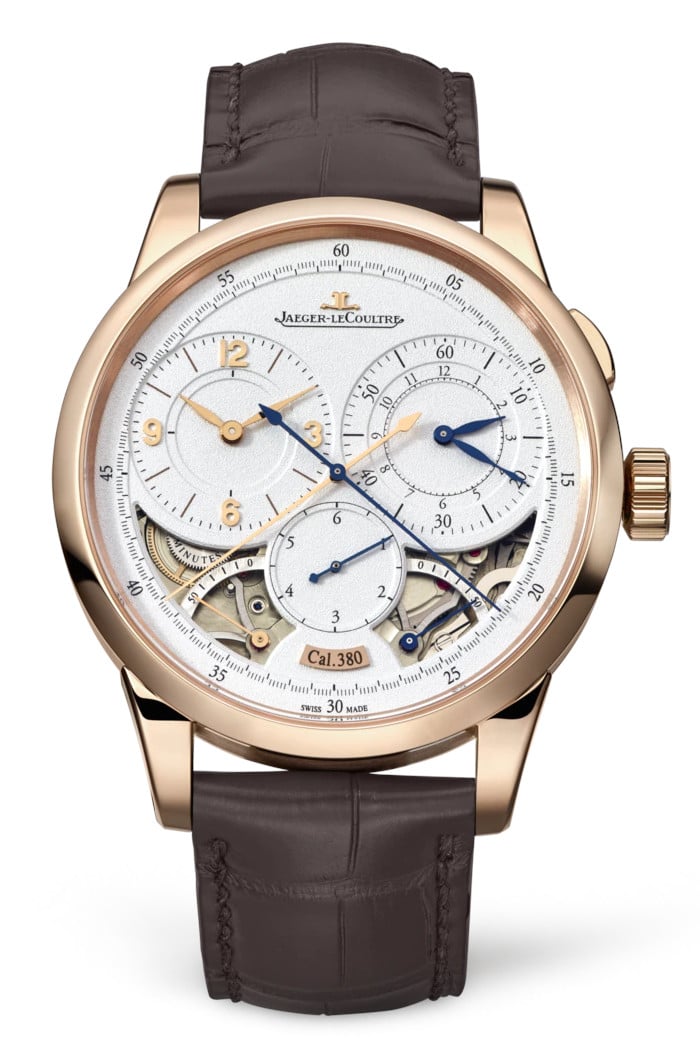
The chronograph complication, for all its sporting pretense, has always been a parasite. It leeches amplitude from the going train, dragging down precision the moment you start it. For nearly two centuries, watchmakers accepted this compromise. Then, in 2007, Jaeger-LeCoultre introduced the Duomètre Chronographe, a watch that didn't just refine the chronograph—it redefined its entire mechanical philosophy. The reference 601.14.20, cased in 18k pink gold with a silver-grained dial, remains the definitive expression of this radical Dual-Wing concept.
At the heart of the Duomètre lies the Calibre 380, a hand-wound movement with two entirely independent barrels and gear trains. One train is dedicated solely to the timekeeping functions (hours, minutes, seconds), while the other powers the chronograph and its mesmerizing jumping seconds (foudroyante) display. Both are regulated by a single escapement, ensuring perfect synchronization. The result is a chronograph that, when engaged, exerts zero influence on the watch's rate—a feat of micro-mechanical isolation that no traditional chronograph can match.
This reference 601.14.20, with its warm pink gold case and open-worked dial revealing the dual power reserves, is more than a tool for measuring elapsed time. It is a statement of horological independence. It wears with the quiet confidence of a watch that knows it has no peers, inviting the wearer to look beyond the surface and into a world where every lever, wheel, and bridge serves a purpose. This review dissects the architecture, the wrist experience, and the enduring value of a modern classic that remains as relevant today as it was at its debut.
The Grande Maison and the Birth of Duomètre
Founded in 1833 by Antoine LeCoultre in the Vallée de Joux, Jaeger-LeCoultre has earned its moniker "the watchmaker's watchmaker." With over 1,200 calibers to its name and a client list that has included Patek Philippe, Vacheron Constantin, and Audemars Piguet, JLC's horological DNA is unmatched. The Duomètre line, launched in 2007, represents the culmination of this expertise—a platform designed to showcase the Dual-Wing concept, where two independent power sources and gear trains share a single escapement. The Chronographe was the first model to demonstrate this principle, and it remains the purest expression of the idea.
Calibre 380: The Dual-Wing Engine
The Calibre 380 is a manual-wind movement comprising 47 jewels, beating at a leisurely 21,600 vibrations per hour (3 Hz). The frequency is a deliberate choice: it allows the jumping seconds hand at 6 o'clock to advance in crisp 1/6th-second increments, a direct visual readout of the escapement's rhythm. Each of the two mainspring barrels provides a 50-hour power reserve—one for the going train (hours, minutes, and small seconds at 10 o'clock), the other for the chronograph train (central seconds, 30-minute counter at 2 o'clock, and the foudroyante).
Winding is via a single crown: clockwise for the time barrel, counter-clockwise for the chronograph barrel. Two power reserve indicators sit on the dial, their hands moving in opposite directions as you wind. The movement architecture is a symphony of depth and symmetry, with bridges arranged to highlight the dual nature. Finishing is exemplary: Côtes de Genève on the bridges, perlage on the mainplate, hand-polished bevels, blued screws, and polished sinks. The chronograph is a mono-pusher design, with the single pusher at 2 o'clock starting, stopping, and resetting the function. There is no date, no GMT—just pure chronograph purity.
Technical Specifications
- Case Diameter: 42mm
- Case Thickness: 13.6mm
- Lug-to-Lug: 50mm
- Case Material: 18k pink gold
- Crystal: Sapphire, front and exhibition caseback
- Water Resistance: 50 meters
- Lume: None
- Strap: Brown alligator leather with 18k pink gold deployant clasp
On the Wrist
Despite its 42mm diameter and 13.6mm thickness, the Duomètre Chronographe wears with surprising elegance. The curved, tapering lugs hug the wrist, and the caseback sits flush without any awkward protrusion. The pink gold case adds a reassuring heft—around 120 grams on the strap—but the balance is impeccable. The alligator strap with JLC's deployant clasp secures the watch firmly, preventing it from sliding. It's a substantial presence that never feels cumbersome, suitable for a full day of wear under a shirt cuff, provided the cuff is not too tight.
The open-worked dial and the depth of the subdials create a three-dimensional landscape that constantly draws the eye. The crown and the single chronograph pusher at 2 o'clock are well-proportioned and easy to operate. Winding the two barrels via the single crown is a tactile pleasure, with distinct clicks and a smooth ratchet. The watch feels alive on the wrist, a direct connection to the intricate mechanics within.
Accuracy and Real-World Performance
Jaeger-LeCoultre's 1000 Hours Control certification demands a precision of -1 to +6 seconds per day in a fully cased watch, surpassing COSC standards. In real-world wear, the Calibre 380 typically runs within +2 to +4 seconds per day, with remarkable consistency whether the chronograph is running or not—a direct benefit of the Dual-Wing architecture. The 3 Hz beat rate is a deliberate choice, allowing the jumping seconds to display 1/6th-second intervals clearly. Expect no deviation when the chronograph is engaged, a unique characteristic that validates the entire concept.
Occasions and Versatility
The Duomètre Chronographe is best suited for dress, formal, and daily wear. Its pink gold case and leather strap lean formal, but the 42mm size and sporty chronograph function allow it to transition to smart-casual settings. It is not a sports watch—50m water resistance and no lume preclude swimming or rugged use—but it excels in boardrooms, dinners, and horological gatherings.
Wrist Presence: 4/5
The warm pink gold and multi-layered dial command attention without shouting. It's a conversation starter for those who notice, but never flashy. The 42mm size gives it modern wrist presence, while the classical finishing keeps it firmly in the realm of haute horlogerie.
Reference Variants
- 601.24.20: 18k white gold case, silver-grained dial, black alligator strap. Cooler tone, slightly more understated.
- 601.34.20: Platinum case, silver-grained dial, brown alligator strap. Limited production, significantly heavier and more exclusive.
Other Duomètre Models
- Duomètre à Quantième Lunaire (ref. 604.24.20)
- Duomètre Sphérotourbillon (ref. 605.25.20)
- Duomètre Unique Travel Time (ref. 606.35.20)
Other Notable JLC Watches
- Reverso Tribute Chronograph
- Master Ultra Thin Perpetual Calendar
- Polaris Chronograph
- Master Control Chronograph Calendar
Competitors and Alternatives
- A. Lange & Söhne Datograph Up/Down: Another hand-wound, in-house chronograph with a jumping minutes counter and exceptional finishing, but uses a traditional single-train architecture.
- Patek Philippe Ref. 5170 Chronograph: A classic manual chronograph with a vertical clutch, but lacks the dual-train isolation and foudroyante of the Duomètre.
- Vacheron Constantin Harmony Chronograph: A mono-pusher chronograph with a distinctive cushion case and in-house movement, offering a different aesthetic but similar horological pedigree.
Homages and Affordable Alternatives
Due to the extreme complexity of the Calibre 380, there are no direct homages. The closest affordable mechanical chronographs with a similar high-complication spirit come from Chinese brands like Sugess, but they lack the dual-wing architecture and are not true homages.
Investment and Value Retention
The reference 601.14.20 had an MSRP of approximately $48,000 when new. It is no longer in production, but pre-owned examples trade between $25,000 and $35,000 depending on condition and completeness. The trend is stable; values have softened from retail but have not plummeted. This is a connoisseur's piece, not a speculative asset. For the long-term collector, it represents a sound purchase with limited downside, especially given its unique mechanical proposition. Auction appearances are rare, with occasional sales in the $20,000-$30,000 range, reflecting steady but quiet demand.
Service and Maintenance
Jaeger-LeCoultre recommends a service interval of 5 years for the Duomètre Chronographe. Due to the dual-train complexity, servicing should be performed exclusively by JLC-authorized centers. The approximate cost is $1,200, and turnaround time can be 8-12 weeks. While not inexpensive, this is in line with other high-complication watches from the Holy Trinity.
Pros and Cons
Pros
- Revolutionary Dual-Wing architecture eliminates chronograph amplitude loss
- Mesmerizing jumping seconds display at 6 o'clock
- Exquisite hand-finishing throughout the movement
- Distinctive, multi-layered dial with dual power reserve indicators
- Wears comfortably despite substantial dimensions
Cons
- No lume, limiting legibility in low light
- 50m water resistance is modest for a sports-inclined chronograph
- Thickness of 13.6mm may not fit under all dress cuffs
- Service costs are high and require authorized centers
Final Verdict
The Jaeger-LeCoultre Duomètre Chronographe ref. 601.14.20 is not merely a chronograph; it is a manifesto. It solves a fundamental mechanical problem with elegance and precision, wrapping the solution in a case that balances classical warmth with modern presence. For the collector who values ingenuity over brand cachet, this watch offers an unmatched blend of technical storytelling and wearable luxury. It remains one of the most significant chronographs of the 21st century.