Introduction: A High-Complication JLC with a Market Problem
The Jaeger-LeCoultre Master Grande Tradition Tourbillon Jumping Date is a watch that demands attention from serious collectors. It combines two of horology's most revered complications: a tourbillon and a jumping date. Yet, like many high-complication pieces from JLC, it sits in a strange market position. It is technically impressive, beautifully finished, and limited in production, but it does not command the resale premiums of a Patek Philippe or a Rolex. For the discerning buyer, this is both an opportunity and a warning.
In this review, we will dissect the watch from a collector's perspective. We will examine its movement, its wearing experience, and most importantly, its investment potential. We will look at the demand cycle for high-complication JLCs and offer a hold-versus-sell judgment. If you are considering adding this piece to your collection, you need to understand what you are buying and what you are not.
The Master Grande Tradition line is JLC's showcase for traditional high watchmaking. It includes minute repeaters, perpetual calendars, and tourbillons. The Tourbillon Jumping Date is a relatively recent addition, and it is limited to a small number of pieces. This rarity adds to its appeal, but it does not guarantee liquidity. In the world of watch collecting, rarity is only valuable if there is demand. And demand for JLC high complications is niche.
Manufacture History: A Legacy of Complications
Jaeger-LeCoultre was founded in 1833 in Le Sentier, Switzerland. The brand has a long history of innovation, having produced over 1,200 calibers and supplied movements to many of the world's most prestigious watchmakers, including Patek Philippe and Vacheron Constantin. The Master Grande Tradition line was introduced in the 2000s as a tribute to the brand's heritage of high complications.
JLC is often called the watchmaker's watchmaker because of its expertise in movement design and finishing. The Master Grande Tradition Tourbillon Jumping Date is a perfect example of this expertise. It combines a tourbillon, a jumping date, and a power reserve indicator in a single, manually wound movement. The brand's ability to produce such complex movements in-house is a testament to its capabilities.
However, JLC's brand positioning is different from that of Patek Philippe or Rolex. It is more of an insider's brand, appreciated by those who know watchmaking. This means that while the watches are highly regarded by enthusiasts, they do not have the same broad appeal or brand recognition. This affects resale value, as the pool of potential buyers is smaller.
The Complication: Tourbillon and Jumping Date
The tourbillon is a device that rotates the balance wheel and escapement in a cage, averaging out positional errors. In modern watchmaking, it is more of a demonstration of craftsmanship than a practical accuracy enhancer. The jumping date, on the other hand, is a practical complication that snaps the date forward instantaneously at midnight, rather than gradually. This requires a significant amount of energy to be stored and released in an instant, which is why jumping dates are often found in high-end movements.
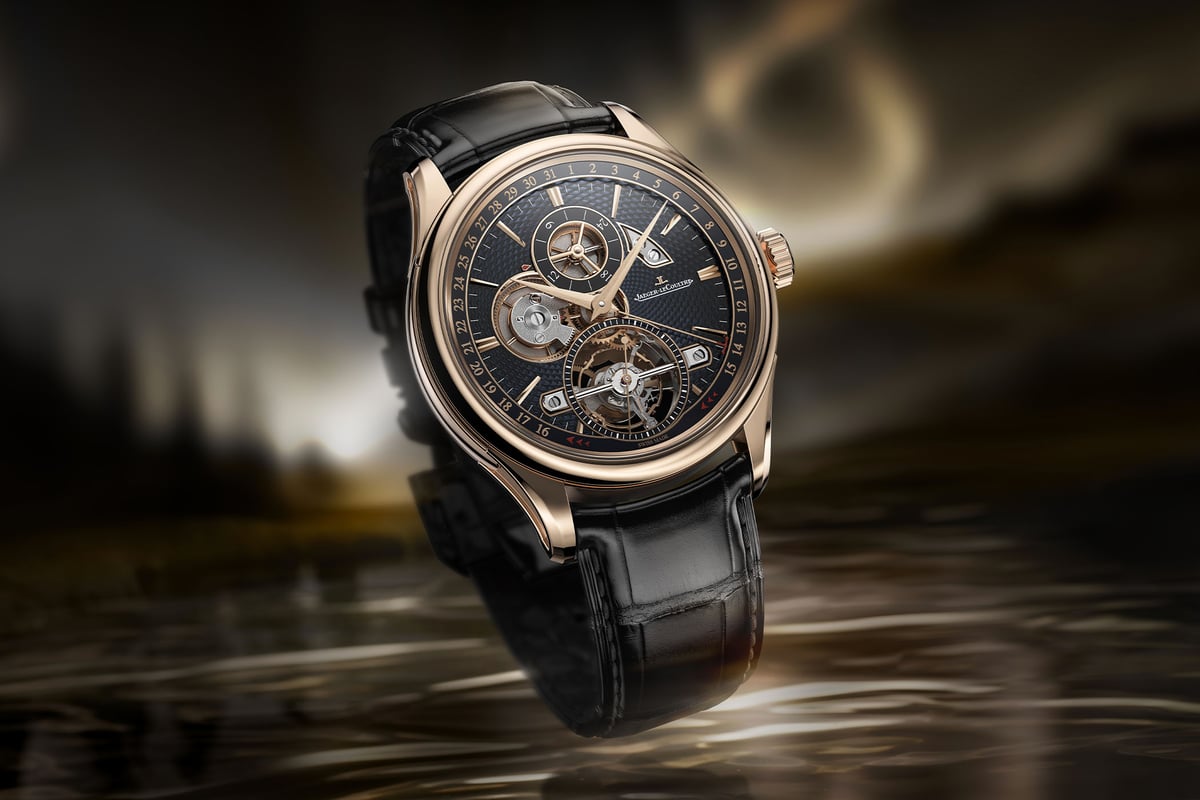
Combining these two complications is not trivial. The tourbillon consumes energy, and the jumping date requires a burst of power. JLC's solution is the Caliber 987, a manually wound movement that manages both. The date is displayed in a large aperture at 12 o'clock, and the tourbillon is visible at 6 o'clock. The layout is symmetrical and elegant, a hallmark of the Master Grande Tradition line.
The jumping date mechanism is particularly interesting. It uses a star wheel and a spring-loaded lever to snap the date disc forward. The date disc itself is large, and the aperture is framed by a gold bezel. The mechanism is designed to be reliable and precise, but it is also delicate. You should avoid changing the date manually during certain hours (typically between 8 PM and 3 AM) to prevent damage to the gears. This is a common precaution for any watch with a date complication, but it is especially important for a jumping date.
Movement: Caliber 987
The Caliber 987 is a manually wound tourbillon movement with a jumping date. It has a power reserve of 48 hours and beats at 28,800 vibrations per hour. The movement is finished to a high standard, with hand-applied bridges, polished bevels, and a classic tourbillon cage. It is not COSC-certified, but that is not the point. This movement is about artistry and tradition.
One of the interesting aspects of the Caliber 987 is the jumping date mechanism. It uses a star wheel and a spring-loaded lever to snap the date disc forward. The date disc itself is large, and the aperture is framed by a gold bezel. The tourbillon is a traditional flying tourbillon, meaning it is cantilevered from one side, which allows for a more unobstructed view. The finishing on the tourbillon bridge is particularly noteworthy, with anglage and polishing that rival the best in the industry.
The movement is manually wound, which means you need to wind it every day or every other day to keep it running. The power reserve indicator on the dial (if present) helps you keep track. The winding action is smooth, and the crown is easy to grip. The movement is visible through the sapphire caseback, allowing you to admire the finishing and the tourbillon in action.
Design and Wearability
The Master Grande Tradition Tourbillon Jumping Date is cased in pink gold. The case is substantial but well-proportioned, with curved lugs that hug the wrist. The dial is silvered opaline, with a large date aperture at 12 o'clock and a tourbillon at 6 o'clock. The hands are elegant, and the markers are applied gold. The overall look is classic and refined, not overly sporty or flashy.
On the wrist, the watch feels substantial due to the gold case, but it is not uncomfortable. The curved lugs help it sit well on a variety of wrist sizes. The leather strap is supple and complements the formal nature of the watch. This is not a daily beater; it is a dress watch for special occasions. It pairs well with a suit or a tuxedo, but it would look out of place with casual attire.
The watch is not water-resistant to any significant degree, so you should not wear it while swimming or showering. There is no lume, so it is not a nighttime companion. The deployant clasp is secure and comfortable, a small but important detail for a watch at this price point. The case finishing is excellent, with a mix of polished and brushed surfaces that catch the light beautifully.
The dial is a study in symmetry. The large date at 12 and the tourbillon at 6 create a vertical axis that is pleasing to the eye. The power reserve indicator, if present, is discreetly placed. The hands are dauphine-style, and they are polished to a high shine. The applied markers are faceted, adding depth to the dial. Overall, the design is elegant and understated, which is typical of JLC's high complications.
Accuracy and Reliability
Tourbillon movements are not inherently more accurate in everyday wear. The rotation of the tourbillon averages out positional errors, but the effect is minimal in a wristwatch. Expect accuracy within a few seconds per day, but do not expect quartz-like precision. JLC does not COSC-certify this model, so the accuracy is more about the quality of the movement and the adjustment at the factory.
Reliability should be good, but high-complication movements require regular servicing. JLC recommends service every few years, and the cost can be significant. The tourbillon and jumping date mechanisms are delicate, so you should avoid shocks and magnetic fields. This is a watch that requires care and attention.
In terms of daily wear, the watch is not designed for active lifestyles. It is a dress watch, and it should be treated as such. If you wear it regularly, you should have it serviced every 5-7 years, depending on usage. The service cost for a high-complication JLC can be several thousand dollars, so you should factor that into the ownership cost.
Investment Value: The Real Story
Now we come to the most important part for serious collectors: the investment value. The Jaeger-LeCoultre Master Grande Tradition Tourbillon Jumping Date is a limited edition, but that does not automatically make it valuable. The secondary market for high-complication JLCs is soft. While the brand has a strong reputation among enthusiasts, it does not have the same resale power as Patek Philippe, Rolex, or Audemars Piguet.
The MSRP for this watch is not publicly disclosed, but it is likely in the $100,000-$150,000 range. On the pre-owned market, these pieces typically trade at a significant discount. We have seen similar JLC high complications trade for 50-60% of retail. This means that if you buy at retail, you should expect to lose money if you sell. The trend is depreciating, and there is no major auction history to suggest otherwise.
Our hold recommendation is simple: hold only if you love the watch. If you are buying for investment, look elsewhere. The value in this watch is in the craftsmanship, the complication, and the joy of wearing it. It is not a financial asset.
That said, there is a case for buying pre-owned. If you can find one at a significant discount, you may be able to enjoy the watch without suffering the full depreciation. The limited edition status may provide some floor, but do not expect it to appreciate. JLC high complications are not known for strong auction results. They are collector's pieces, not investment vehicles.
Alternatives
If you are looking for a high-complication tourbillon with better resale, consider the Patek Philippe Grand Complications 5316, the A. Lange & Söhne Tourbograph Perpetual, or the Vacheron Constantin Traditionnelle Tourbillon. These watches offer similar or greater complications and have stronger secondary market performance. However, they are also more expensive.
If you are looking for a more affordable alternative, there are no direct homages to this watch. The combination of a tourbillon and a jumping date is rare, and no budget brand offers a true homage. You could consider a simple tourbillon from a Chinese brand, but it will not have the same level of finishing or the jumping date complication.
Within JLC's own lineup, you could consider the Master Grande Tradition Tourbillon Cylindrique à Quantième Perpétuel. It is a more complicated watch with a perpetual calendar, but it also depreciates. The Master Control line offers more affordable options, but they lack the high-complication cachet.
Final Verdict
The Jaeger-LeCoultre Master Grande Tradition Tourbillon Jumping Date is a beautiful piece of high horology. It is technically impressive, beautifully finished, and limited in production. However, it is not an investment. The secondary market is soft, and the depreciation is significant. Buy it if you appreciate the craftsmanship and want a tourbillon with a jumping date from a respected maison. Do not buy it expecting to make money.
For the sophisticated young collector, this watch represents a chance to own a high complication at a relatively accessible price on the secondary market. If you can find one pre-owned at a good price, it is a wonderful addition to a collection. Just be aware of the service costs and the lack of liquidity. In the end, the Master Grande Tradition Tourbillon Jumping Date is a watch for the heart, not the portfolio.