Jaquet Droz is a house that has always understood the theatrical value of a dial. Its Grande Seconde is one of the most recognizable layouts in modern watchmaking: two intersecting subdials, hours and minutes at twelve, a large seconds display at six, all arranged in a figure-eight that feels less like decoration than a piece of Enlightenment geometry. The Grande Seconde Skelet Sapphire takes that figure-eight and removes the scenery.
This is not the first skeletonized Grande Seconde, but the sapphire-dial version is the most transparent. The movement becomes the dial; the sapphire becomes a lens rather than a surface. The result is a dress watch that asks to be read closely, not from across a room. It is technical, precious, and slightly eccentric, which is exactly where Jaquet Droz tends to be at its best.
The Figure-Eight, Opened Up
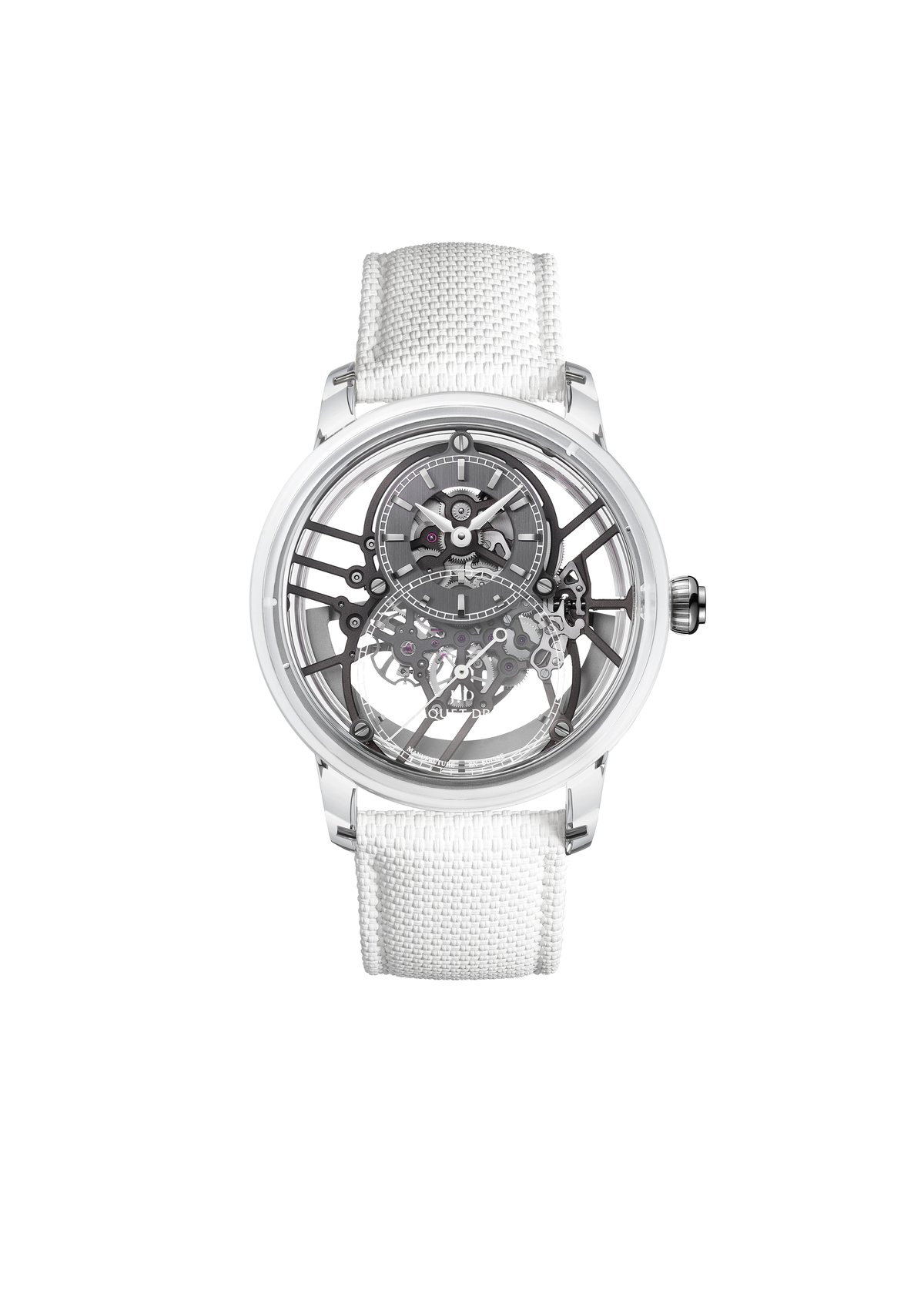
The Grande Seconde has always been a watch about proportion. The upper subdial is smaller, the lower seconds display larger, and the two are linked by a bridge of dial surface that gives the design its distinctive silhouette. When you skeletonize a watch like this, the risk is that the figure-eight disappears into a tangle of wheels and bridges. Jaquet Droz avoids that by keeping the sapphire dial as a organizing layer.
The sapphire is not printed with a full conventional dial. Instead, it frames the movement and carries the essential indications, so the eye still reads the hours and minutes in the upper register and the seconds in the lower. The calibre is visible through the sapphire, but the watch does not become a pure display piece. There is still a dial architecture, still a hierarchy. That is the difference between skeletonization as a technique and skeletonization as a gimmick.
In person, the effect is layered. The sapphire has a faint presence of its own, a reflection that reminds you it is there, while the movement below sits in shadow and light. The figure-eight remains legible because the bridge work follows the layout rather than fighting it. Jaquet Droz has opened the watch without turning it into a machine shop.
Movement and Finishing
The engine is the Jaquet Droz Cal. 2663 SQ, an automatic skeletonized calibre with a 68-hour power reserve and a frequency of 28,800 vibrations per hour. The SQ designation signals the skeletonized treatment, and the movement is built around the Grande Seconde's unusual display: a conventional going train driving the hours and minutes, and a separate large seconds train at six o'clock.
The architecture is the attraction here. The bridges have been opened and beveled, the mainplate reduced, and the going train left visible without becoming chaotic. Finishing is traditional rather than industrial: circular graining on the bridges, polished chamfers, blued screws, and a balance that is allowed to breathe under the sapphire. The skeletonization does not feel applied after the fact; it feels like a deliberate reduction of material to reveal the calibre's structure.
Because this is an automatic watch with a 68-hour reserve, it is practical in a way that many skeletonized dress watches are not. You can take it off on Friday and pick it up on Monday without resetting it. The winding action is smooth, and the rotor is visible through the caseback, though the front of the watch is where the real show is. Jaquet Droz has not chased extreme thinness or high-frequency performance here; it has built a movement that suits the Grande Seconde's relaxed, formal character.
Case, Dial, and Wrist Feel
The case is rendered in 18k gold, which gives the watch the density and warmth you expect from a precious-metal dress piece. The profile is rounded rather than sharply sculpted, and the lugs are short enough that the watch sits close to the wrist. There is no lume, no rotating bezel, and no sport-watch hardware. This is a watch that relies on finish and proportion rather than utility.
The sapphire dial is the defining element. It adds visual width because the eye can see through to the movement, and the gold case around it frames the transparency like a display case. On the wrist, the watch reads larger than a closed-dial dress watch, but not in a bulky way. It has presence because of the depth of the dial, not because of its footprint. Under a shirt cuff, it slips into place without the awkwardness of a thicker sports watch.
The alligator leather strap is the right pairing. It is formal, comfortable after a short break-in period, and it keeps the watch from feeling like a piece of jewelry. The pin buckle suits the traditional character of the Grande Seconde, though a deployant clasp would be a sensible option for daily wear. Because there is no lume and no meaningful water resistance specified for this reference, the Skelet Sapphire is a fair-weather watch. It is not the piece you wear to the beach, but it is perfectly at home in an office, a gallery, or a dinner.
Living With It
Day-to-day, the watch asks for a little attention. The gold case will pick up hairlines, the sapphire dial will show fingerprints if you handle it carelessly, and the leather strap will need to be kept away from water. In exchange, you get a dial that changes with the light. The skeletonized movement is not a static pattern; the balance moves, the light catches the bevels, and the sapphire adds a layer of reflection that makes the watch feel different at different angles.
Accuracy is not the headline here. Jaquet Droz does not submit this calibre for COSC certification, so there is no chronometer certificate to quote. A well-regulated modern automatic of this type should run within a handful of seconds per day in normal wear, with the usual variations from position and temperature. The 68-hour power reserve is the more relevant daily feature: it makes the watch easy to rotate and forgiving of a weekend in the box.
Service should be handled through Jaquet Droz or an authorized Swatch Group service center. The skeletonized components and the specific sapphire dial mean independent watchmakers may not have the parts or the documentation to work on it properly. Service intervals vary with wear, but a precious-metal automatic with a skeletonized movement is not a watch to treat casually. Budget for authorized care when the time comes.
Value and Collecting
The Grande Seconde Skelet Sapphire is not a liquidity play. Jaquet Droz has a dedicated collector base, but it is not a brand that behaves like a auction-house darling, and the Skelet Sapphire is unlikely to appreciate like a steel sports watch. Its value is in the design, the in-house movement, and the fact that it offers something different from the usual skeletonized dress watches. The sapphire dial and the figure-eight layout give it a distinct identity, and that identity is worth paying for if it speaks to you.
On the secondary market, examples are not widely traded, so pricing tends to be boutique-dependent and condition-sensitive. The trend is stable rather than exciting. That is not a criticism; it is simply the reality of a connoisseur's brand. Buy it because you want to wear it, not because you want to flip it. The hold recommendation is straightforward: this is a long-term keeper for someone who values mechanical transparency and classical proportions over hype.
Verdict
The Grande Seconde Skelet Sapphire is one of the most successful expressions of Jaquet Droz's core idea: the figure-eight as a frame for mechanical transparency. It is not a watch for every day of every life, but it is a superb formal piece for collectors who want a movement they can study without losing the elegance of a dress watch. The sapphire dial keeps the design legible, the in-house calibre provides real technical interest, and the gold case gives it the weight and warmth of a proper precious-metal object.
It is not inexpensive, and it is not an investment in the financial sense. It is an investment in the pleasure of looking at a watch closely. For the right collector, that is enough.