The serpent as a complication
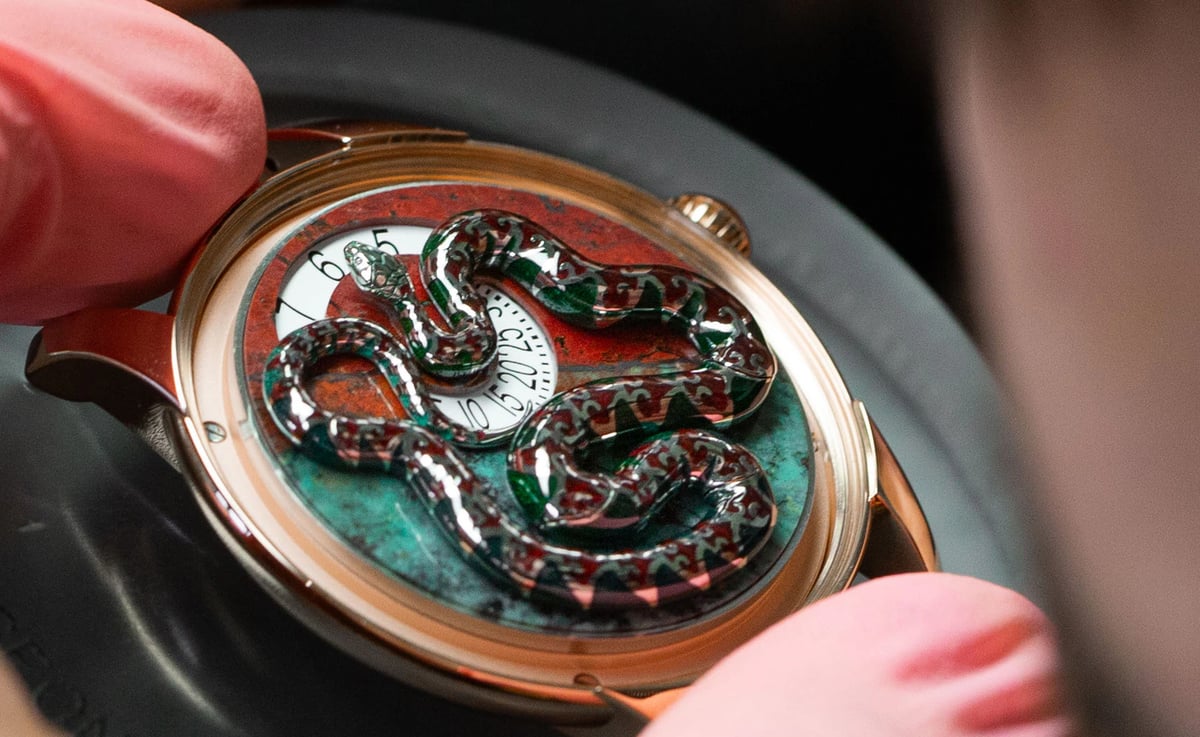
Snakes have a long run in jewelry and watch design because they are almost too easy to read. They suggest eternity, danger, renewal, and glamour at the same time. The risk is that the snake becomes a sticker — a motif applied to a dial and sold as mythology. Jaquet Droz avoids that trap by making the serpent structural. The Ophidian Hour is organized around the animal, not decorated with it after the fact.
That is where the automaton language matters. Jaquet Droz built its reputation on figures that move, and the Ophidian Hour belongs to that lineage. The watch is not simply a static picture of a snake on a dark dial. It is a piece of mechanical theater, and the snake is the performer. When the animation is activated, the dial changes from an image into a scene. That shift — from looking at a watch to watching a watch — is the whole point.
The design also keeps the watch on the formal side of luxury. This is not a sports watch with a snake slapped on it. The precious case, the dark dial, and the leather strap push it toward evening wear and private-collection display. It has more in common with a jeweled object than with a tool watch, and that is exactly how it should be judged.
Jaquet Droz and the automaton inheritance
Pierre Jaquet-Droz founded the house in 1738 in La Chaux-de-Fonds, and its earliest fame came from automata as much as from watches. The writer, the draughtsman, and the musician were not side projects; they were proof that a workshop could make mechanism feel almost alive. Modern Jaquet Droz still trades on that inheritance, even when it is making a Grande Seconde or a Petite Heure Minute rather than a full animated tableau.
The Ophidian Hour makes that inheritance explicit. It is a late chapter in the brand’s automaton story, and it should be read in that context rather than as a random unique piece. Jaquet Droz is one of the few houses where a snake automaton is not a marketing stretch. The brand has spent centuries turning small mechanical gestures into spectacle, and the Ophidian Hour is a concentrated version of that idea.
That history also explains why the watch feels more like an object than a product. A unique piece from a house with automaton DNA carries a different kind of weight than a limited-edition colorway from a brand that otherwise makes steel chronographs. The Ophidian Hour is not trying to fit into a catalog. It is trying to become a footnote in a much older story.
Movement and mechanics
The Ophidian Hour runs on an automatic Jaquet Droz caliber, with the 2653 family providing the base architecture. The movement offers a power reserve of around 68 hours and beats at 28,800 vibrations per hour, which is the modern luxury baseline rather than a headline. The important number is not the frequency; it is the fact that the automaton has to coexist with reliable timekeeping.
Jaquet Droz finishes its movements to house standards, with attention to bridges, anglage, and the visual quality of the back. This is not a movement designed to win a chronometry contest. It is a movement designed to support the object. The Ophidian Hour is not COSC-certified, and that is fine. A collector who buys this watch is buying the serpent, the case, the dial, and the mechanical gesture. The rate is part of the package, not the reason for the purchase.
The automaton is the real complication here. It adds a layer of mechanical complexity that most watches never attempt, and it changes the ownership experience. You do not just wear the Ophidian Hour; you activate it. You show it. You explain it. That interactive quality is rare in modern watchmaking, where so much of the experience has been reduced to a wrist shot and a spec sheet.
Case, dial, and wrist feel
The Ophidian Hour is built in precious metal, with an 18k white gold case that gives it a cool, jewel-like presence. The dark onyx dial sets off the serpent motif and makes the animation read clearly. The strap is leather, which is the right choice for a piece this formal; a bracelet would turn the watch into a different object, and probably a less successful one. The clasp is a pin buckle, keeping the profile traditional.
On the wrist, the watch wears like jewelry with a secret. The precious case has real weight, but it does not feel clumsy; the leather strap keeps the package close to the arm, and the overall impression is one of ceremony rather than sport. The serpent motif makes the watch feel sculptural, and the automaton adds a second layer of presence when it is activated. This is not a piece you forget you are wearing. That is the point.
The best high-jewelry watches have a physical confidence that comes from material and proportion, not from bulk alone. The Ophidian Hour asks to be worn with a clean cuff and a little ceremony. It is a dinner watch, a collector’s watch, a watch for the moment when someone asks what is on your wrist. It does not need to be a daily driver, and it should not be judged as one.
Accuracy and ownership
Jaquet Droz does not position the Ophidian Hour as a chronometer, and buyers should not expect chronometer-style obsession. Expect automatic-watch accuracy in the range of a few seconds per day, with real-world variation depending on wear and position. For a unique automaton piece, rate is secondary. Condition, function, and service history matter far more.
Ownership is where the watch becomes serious. A unique piece with an automaton should be serviced by Jaquet Droz or an authorized specialist who understands the mechanism. A generalist watchmaker may be able to regulate an automatic movement, but the animation is not a place for improvisation. Insurance and secure storage are part of the cost of ownership, and a collector should budget for both.
This is also not a watch for a locker room or a beach holiday. There is no lume, and the water resistance is not the point. The Ophidian Hour belongs to the formal side of life: dinners, gallery openings, private viewings, the kind of evening where a watch is allowed to be an object rather than a tool.
Occasions and presence
The Ophidian Hour is a formal and dress watch first. It works with a suit, a tuxedo, or a dark knit, and it has enough visual authority to carry a room without being loud in the way a diamond-set sports watch can be. Its presence is high — five out of five — because it is a unique high-jewelry object with a moving serpent. That is not a subtle watch, and it should not pretend to be.
The best way to wear it is to let it be the only statement. Clean tailoring, a simple cuff, and no competing jewelry. The snake is already a strong sign; adding more noise would flatten the effect. This is a watch for collectors who understand that restraint makes spectacle more powerful.
Market, value, and the auction question
The Ophidian Hour is a unique piece, which means the usual market metrics do not apply. There is no public MSRP, no current retail price, and no meaningful pre-owned range because there is no steady supply. Price is by negotiation. That makes it a collector’s object rather than a liquid asset. If you buy it, buy it because you want to live with it, not because you plan to flip it.
Unique high-jewelry automata can hold cultural value, but they are illiquid. The buyer pool is narrow, and the watch’s value depends on provenance, condition, and the strength of the Jaquet Droz name in that specific collector’s mind. There is no major public auction history for this reference, and that is normal for a one-off piece. Charity auctions and private sales may exist, but they are not a reliable pricing benchmark.
The hold recommendation is simple: buy for the collection, not for the trade. The Ophidian Hour is the kind of watch that makes a collection feel less generic. It is not the foundation of a portfolio, but it can be the piece that gives a portfolio a personality.
Similar watches and the homage question
The closest cultural cousin is the Bulgari Serpenti, which uses the same serpent sign but treats it as jewelry first and mechanics second. Van Cleef & Arpels offers a different model of automaton storytelling with pieces like the Lady Arpels Pont des Amoureux, where the mechanism creates a romantic scene rather than an animal. Cartier’s Panthère Joueuse does something similar with a different animal, turning jewelry-house craft into a moving tableau.
There is no meaningful affordable homage to the Ophidian Hour. Plenty of fashion watches use a snake motif, but they copy the symbol, not the craft. The Ophidian Hour is a one-off high-jewelry automaton; a two-hundred-dollar watch with a snake on the dial is not an alternative, it is a different product category. Collectors should be honest about that gap.
Final verdict
The Jaquet Droz Ophidian Hour is not the right first serious watch, and it is not trying to be. It is a one-off piece for collectors who want Jaquet Droz’s automaton heritage on the wrist, wrapped in a serpent that makes time feel theatrical. It is expensive, illiquid, and impractical in the way that all good collector objects are impractical.
But it is also memorable. In a market full of steel sports watches and limited-edition colorways, the Ophidian Hour does something rarer: it makes a watch feel like a cultural object. Buy it for the object; the market can take care of itself.