Jaquet Droz has been in the business of wonder since the 18th century, when Pierre Jaquet-Droz built androids that could write, draw and play music for European courts. The modern brand, part of the Swatch Group, has spent the past decade translating that heritage into wristwatches. The Automates collection is the purest expression of it, and the Parrot Repeater is one of its most complete statements: a chiming complication layered with an animated scene, executed at a level of hand-finishing that borders on decorative art.
This is not a watch you evaluate on daily-rate stability or lug geometry. It is a piece you evaluate on craft, rarity and emotional impact — and on those terms it is one of the most compelling objects in contemporary haute horlogerie. Here is what a discerning collector needs to know before chasing one.
The house that built automata
Pierre Jaquet-Droz founded his workshop in 1738 in La Chaux-de-Fonds, and his name became synonymous with a very particular kind of mechanical ambition. His automata — the Writer, the Draughtsman and the Musician — were touring sensations in the 18th century, convincing courts across Europe that Swiss mechanics could approximate life itself. That lineage matters here, because the Parrot Repeater is not a marketing exercise in heritage. It is a direct descendant of that obsession: a mechanism whose primary job is to delight.
Under Swatch Group ownership, Jaquet Droz has leaned into that identity rather than fighting it. While sister brands chase sports watches and steel integrated bracelets, Jaquet Droz builds enamelled dials, animated scenes and chiming complications for a collector who wants something nobody else at the table is wearing. The Automates line, introduced in the 2010s, is the culmination: a series of limited pieces where automatons and repeaters share a single case.
A jungle painted in enamel
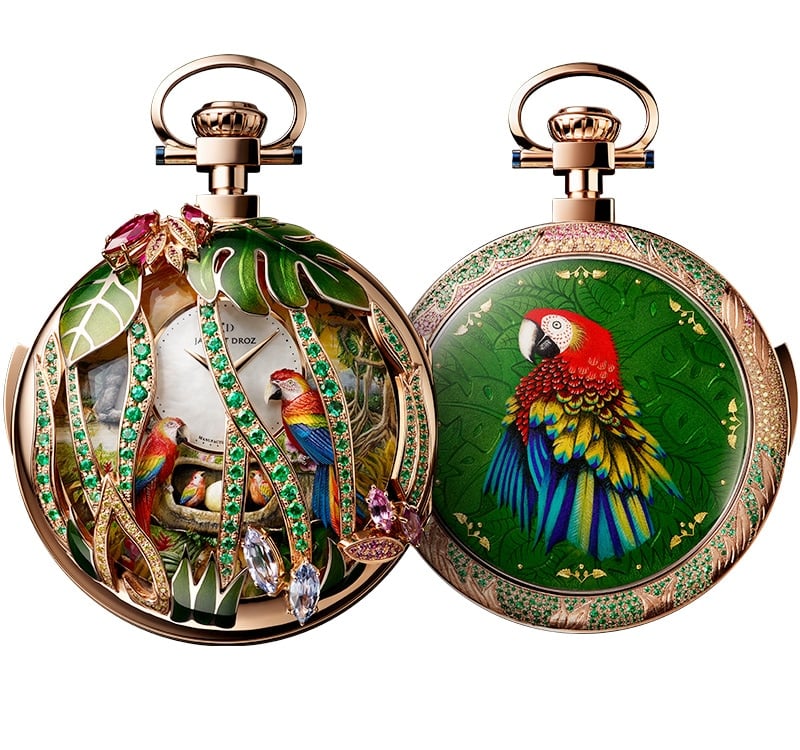
The first thing that stops people is the dial. Jaquet Droz works with grand feu enamel — fired at high temperature, layered and hand-painted — and the Parrot Repeater uses that technique to build a small tropical world. The palette is rich and saturated in a way that printed dials simply cannot replicate, and because each dial is painted by hand, no two examples are identical. That matters more than it sounds: at this price point, uniqueness is part of the product.
Then the automaton engages. When the repeater is activated, the scene comes alive — parrots move, foliage shifts, and the whole composition becomes kinetic for the duration of the chime. It is a deliberately brief performance, and that brevity is the point. You do not buy this watch to watch it constantly; you buy it for the moment you show someone.
The case is executed in gold, with a sapphire crystal over the dial and a hand-stitched leather strap. There is no lume, no sports pretence and no attempt to be versatile. Jaquet Droz has made a decorative object and been honest about it, which is more than most high jewellery watchmakers manage.
The repeater underneath
A minute repeater is one of the hardest complications to execute well. It requires rack-and-snail gearing to read the time, a pair of gongs to strike it, and hammers tuned so the hours, quarters and minutes are audibly distinct. Add an automaton and you are asking a single movement to do two very different jobs — one acoustic, one visual — without compromising either.
Jaquet Droz solves this with a hand-wound calibre designed specifically for the Automates line, in which the automaton runs on its own gear train layered onto the repeater architecture. The result is a movement that is as much a piece of mechanical sculpture as a timekeeper, and one that demands specialist attention over its life. This is not a calibre that any competent watchmaker can service; the automaton alone puts it in a different category.
The acoustic character is the part collectors argue about. Repeaters are judged on volume, clarity and the quality of the tone — whether the strike is pure and sustained or thin and metallic. Jaquet Droz tunes its repeaters to be heard clearly in a quiet room rather than to project across a dinner table, which is the correct choice for a watch like this. You will not mistake it for a Patek Philippe Grand Complication, but you will not be disappointed either.
Notably, Jaquet Droz does not pursue chronometer certification on these pieces. That is a deliberate statement of priorities: this watch is judged on craft, not on seconds per day.
On the wrist
The Parrot Repeater wears like what it is: a substantial gold object with a domed, decorative dial and a case built to house an automaton. It does not disappear on the wrist, and it is not meant to. The weight is present and reassuring, the strap softens with wear, and the balance point sits close to the wrist rather than tipping forward. This is a watch you feel — and that is part of the appeal.
Comfort is genuinely good for a piece of this nature, but context matters. It is a dress-coded object, happiest under a cuff or paired with knitwear on a cold evening. It is not a watch to wear through a gym session or a beach day. Water resistance is not the point here; treat it as you would any enamelled, chiming object and keep it away from water. The automaton and repeater deserve a reasonably careful owner.
Presence is off the charts. A five out of five, without hesitation. The enamel scene and animated parrots are a conversation-ending flex in any room, and the sound gives it a second dimension that no amount of case finishing can match. Once this watch chimes at a table, nobody notices anything else on anyone's wrist.
Accuracy and ownership
Jaquet Droz does not position the Parrot Repeater as a chronometer, and there is no COSC certification. Expect hand-wound mechanical behaviour: a few seconds of daily variation, sensitive to how consistently you wind it and how often you trigger the repeater, which draws energy from the mainspring. Realistically, buyers of this watch are not timing trains by it. The measure of quality is the crispness of the chime, the smoothness of the automaton and the finish under a loupe.
Ownership is a relationship rather than a transaction. Service should go back to Jaquet Droz or an authorised specialist centre — a generalist watchmaker should not touch the animated mechanism, and the repeater itself requires someone who understands gongs and hammers. Plan for a considered, occasional service rather than an annual ritual, and budget for the fact that automaton work adds complexity and cost.
Price, rarity and the collector's math
The Parrot Repeater sits in six-figure territory — indicative pricing lands somewhere in the high hundreds of thousands of dollars, and examples are scarce enough that any figure should be treated as a starting point rather than a rule. Jaquet Droz produces these pieces in very small series, and they rarely surface on the secondary market, which means the usual price-discovery mechanisms barely apply.
Is it an investment? Be honest with yourself. Limited-production automaton repeaters from major houses have historically held value rather than multiplied. The scarcity is real, but the buyer pool is narrow: you need someone who wants a chiming automaton specifically, and those collectors are few. Buy it because you want to live with it, not because you expect it to fund a retirement. Compared with a steel sports watch, the liquidity is poor; compared with other high jewellery objects, it is actually reasonable.
There is no meaningful auction history to point to for this reference, and comparable Jaquet Droz automata trade infrequently and often privately. If you are offered one, provenance and condition of the enamel matter enormously — a repainted dial is a permanently damaged dial, and the automaton should be demonstrated in person before any money changes hands.
What else is out there
The honest comparison set is small. Ulysse Nardin's Hannibal Minute Repeater is another theatrical automaton repeater from a house with a taste for mechanical spectacle, and it appeals to the same buyer. Christophe Claret's Margot builds automaton watchmaking around a single romantic gesture rather than a full scene — a different flavour of the same idea. And Vacheron Constantin's Les Cabinotiers minute repeaters offer the restrained, ultra-refined alternative for collectors who want the chime without the theatre.
There is no credible homage, and that is worth saying plainly. The automaton repeater niche is far too specialised to be copied affordably; buyers chasing the look settle for enamel-dial dress watches instead. That absence is part of what protects the Parrot Repeater's distinctiveness.
Verdict
The Parrot Repeater is Jaquet Droz at full voice: a minute repeater that performs a painted jungle scene rather than merely chiming the time. It is impractical, expensive and almost impossible to find — and that is precisely the point. For a collector who already owns the safe bets, this is the piece that makes a collection feel alive.
If you want a do-everything watch, walk away now. If you want an object that stops conversations, rewards a careful owner and carries a genuine line back to the 18th-century automata that made this house famous, there is very little else like it.