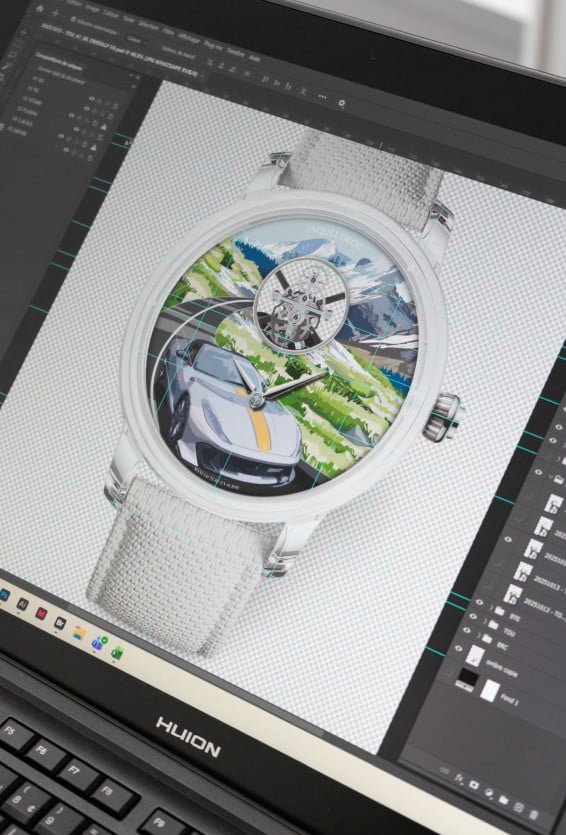
There are tourbillons that shout and tourbillons that whisper. The Jaquet Droz Tourbillon Plasma Ceramic belongs to the second camp, but it does not whisper in the usual precious-metal register. It whispers in ceramic. That is the first thing to understand about this watch: the material is not a gimmick, and it is not a colorway. It is a whole attitude. Plasma ceramic gives the tourbillon a mineral, almost couture-like surface that feels closer to contemporary art than to the gilded dress watches that usually house a flying tourbillon.
Jaquet Droz has always been a maison of theatre and restraint at the same time. Its historic automata were engineered marvels disguised as poetry. Its modern Grande Seconde is one of the cleanest layouts in luxury watchmaking. The Tourbillon Plasma Ceramic continues that tension: a serious seven-day automatic tourbillon inside a case material that feels more like a material study than a conventional dress watch. The result is niche, expensive, and deeply specific. It is the kind of watch that rewards a collector who knows why they want it.
The brief: a tourbillon in a mineral shell
Most tourbillons at this level are exercises in tradition. They come in gold, they sit on alligator, and they lean on enamel, guilloche, or hand-engraving to make their case for craft. The Jaquet Droz Tourbillon Plasma Ceramic does not abandon craft, but it changes the conversation. The ceramic case makes the watch feel more contemporary. The tourbillon keeps it mechanically serious. The combination is unusual enough that it does not really compete with a Breguet Classique or a Patek Philippe dress tourbillon. It competes with the collector's desire for something that does not look like everything else in the safe.
Plasma ceramic is the headline, but the watch is not only a material story. The open tourbillon is the visual anchor. The dial architecture lets the regulating organ breathe, and the case material frames it like a small mechanical theatre. This is a watch that wants to be looked at closely, not scanned from across a room. It is also a reminder that Jaquet Droz, for all its historical automata, is still capable of making a modern object with a strong point of view.
Brand context: 1738, automata, and the modern tourbillon
Jaquet Droz was founded in 1738 by Pierre Jaquet-Droz, and its early reputation was built on automata, enamel, and mechanical spectacle. The maison's historical writing automata are among the most famous mechanical objects in horological history. That heritage matters here because it explains why Jaquet Droz can get away with a tourbillon that feels a little theatrical. The brand has always been comfortable with the idea that a watch can be both a machine and a performance.
In its modern form, under the Swatch Group, Jaquet Droz has focused on the Grande Seconde, the Petite Heure Minute, and a series of high-complication pieces including tourbillons and automata. The Tourbillon Plasma Ceramic sits at the more experimental end of that range. It is not the volume-selling Grande Seconde. It is a collector-facing object with a material twist, and that is exactly where Jaquet Droz tends to be most interesting. The brand is at its best when it is not trying to be a generic luxury watchmaker.
Movement: Caliber 25JD and the seven-day argument
The heart of the Tourbillon Plasma Ceramic is the Jaquet Droz Caliber 25JD, an automatic flying-tourbillon movement with a seven-day power reserve. That is a serious piece of engineering. A seven-day automatic tourbillon is not a simple thing to package, and the long reserve changes the ownership experience. You can put the watch down for a week and come back to a running movement, which is more than can be said for many high-complication dress watches.
The 25JD is an in-house caliber, and its architecture puts the tourbillon front and center. The finishing is traditional, but the layout is not stuffy. This is a movement that wants to be seen. The automatic winding system keeps the watch practical, while the long reserve adds a layer of daily usability that a manually wound tourbillon often lacks. The frequency is 28,800 vph, which is a modern, stable beat rate for a high-end mechanical movement. There is no COSC certification, and that is fine. A tourbillon is not a chronometer certificate in itself. It is a regulating device with a long history, and in this watch it is also the main event.
What matters is the combination: automatic winding, seven days of reserve, and a flying tourbillon. That is a lot of mechanical value in one package. The movement is not trying to be a skeletonized showpiece in the way some modern tourbillons are. It is a traditional high-complication caliber with a strong visual center. That balance is part of the watch's appeal. It feels engineered rather than decorated for the sake of decoration.
Case and material: what plasma ceramic changes
Plasma ceramic is the reason this watch exists in the conversation. Ceramic has become common in sports watches, but it is still rare in traditional dress tourbillons. The material gives the case a hard, mineral surface with a depth that reads differently in daylight and candlelight. It does not have the warm glow of gold, and it does not have the industrial anonymity of steel. It feels more like a treated stone or a technical ceramic sculpture. That is a very different flavor for a Jaquet Droz tourbillon, and it is the right kind of different.
The practical side of ceramic is scratch resistance. The emotional side is that it changes how the watch is perceived. A gold tourbillon can feel inherited. A plasma-ceramic tourbillon feels authored. It feels like a contemporary object with a historical movement inside. That is a powerful combination for younger collectors who respect tradition but do not want to dress like their grandfather. The watch still has a sapphire crystal, no lume, and a leather strap with a folding clasp. It is not pretending to be a sports watch. It is a dress object with a material edge.
One thing to keep in mind: ceramic is tough against scratches, but it is not invincible against sharp impacts. A hard knock on a tile floor is still a hard knock. Collectors who are used to steel sports watches should adjust their expectations. This is a watch to wear with care, not to treat as a beater. That is true of most tourbillons, but the ceramic case makes the point more visible. The material is beautiful, but it asks for a certain amount of respect.
On the wrist: feel, balance, and presence
On the wrist, the Tourbillon Plasma Ceramic feels less like a conventional dress tourbillon and more like a small sculpture with a strap. The ceramic case has that cool, dense first touch that ceramic always delivers, then warms quickly against the skin. Because the material is not trying to imitate gold or steel, the watch reads as modern even when paired with formal clothing. The leather strap and folding clasp keep the case centered, and the overall balance is more discreet than the model name might suggest. This is a tourbillon that sits close to the cuff rather than demanding airspace.
It is not a featherweight titanium piece, nor is it a chunky sports watch. The presence comes from the material and the open tourbillon rather than from bulk. Collectors who are used to precious-metal dress watches will notice the sharper, more mineral character immediately. Those who want a watch that disappears under a shirt cuff may find it more event-driven than daily-wear automatic, but that is part of the point. This is a piece with a deliberate sense of occasion. It works best when the rest of the outfit is quiet. A dark suit, a simple shirt, and no other loud jewelry. Let the case and the tourbillon do the talking.
Accuracy and daily ownership
The Tourbillon Plasma Ceramic is not COSC-certified, and Jaquet Droz does not sell it as a chronometer-grade daily tool. A tourbillon can help with rate stability in principle, but it is not a guarantee of quartz-like accuracy. Expect a well-regulated mechanical watch that should keep time within a few seconds per day when properly adjusted, and ask for a timing report if you are buying pre-owned. This is a watch to enjoy for its regulation theatre, not to benchmark against a smartwatch.
Daily ownership is also about winding and setting. The automatic movement and seven-day reserve make it forgiving. You can rotate it with other watches without worrying that it will stop every other day. The lack of a date keeps the dial clean and the setting simple. There is no lume, and none is needed. The leather strap will wear over time, so budget for a replacement eventually. The folding clasp is a practical touch for a watch at this level. These are small things, but they matter when you are living with a high-complication piece rather than just photographing it.
When to wear it
The obvious answer is formal and dress occasions. This is a tourbillon with a ceramic case, not a dive watch. It looks excellent with a dark suit, a tuxedo, or a well-cut jacket. The plasma ceramic gives it enough modernity that it also works with a more fashion-forward evening look. It is not a sport watch, and it is not a travel watch in the utility sense. There is no GMT, no date, and no lume. It is a watch for dinners, gallery openings, weddings, and the kind of collector events where people actually look at wrists.
That said, it can work as a daily piece for someone who works in a creative or luxury environment and does not need a tool watch. The automatic movement and long reserve make it practical. The ceramic case is scratch-resistant. The leather strap is comfortable. But it is still a tourbillon. You will be aware of it on your wrist, and you will probably avoid wearing it to the beach or the gym. The occasions list should be read as a hierarchy: formal first, dress second, daily third. It is not a sports watch, and it should not be treated as one.
Variants and family context
Jaquet Droz has not made this an easy model to catalogue by public reference code. The defining variant is the plasma-ceramic tourbillon with the open dial and leather strap. Exact edition size and public reference coding are not consistently published in consumer materials, so collectors should rely on the maison's documentation rather than internet shorthand. That opacity is common with low-volume high-complication pieces, but it does mean you need to buy from a reputable source with papers and service history.
Within the Jaquet Droz tourbillon family, the Tourbillon Plasma Ceramic sits alongside the Grande Seconde Tourbillon, the Tourbillon Skelet Sapphire, and the Tourbillon Enamel. Each takes a different route to the same mechanical center. The Grande Seconde Tourbillon is the more classical layout. The Skelet Sapphire is the more transparent, modern take. The Enamel is the more traditional decorative route. The Plasma Ceramic is the material-forward one. It is the piece you choose when you want the tourbillon to feel like a contemporary object rather than a heritage exercise.
Similar watches and alternatives
The most obvious alternative is the Breguet Classique Tourbillon Extra-Plat Automatique 5367. It is also a dress tourbillon, but it is thinner, more classical, and more explicitly rooted in traditional watchmaking. If you want a tourbillon that looks like a tourbillon from a hundred years ago, the Breguet is the safer choice. If you want one that looks like it belongs in a modern collection, the Jaquet Droz makes a stronger argument.
The Hublot Big Bang Tourbillon Automatic Ceramic is the opposite end of the ceramic-tourbillon spectrum. It is sportier, louder, and more overtly technical. It shows how far ceramic can be pushed in a different direction. The Chopard L.U.C Flying T Twin is another serious in-house flying tourbillon, but it is more traditional in its precious-metal setting. Together, these watches show that the Jaquet Droz is not alone in the category, but it is one of the few that combines a dress-tourbillon layout with a truly contemporary case material.
Investment and service
Jaquet Droz does not publish a single global price for every market and variant, and this model is often treated as price on request. That makes hard investment math difficult. The watch should be bought as a collector's object, not as a liquid asset. Low-volume tourbillons from Jaquet Droz have a dedicated following, but they do not trade with the same liquidity as a steel Patek Philippe or an Audemars Piguet Royal Oak. The trend is best described as stable rather than appreciating. If you find one at a fair price with full documentation, it can be a rewarding hold. If you are looking for a quick flip, look elsewhere.
Service should go through Jaquet Droz or a Swatch Group-authorized watchmaker. Tourbillon work is not a generalist job, and the ceramic case adds another layer of care. Jaquet Droz does not publish a single universal service interval for every owner, so follow the maison's guidance and the watch's performance. If the watch is running well and the reserve is healthy, there is no need to service it just for the sake of it. If it starts losing time or the power reserve drops, that is the signal. There is no major auction history for this specific reference in public records, which is another reason to treat it as a passion purchase rather than a speculation.
Pros and cons
The pros are clear. The plasma-ceramic case gives the tourbillon a modern, mineral surface that stands out in a sea of gold dress watches. The seven-day automatic flying tourbillon is a serious mechanical flex. The low-volume nature of Jaquet Droz high complications gives it collector appeal. The watch is also beautifully balanced on the wrist, with a presence that is distinctive without being loud.
The cons are equally clear. Public specifications and reference coding are opaque, which makes research harder. The ceramic case is scratch-resistant but not impact-proof, and repairs will not be cheap. Resale liquidity is thin compared with mainstream luxury sports watches. And the price is high enough that it only makes sense for someone who genuinely loves the object. This is not a rational first luxury watch. It is a rational tenth watch for a collector who already has the classics and wants something with a point of view.
Final verdict
The Jaquet Droz Tourbillon Plasma Ceramic is not a watch for someone who wants a spec sheet to do the talking. It is for a collector who wants a Jaquet Droz tourbillon with a material story, a seven-day movement, and a presence that feels closer to art object than daily beater. The plasma ceramic gives it a contemporary edge, while the Caliber 25JD keeps it mechanically credible. It is niche, expensive, and a little opaque, but those are not flaws if you know what you are buying.
Buy it for the object, not the spreadsheet. Buy it because you want a tourbillon that does not look like every other tourbillon in the room. Buy it because the combination of ceramic and seven-day automatic movement speaks to you. If that sounds like your kind of watch, the Tourbillon Plasma Ceramic will reward you every time you look down at your wrist. If it does not, there are safer ways to spend the money. That is exactly what makes it interesting.