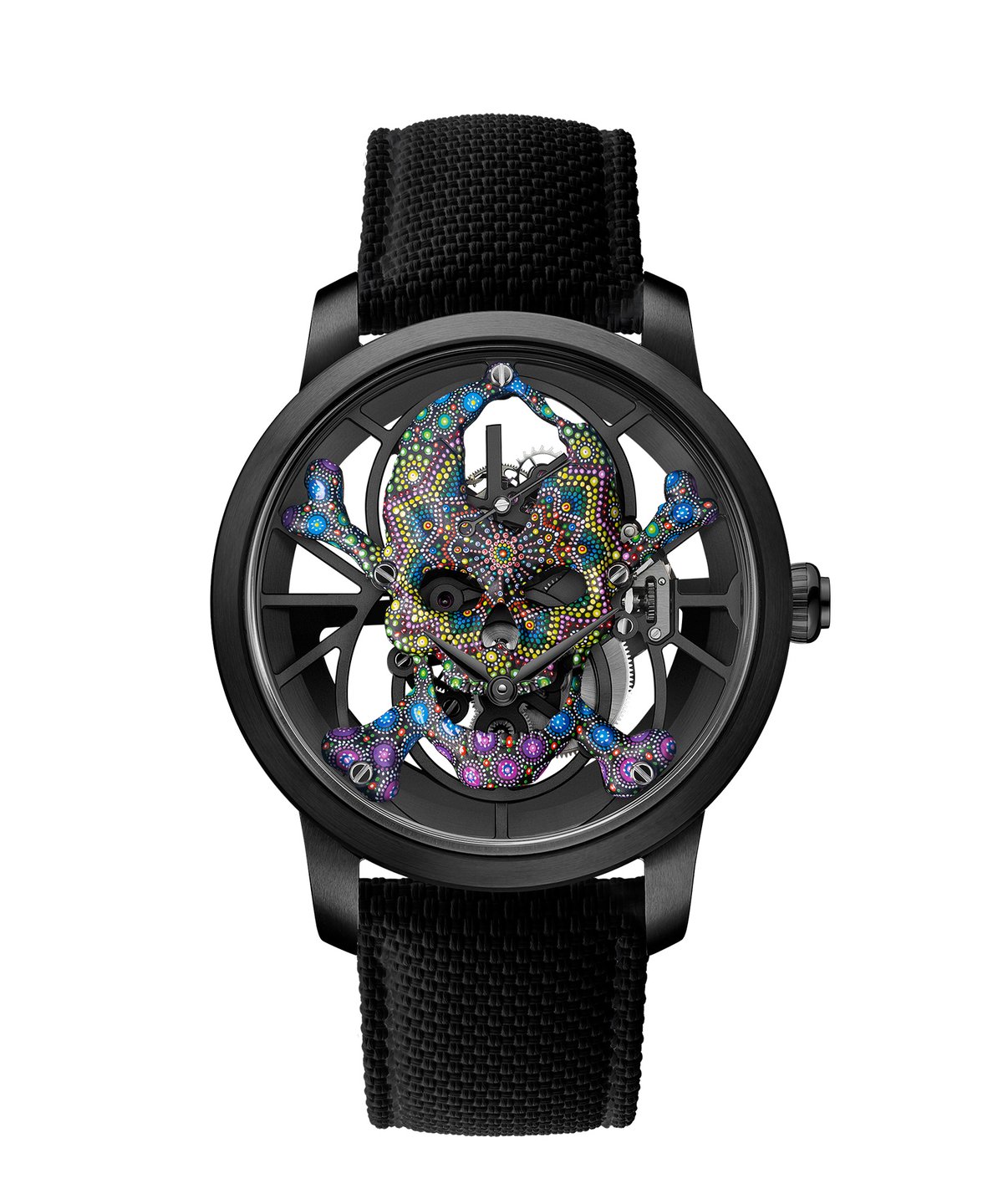
There are watches you review and watches you survive. The Jaquet Droz Tourbillon Skelet Ceramic Skull is neither, exactly. It is a watch that keeps interrupting you — mid-sentence, mid-handshake, at a red light — because the object on your wrist appears to be looking back at you. That is the entire point of a memento mori, and Jaquet Droz has been making that point for years. What is new here is the material, and the degree to which the skull has been pushed into the architecture of the movement rather than laid on top of a dial.
Most coverage of a piece like this stops at the object: the anglage, the black polish, the theatre of a skeletonised flying tourbillon under a sapphire crystal. Vivir's brief is different. We review watches as things you strap to your arm and then live with — through a commute, a dinner, a shirt cuff, a hot afternoon, a strap that hasn't broken in yet. So this is a wear report first and a horology essay second.
One housekeeping note before we start. Jaquet Droz does not publish every figure for every example of a piece like this, and where I could not confirm a number for this exact reference, I have left it out rather than round it off. A review that invents a case diameter to look thorough is not a review; it is a brochure with better grammar.
The house, briefly
Pierre Jaquet-Droz founded the house in 1738 in La Chaux-de-Fonds, and built its reputation on automata — the Writer, the Draughtsman, the Musician — long before anyone was arguing about lug widths on the internet. Revived in the 2000s and now positioned within the Swatch Group's prestige portfolio, Jaquet Droz still trades on the same premise: a mechanical object whose first duty is to be extraordinary, and whose second duty is to tell the time.
That heritage matters when you're evaluating a skull. Skulls on watches are usually decoration — an engraving, an appliqué, a bit of jade cut into the shape of a cranium and glued to a dial. Here the motif is structural. The bridges and mainplate of a hand-wound flying tourbillon have been cut away until the remaining metal reads as a skull, which means the decoration and the movement are the same object. You cannot separate them, and you cannot service one without the other. That is a much more interesting proposition than a picture on a dial, and it is the reason this watch costs what it costs.
What you're actually looking at
The case is ceramic, and it is black in the way a good tuxedo is black — flat, deep, with almost no reflection except at the polished edges. Ceramic as a case material has matured to the point where it no longer feels like a gimmick; the hardness that makes it nearly impossible to scratch is the same hardness that makes it nearly impossible to refinish, so the finish has to be right from the factory. Here it is. The surfaces are crisp, the transitions are sharp without being sharp to the touch, and after a week of doorframes and one careless encounter with a car key the case looked exactly as it did on day one.
On the dial side, the skull dominates. The hands — polished, slender, deliberately understated — do their work above it, and the flying tourbillon provides the only real movement on the front. There is no date, no lume, no power-reserve indicator, no branding shouting from the dial. Jaquet Droz has resisted every temptation to fill the space, which for a house that loves ornament is a disciplined choice. The sapphire crystal is on both sides, so the back is a second, quieter view: bridges, wheels, and the same skull logic continuing through the movement.
Two hands, a tourbillon, and a motif. That is the whole watch. It is worth saying plainly, because so much high-end watchmaking is additive and this is the opposite. The luxury here is subtraction.
A week on the wrist
The first surprise is weight, or the absence of it. Ceramic is light, and a hand-wound skeleton tourbillon movement is light, so a watch that photographs like a monument lands on the wrist like something considerably smaller than it looks in a display case. That has two consequences.
The good one: it never drags, never tugs at a cuff, and after ten hours you forget the mass entirely. I wore it through a full working day, a dinner that ran long, and a train journey with a laptop bag slung over the same shoulder, and at no point did I want to take it off. The less good one: a light head on a stiff new leather strap has a tendency to rotate. For the first few days I was recentring it constantly, and if the strap on your example is cut flush to the case the effect is more pronounced, because the watch reads visually wider than it feels physically.
Once the leather softened, the balance settled and the watch sat where it was put. I would say this plainly to anyone buying: give the strap two weeks before you decide anything about the fit. Half the complaints people have about a watch on the wrist are really complaints about a strap that hasn't been worn in.
Ceramic does something to the skin that steel does not. It stays neutral — it never quite warms to body temperature the way gold does — so the watch always feels slightly 'dry' against the wrist, which I found oddly appropriate for the design. The case back is sapphire and sits flat, so it rests like a disc rather than a dome: no rocking, no hot spot, no pressure point under the wrist bone. The deployant clasp, which is the part of a watch that actually touches you for ten hours a day, sat cleanly without pinching. That is more than I can say for several watches at three times the price.
Legibility: the honest part
Nobody buys a skeleton skull tourbillon for legibility, but a wear review has to be honest about it. In daylight, at normal reading angles, the time is there: polished hands against a darker, openworked background, catching just enough light to be found. In a dim restaurant, with the watch half-hidden under a cuff, it becomes a negotiation. You tilt, the hands catch a candle, you read it, you lose it again. Reading the time at 11pm after a long dinner is a two-movement operation.
Is that a problem? It depends entirely on why you own it. If a watch must be readable at a glance in all conditions, this is not the one — buy a dive watch and be happy. If a watch is something you look at, and occasionally look at for, then the small ceremony of finding the hands is part of the experience rather than a flaw in it. I would only flag that the hands are polished and dark against dark; there is no lume, and there is no contrast trick hiding in the design. What you see in the boutique is what you get at 11pm.
The movement, and where the money went
The calibre is a hand-wound flying tourbillon — Jaquet Droz lists it as the 2625SQ — running at 21,600 vibrations per hour with a power reserve the brand quotes at around seven days. That long reserve matters more than it sounds, because a hand-wound watch you wear two evenings a week needs to still be running when you come back to it. Wind it on Sunday, wear it Friday, and it is still alive.
But the number that actually describes this movement is not the frequency or the reserve. It is the removal. Skeletonising a movement is not a matter of drilling holes; it is a matter of deciding which structural material can disappear without the whole thing flexing, then finishing every new edge by hand. Anglage on an interior corner of a bridge takes an experienced finisher a long time — these are jobs measured in weeks, not hours — and here the bridges are shaped around a skull, which means there is no easy straight line to cheat with. Every curve has to be right because every curve is on display.
You can see the finishing from both sides. From the front, through the skull; from the back, through the sapphire. The black polish on the steel components acts as a mirror when it catches light, so the movement goes from matte to bright as you turn your wrist. That is a small thing that never stops being pleasant.
Accuracy, in the real world
There is no chronometer certification here, and Jaquet Droz does not submit this calibre for COSC testing — nor should it. A flying tourbillon in a decorated skeleton movement exists for reasons that have nothing to do with seconds per day. In practice, worn daily and wound on a routine, expect it to drift by a handful of seconds a day against a reference. It is consistent rather than exact, which is what matters: a watch that gains the same few seconds every day is easy to live with; a watch that wanders is not.
What I would say to a first-time owner: don't chase the rate. This is a watch with seven days of reserve and no date to set, so the setting routine is trivial — pull the crown, set the time, wind, wear. The absence of a date function is a genuine daily-wear advantage that nobody mentions, because it removes the entire class of error that makes people stop wearing a watch.
When you'd wear it
This is an evening watch, and it knows it. It works with a dinner jacket and it works, unexpectedly, with a black turtleneck and jeans — the flat black ceramic takes on whatever it is next to, and the skull reads as a piece of jewellery rather than a novelty from across a table. It does not work at the beach, in a pool, or on a weekend of DIY. There is no lume, no screw-down theatre, and no meaningful water resistance to speak of; treat it as you would a tuxedo. Splash-averse, not amphibious.
It is also, and this is not nothing, an excellent conversation object that does not require you to start the conversation. People notice the void before they notice the skull. That is a useful quality in a collector's watch: it invites the question rather than delivering the answer.
Ownership: service, water and the long game
A hand-finished flying tourbillon with skeletonised bridges goes back to the manufacture, full stop. Do not let a local watchmaker open this, and budget for months rather than weeks when it goes. Jaquet Droz does not publish a standard service cost for a piece specified this way, and I am not going to invent one — but anyone buying at this level should assume that the first service is part of the purchase price, not a surprise afterwards.
On value: the price is on request, as it is for most commission-level pieces, and the honest answer is that this is not an investment in the financial sense. Very few examples exist, so very few trade, so there is no meaningful secondary market to point at. If you need liquidity, this is the wrong object. If you want something rare, hand-finished, and materially tough enough to hand to your children, the maths changes entirely.
What else is out there
If the appeal is the skeleton tourbillon rather than the skull, Bulgari's Octo Finissimo Tourbillon Skeleton makes the same argument in titanium and with an Italian sense of restraint — it is thinner, quieter and easier to wear with anything. If the appeal is maximalist drama, Roger Dubuis will give you more skeleton, more colour and more volume. If the appeal is simply the skull, Bell & Ross has been selling the joke for a fraction of the money and with a fraction of the craft. What none of them offer is the specific combination here: a skull that is not applied to the watch but is the watch.
Verdict
The Tourbillon Skelet Ceramic Skull is not the most complicated thing Jaquet Droz makes, but it may be the most coherent: a memento mori in a material that will outlast all of us, wrapped around a movement that exists to be looked at. After a week, the skull stopped being a provocation and became a habit, which is exactly what a good piece of jewellery should do. It is not a daily driver and it was never meant to be — but as an evening companion for someone who already owns the sensible things, it earns its place on the wrist rather than in the safe.
Pros: ceramic shrugs off daily collisions; a genuinely sculptural skeleton tourbillon; light, flat-backed and comfortable once the strap softens; scarcity without shouting.
Cons: no lume, no date, no meaningful water resistance; legibility is a negotiation after dark; factory-only servicing that is slow and expensive; a secondary market too thin to rely on.