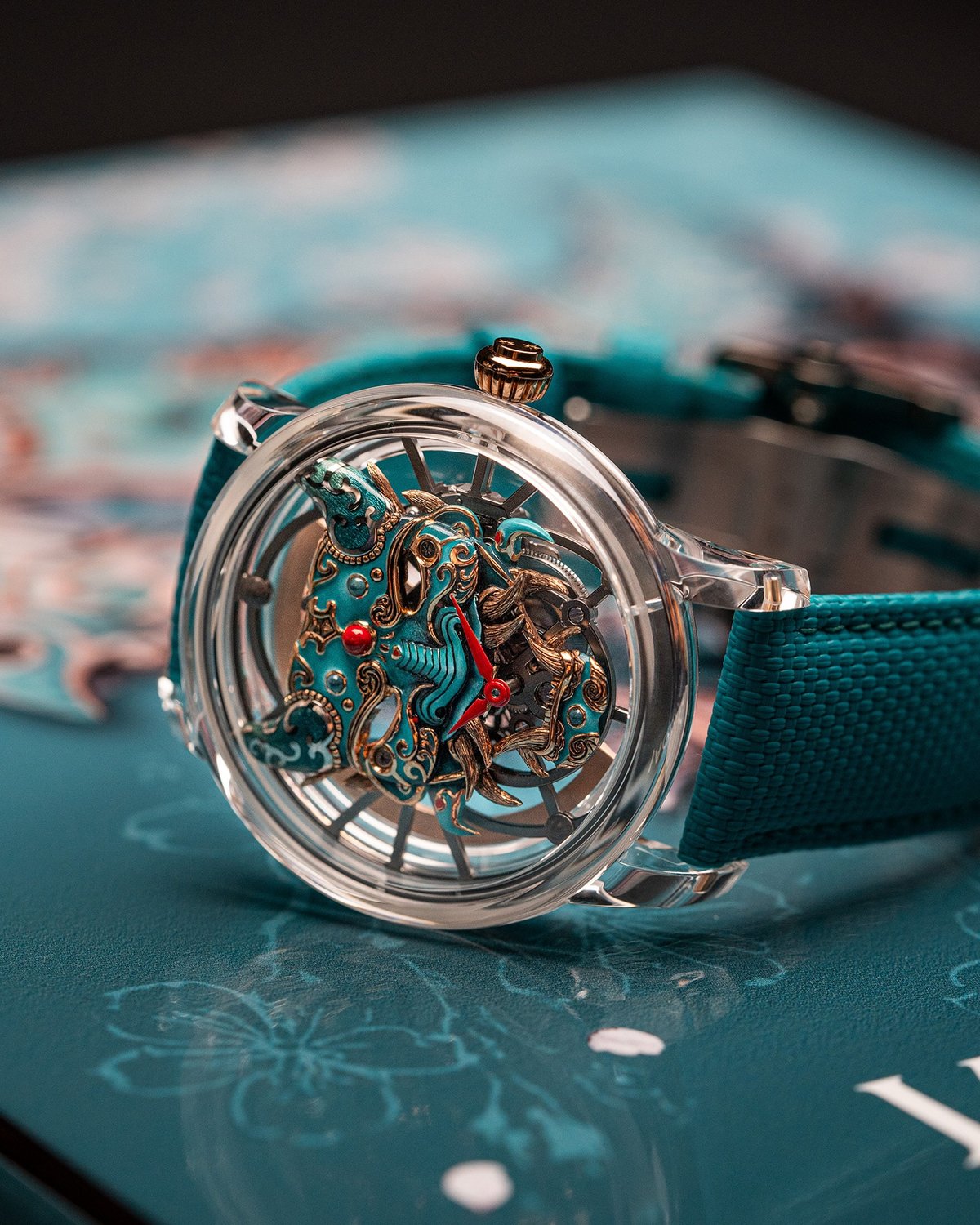
In the current collector market, sapphire cases are the new flex. They are harder to make than steel, harder to finish, and impossible to ignore on the wrist. Jaquet Droz enters that conversation with the Tourbillon Skelet Sapphire Bushido, a piece that takes the transparent-case formula and gives it a cultural narrative instead of just a technical one. The Bushido theme is not decoration for decoration's sake; it is a code, a story, and a reason for the object to exist beyond its spec sheet.
That matters because sapphire tourbillons are proliferating. Hublot, Girard-Perregaux, Richard Mille, and others have all used transparent cases to turn movements into sculpture. Jaquet Droz differentiates by leaning into its own DNA: automata, decorative arts, and a sense of mechanical theatre that goes back to the eighteenth century. The Bushido is not trying to be a sports watch. It is trying to be a collector's object with a specific point of view.
Brand context: from automata to sapphire
Jaquet Droz was founded in 1738 by Pierre Jaquet-Droz, a name that still carries weight in the world of automata and astronomical clocks. The brand's modern identity is built on the Grande Seconde, the Petite Heure Minute, the Bird Repeater, and a steady stream of unique pieces that treat the dial as a canvas for métiers d'art. The Tourbillon Skelet Sapphire Bushido fits that lineage. It is not a mainstream steel sports watch with a tourbillon bolted on. It is a display object, a piece made for the collector who already knows the brand and wants something that feels like a private commission.
The Bushido theme gives the watch a cultural anchor. Bushido, the way of the warrior, is about discipline, honor, and the acceptance of mortality. That is a strong narrative for a skeletonized tourbillon, which is itself a meditation on time, motion, and the visible passage of seconds. Jaquet Droz does not need to literalize the theme with a samurai figure for it to work. The point is the attitude: precision, restraint, and a blade-like clarity in the design.
Movement and architecture
The Tourbillon Skelet Sapphire Bushido is built around an in-house skeletonized tourbillon movement. Jaquet Droz has not confirmed every technical figure in the public material reviewed here, so this review does not quote power reserve, frequency, or jewel count. What is clear is the architecture: openworked bridges, a flying tourbillon, and a movement designed to be seen from every angle. The sapphire case is not just a container; it is part of the display.
That architecture changes how you read the watch. In a conventional tourbillon, the dial is the stage and the movement is backstage. Here, the movement is the dial. The sapphire case removes the usual visual barriers, so the finishing, the geometry of the bridges, and the motion of the tourbillon become the main event. The Bushido theme is carried through the decoration, but the piece does not rely on a painted scene to be interesting. The mechanics do the heavy lifting.
This is also why the watch feels more like a piece of kinetic art than a tool. A skeletonized tourbillon is already a statement; a sapphire-cased skeletonized tourbillon is a statement with nowhere to hide. The finishing has to be good because the owner will look at it from every angle. Jaquet Droz understands that kind of pressure. The brand has been making display objects for centuries.
On the wrist: comfort, balance, and presence
The sapphire case does not sit like a steel watch. It has a cool, glassy rigidity, and the visual effect is one of transparency rather than mass. The strap does most of the comfort work, pulling the eye toward the openworked movement and the Bushido-themed decoration. On the wrist, the watch reads as a sculpture with a strap, not as a conventional case with a dial. That is the point.
Comfort is good for a piece of this nature, but it is not a sports-watch kind of comfort. You are aware of the case because it catches light and because people notice it. The lack of lume and the absence of a confirmed water-resistance figure should tell you how to treat it: carefully, deliberately, and away from chlorine. This is a watch for dinners, gallery openings, collector meetups, and the kind of private viewing where the watch is the conversation starter.
Balance is more about visual weight than physical weight. The sapphire case makes the movement feel suspended, and the strap anchors it without fighting for attention. If you are used to heavy precious-metal tourbillons, the Bushido will feel different: less like a brick on the wrist and more like a lens through which you see the mechanics. That is a useful distinction for collectors who want a tourbillon they can actually wear to formal events without feeling like they are carrying a safe.
Accuracy and ownership reality
A tourbillon is not a guarantee of quartz-like accuracy. A well-regulated mechanical tourbillon can be expected to run within a few seconds a day in normal wear, but no COSC certification is claimed here. The tourbillon is a complication with historical and aesthetic value, not a modern accuracy solution. If you need atomic time, use your phone. If you need a visible reminder that time is mechanical, this is the watch.
Ownership reality is more important than lab numbers. The sapphire case is scratch-resistant but not indestructible; it can chip or crack under impact. The movement is exposed, which means the watch is more sensitive to dust, moisture, and rough handling than a closed-case piece. This is not a daily beater. It is a collector's object that should be worn with intention and stored with care.
When to wear it
The Bushido works best in formal and dress contexts. It is a natural pairing with a dark suit, a tuxedo, or a minimalist evening outfit that lets the watch do the talking. It is also a collector's piece, which means it belongs at watch fairs, auction previews, brand dinners, and private gatherings where people understand what they are looking at. It is not a sport watch, not a travel watch, and not a daily driver. That is not a criticism; it is a clarification.
If you want one watch for everything, this is not it. If you want a piece that marks a specific moment in your collection, the Bushido makes sense. It has the kind of presence that changes the way people read your wrist. It says you are not just buying a brand; you are buying a narrative and a craft object.
Wrist presence
Five out of five. The Tourbillon Skelet Sapphire Bushido is a transparent, high-jewelry object that turns the movement into the dial and the wrist into a display case. It is not loud in the way a diamond-set sports watch is loud; it is loud in the way a sculpture is loud. People look twice because they are not sure what they are seeing. That is a rare quality in modern watchmaking.
Variants and family context
The Bushido is a unique piece with no public reference number. Jaquet Droz has used the Tourbillon Skelet Sapphire platform for other unique executions, each with its own decorative theme. The family also includes the Tourbillon 8 Days and the Grande Seconde Tourbillon, which share the brand's interest in visible mechanics and classical complications. If you are shopping within the brand, the Bushido sits at the artisanal end of the spectrum: less about daily versatility, more about craft and narrative.
Other notable Jaquet Droz models include the Grande Seconde, the Petite Heure Minute, the Bird Repeater, and the Automata collection. These are the references that built the brand's modern reputation for decorative arts and mechanical theatre. The Bushido is a natural extension of that identity, even if it uses a sapphire case and a skeletonized tourbillon rather than a painted enamel dial.
Alternatives to consider
If you want the sapphire-case tourbillon experience from another brand, the Hublot Big Bang Unico Sapphire is the obvious comparison. It is more sports-oriented, more aggressive, and more likely to be seen at a car event than a gallery opening. The Girard-Perregaux Quasar Light is another sapphire-case statement piece with an openworked, sculptural movement. The Ulysse Nardin Freak is a no-dial, tourbillon-forward alternative for collectors who want mechanics as theatre. The Richard Mille RM 056 is the ultra-high-horology sapphire case benchmark, with a far more aggressive sporting posture.
For buyers who want the skeleton aesthetic at a fraction of the price, the Seiko 5 Sports Skeleton and the Fossil Townsman Automatic Skeleton offer an accessible openworked look. They do not pretend to be sapphire-cased tourbillons, and they should not be compared on craft. They are entry points into the visual language, not substitutes for the real thing.
Investment and auction reality
The Tourbillon Skelet Sapphire Bushido is a unique piece, which means there is no public MSRP or current retail price in the usual sense. The price is on request, and the pre-owned market is not a transparent auction market. This is a relationship-driven segment. You buy a unique piece because you want it, because you have a relationship with the brand, and because the craft speaks to you. You do not buy it as a short-term flip.
That said, unique Jaquet Droz pieces have collector appeal. The brand has a long history, a strong decorative-arts identity, and a limited output of special pieces. The Bushido theme adds a cultural narrative that could help it stand out in a private sale. But liquidity is slow, and the absence of a confirmed repeat auction history means you should treat any price talk as anecdotal. The trend is stable rather than appreciating. Hold if you love it; do not underwrite it as a financial instrument.
Service and ownership costs
Service should go through Jaquet Droz authorized channels. The sapphire case and unique-piece finishing make this a watch that should not be handed to a local generalist. Service intervals and costs are not publicly confirmed in the material reviewed, so this review does not quote a number. The practical advice is simple: budget for authorized service, keep the watch away from moisture and impact, and store it in a proper watch box when it is not on the wrist.
Ownership is not just about the purchase price. It is about the care and attention a piece like this demands. The sapphire case is beautiful, but it is also a material that rewards careful handling. The movement is exposed, which means dust and moisture are real concerns. If you are the kind of collector who likes to swap watches daily and wear them hard, this is not the piece for you. If you like to plan your outfits around a watch, the Bushido is a joy.
Pros and cons
The pros are obvious: a sapphire case that turns the movement into a display object, an in-house tourbillon with openworked architecture, a Bushido theme that gives the watch a specific cultural narrative, and unique-piece rarity. The cons are equally clear: no confirmed public dimensions or water resistance, sapphire cases are service-sensitive, the watch is not a daily beater, liquidity is limited, and the price is on request. This is not a rational purchase in the way a steel sports watch is rational. It is an emotional purchase with a strong intellectual case.
Final verdict
The Tourbillon Skelet Sapphire Bushido is less a watch than a transparent stage for Jaquet Droz's twin obsessions: automata-like motion and decorative craft. It is not the rational daily purchase; it is a collector's object with a samurai narrative cut into sapphire and movement. For the right buyer, that is exactly the point.
If you are looking for a single watch to wear every day, keep walking. If you are looking for a piece that marks a stage in your collection, a piece that starts conversations at auction previews and collector dinners, the Bushido deserves a place on your shortlist. It is rare, it is cultural, and it is unapologetically mechanical. In a market full of safe choices, that is worth something.