The Architecture of Restraint: An Analysis of the Junghans Meister Damen Automatic
In the quiet town of Schramberg, Germany, horology is practiced with a specific type of reverence—one that prioritizes the functional over the decorative. The Junghans Meister Damen Automatic is the contemporary manifestation of this philosophy. While many manufacturers approach the 'ladies' segment' by simply adding diamonds or quartz movements to existing designs, Junghans has maintained the mechanical integrity of the Meister line, ensuring that this 33.1mm timepiece is a horological peer to its larger counterparts.
Historical Context: The Meister Legacy
To understand the Meister Damen, one must first look back to the 1930s. This was the era when Junghans first introduced the 'Meister' designation for its highest-grade movements and most refined designs. By the 1950s, the line had evolved into the iconic silhouette we recognize today: a bowl-shaped case, a domed crystal, and a dial that emphasizes radial symmetry. The Damen Automatic carries this DNA forward, acting as a bridge between the mid-century golden age of watchmaking and the technical requirements of the modern wearer.
Case Geometry and Materiality
The case of the Meister Damen Automatic is a study in curves. Constructed from high-grade 316L stainless steel, the case measures 33.1mm in diameter. However, because of the extremely thin bezel and the expansive domed sapphire crystal, the watch wears larger than its dimensions suggest. The finishing is entirely high-polish, executed with a mirror-like consistency that reflects the brand’s commitment to quality control. The lugs are short and taper sharply downward, a technical choice that ensures the watch remains centered on the wrist, regardless of the wearer’s bone structure.
One of the most impressive technical feats of this case is its thickness—or lack thereof. At 9.8mm, including the height of the domed crystal, it is remarkably slim for an automatic watch. This is achieved through the use of the J840.1 caliber, which is a relatively thin movement, and a clever case back design that recesses the movement slightly into the mid-case. The exhibition case back, secured by four screws, provides a window into the mechanical heart of the timepiece, a feature that many collectors in this segment increasingly demand.
The Dial: A Lesson in Legibility
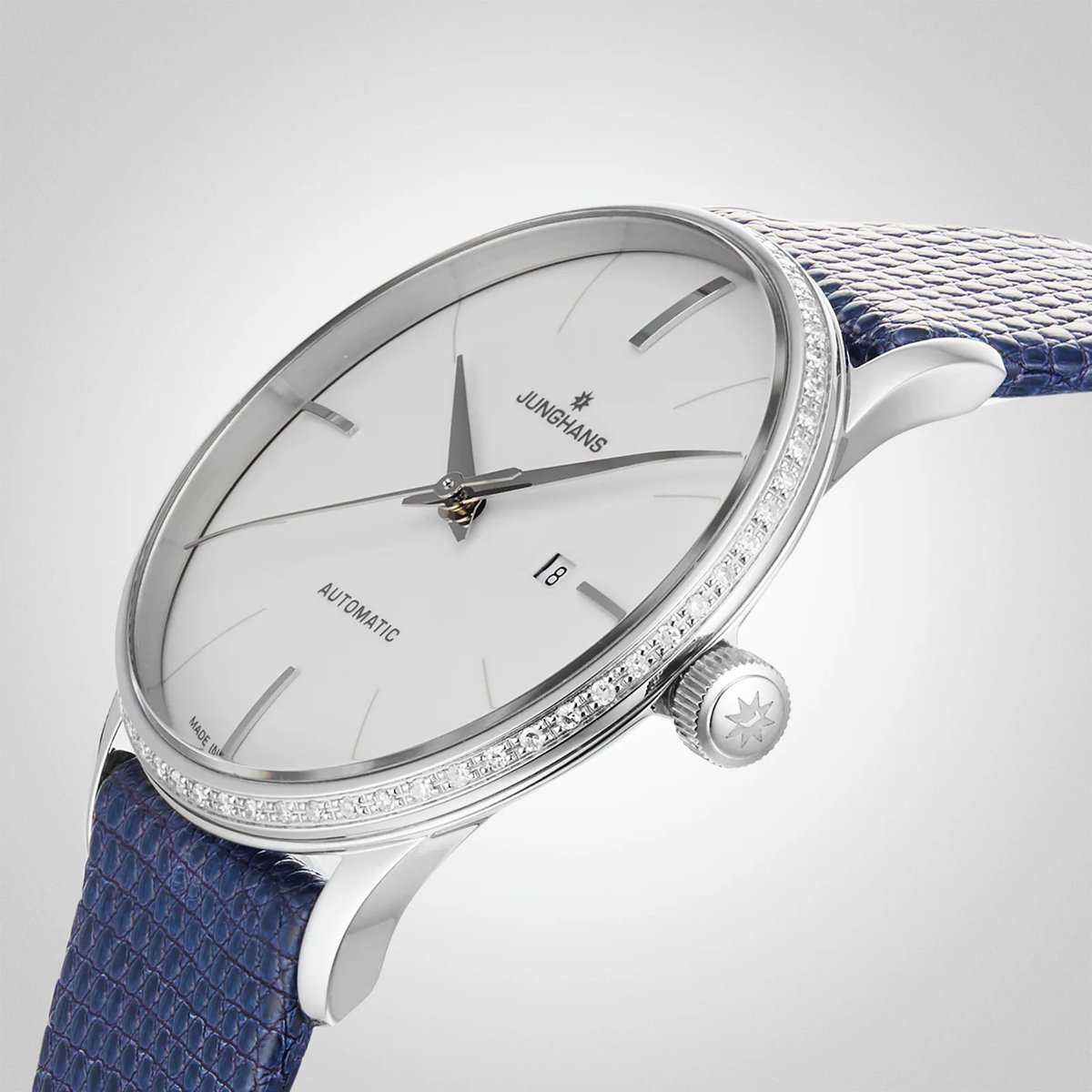
The dial of the reference 027/4044.00 is a matte silver-white that changes character depending on the light. In direct sun, it appears bright and crisp; in lower light, it takes on a creamy, vintage warmth. The hour markers are applied batons at 12, 3, 6, and 9, with printed indices in between. This hierarchy of information ensures that the dial remains uncluttered while providing precise time-telling capability.
The hands are dauphine-style, polished to a high shine, and perfectly proportioned to the dial's diameter. The minute hand features a slight curve at its tip, a traditional touch that follows the contour of the domed crystal and minimizes parallax error. The date window at 3 o'clock is discreet, with a color-matched date wheel that preserves the visual harmony of the dial. It is a masterclass in how to integrate a complication without disrupting the overall aesthetic balance.
Movement Analysis: Caliber J840.1
At the heart of the Meister Damen Automatic is the Caliber J840.1. Based on the ETA 2671, a movement renowned for its reliability in smaller-diameter watches, Junghans has refined the caliber to meet their specific standards. Operating at 28,800 vibrations per hour (4Hz), the movement offers a smooth sweep of the seconds hand. The 38-hour power reserve is standard for this architecture, though it requires daily wear or a winder to remain operational through a weekend.
Technically, the J840.1 is a robust choice. It includes a hacking seconds feature for precise time setting and a quick-set date function. From a finishing perspective, Junghans has opted for a clean, industrial look that is very much in line with German design. The rotor is the highlight, featuring a sunray finish that radiates from the center, catching the light as it oscillates. The bridges are rhodium-plated, providing corrosion resistance and a bright, uniform appearance.
On the Wrist: A Transcendent Experience
Wearing the Meister Damen Automatic is an exercise in comfort. The leather strap is of exceptional quality, soft from the first wear and featuring a slight taper that complements the case. The pin buckle is signed and shares the same high-polish finish as the case. Because the watch is so well-balanced, it does not migrate on the wrist, a common issue with smaller watches on metal bracelets. It feels substantial but never heavy, a 'set it and forget it' timepiece that transitions seamlessly from a morning board meeting to an evening gala.
The Verdict for the Discerning Collector
The Junghans Meister Damen Automatic is not a watch for those seeking a status symbol or a loud statement of wealth. It is a watch for the individual who appreciates the 'Schramberg school' of design—where every line serves a purpose and every component is built to last. It offers a level of mechanical sophistication and historical depth that is rare at this price point. In an era of disposable fashion, the Meister Damen stands as a testament to the enduring value of precision engineering and thoughtful design. It is, quite simply, a masterpiece of the miniature.