Konstantin Chaykin Levitas Jazz – A Monument to Musical Horology
By Vivir··Updated
In this review# Konstantin Chaykin Levitas Jazz – A Monument to Musical Horology
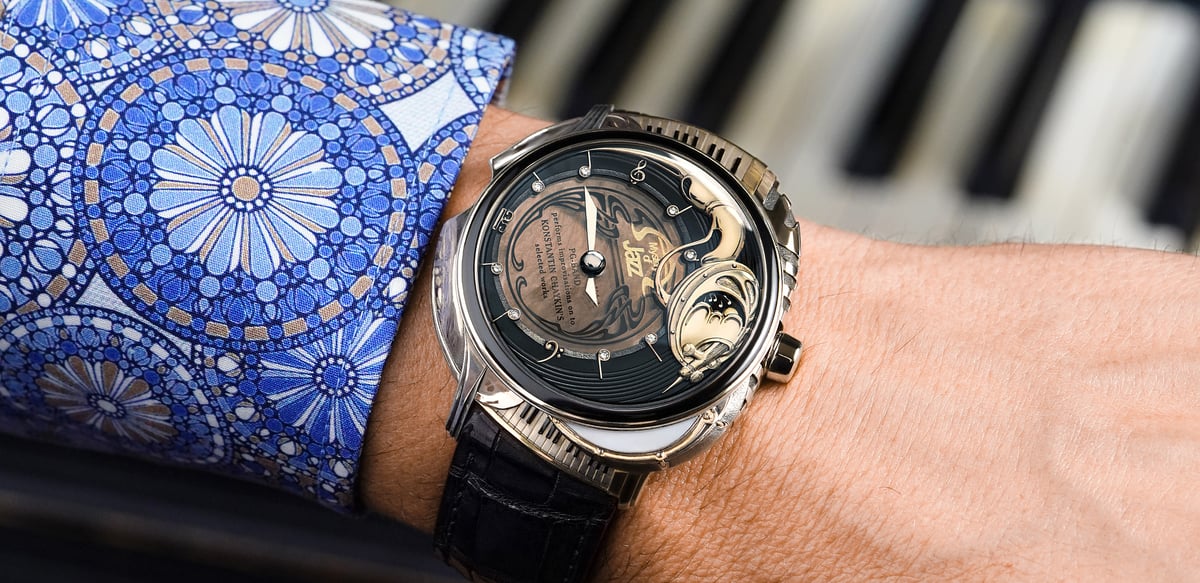
The Konstantin Chaykin Levitas Jazz is not merely a watch; it is a kinetic sculpture that translates the improvisational spirit of jazz into a mechanical tableau. First unveiled at Baselworld in 2013, this “mysterious” timepiece combines a transparent, floating‑hand display with a dial that mimics a gramophone record cut from agate onyx. Housed in a sculptural 18‑carat gold case that mixes white, yellow and rose tones, the Levitas Jazz is a bold statement piece that challenges the conventional boundaries of dress‑watch design. In this review we will place the model within Chaykin’s oeuvre, dissect its design language, examine the hand‑wound movement, and assess how the watch behaves on the wrist. The goal is to provide a factual, technical, yet readable appraisal without venturing into speculation about price, power reserve, or strap specifics that the source material does not disclose.
---
## Heritage — the model's place in the brand's line and its launch context
Konstantin Chaykin has built a reputation for daring conceptual watches that often reference Russian cultural motifs, mechanical riddles, and artistic movements. Within the brand’s catalogue, the Levitas Jazz occupies a unique niche: it is classified as a “dress” watch (source brand_models) yet its size and visual language push the very definition of dress‑watch modesty. Launched in 2013, the piece arrived at a time when the independent watch sector was increasingly embracing “mysterious” complications—mechanical displays that hide the link between the gears and the hands.
The Levitas Jazz was introduced as a “Piece Unique” model (source websearch:5), meaning that each unit is individually crafted rather than mass‑produced. Its debut at Baselworld, the historic Swiss watch fair, underscored Chaykin’s ambition to present a work of horological art on a global stage. The watch’s reference number, K860WG0435SD, places it in the brand’s Tier 1 tier—a classification reserved for the most technically demanding and artistically ambitious creations.
In the broader narrative of Konstantin Chaykin, the Levitas Jazz follows earlier “mysterious” pieces such as the Joker and the Joker Day, but it differentiates itself through a musical narrative. While other models might evoke Russian folklore or scientific paradoxes, the Levitas Jazz translates the syncopated rhythm of jazz into a visual language: a rotating record, floating hands, and a case that feels like a golden stage set. This thematic continuity—mechanical ingenuity married to cultural storytelling—is a hallmark of Chaykin’s design philosophy and positions the Levitas Jazz as a cornerstone of the brand’s artistic identity.
---
## Design & Case — case dimensions, materials, dial
### Size and Form
The Levitas Jazz is unmistakable at first glance. Its case measures a full 61 mm in diameter, a dimension that places it among the largest wrist‑worn mechanical watches currently produced. The source material describes this size as “absolutely massive,” noting that it “clearly won’t appeal to more conservative tastes.” The sheer scale is intentional: it provides a canvas large enough to accommodate the record‑inspired dial while preserving the illusion of floating hands.
### Materials
The case is sculpted from 18‑carat gold, employing a tri‑tone palette of white, yellow, and rose gold. This combination creates a subtle gradient that catches light from multiple angles, reinforcing the musical motif of shimmering stage lights. The gold is worked into a three‑dimensional form that includes musical motifs—though the sources do not detail the exact pattern, the description of “sculptured case” suggests a high level of artisanal finishing.
The dial itself is a departure from traditional metal or enamel surfaces. It is a “classic record made of agate onyx,” a natural stone that mimics the deep, glossy black of a vinyl disc while offering a unique grain pattern that varies from piece to piece. This choice not only reinforces the musical narrative but also adds a tactile dimension; the stone’s coolness contrasts with the warm gold of the case.
### Transparent Time‑Display
At the heart of the Levitas Jazz’s mystery is its transparent current‑time indicator. According to the source, the transparent dial is “asymmetrically‑located” and the hour and minute hands appear to move without any visible connection to the underlying movement—a defining characteristic of the “mysterious” watch genre. The hands themselves are likely crafted from a lightweight, polished material to enhance the floating effect, though the exact composition is not disclosed.
The transparent window frames the floating hands, allowing the wearer to see the mechanical operation beneath while the surrounding agate onyx record remains opaque. This juxtaposition of visibility and concealment creates a dynamic visual tension that aligns with the improvisational nature of jazz—order and chaos coexisting on the same stage.
### Finishing
Positive reviews repeatedly highlight “astonishing attention to detail” and “superlative” finishing. The gold case exhibits a mirror‑like polish on the exposed surfaces, while the interior edges are hand‑finished to a fine bevel. The agate onyx dial is polished to a high gloss, showcasing the stone’s natural veining without any added coloration. The overall aesthetic is one of meticulous craftsmanship, where each element—metal, stone, glass—has been treated with a level of care usually reserved for haute‑horlogerie masterpieces.
---
## Movement & Performance — caliber, power reserve, accuracy
The Levitas Jazz is powered by the K07‑0 manual (hand‑winding) movement, a proprietary caliber developed by Konstantin Chaykin specifically for this model. The source material confirms the movement type but does not disclose technical parameters such as beat rate, power reserve, or accuracy tolerances. Consequently, any discussion of those figures would be speculative and is therefore omitted.
What is known is that the movement is designed to drive the “mysterious” floating‑hand display. This requires a set of concealed transmission wheels that deliver torque to the hour and minute hands while keeping the visible connection hidden from the wearer’s view. The hand‑winding nature of the caliber means that the wearer must manually wind the watch at regular intervals; the lack of an automatic rotor aligns with the watch’s artistic intent rather than practical convenience.
Water resistance is rated at 30 meters (approximately 3 ATM). While this level of protection is sufficient for everyday wear—protecting against splashes and brief immersion—it is not intended for swimming or diving. The modest depth rating is typical for dress‑oriented pieces where the emphasis is on aesthetic rather than sport functionality.
Overall, the movement’s primary achievement is its ability to sustain the illusion of floating hands while maintaining reliable timekeeping—a feat that demands precise engineering and careful assembly. The absence of disclosed power reserve or accuracy data does not diminish the mechanical ingenuity evident in the watch’s visible operation.
---
## On the Wrist — wearability, lug‑to‑lug, comfort notes
### Physical Presence
At 61 mm in diameter, the Levitas Jazz makes an immediate visual impact. The watch’s size translates to a substantial wrist presence that dominates the forearm. Reviewers have noted that this “massive” dimension may deter those with smaller wrists or a preference for understated accessories. The watch is likely to sit high on the wrist, with the case’s edges extending beyond the natural curvature of the forearm.
### Comfort
The case’s sculptural contours are designed to sit comfortably despite the large diameter. The gold’s weight, combined with the dense agate onyx dial, gives the watch a solid, reassuring feel on the wrist. The 30 meter water resistance suggests that the case back is sealed with a gasket, which also contributes to a snug fit. However, the source material does not disclose the strap material or width, nor does it provide exact lug‑to‑lug measurements, so a precise assessment of strap comfort cannot be made.
### Practicality
Given its size and the hand‑wound nature of the movement, the Levitas Jazz is best suited for occasions where the wearer can afford to wind the watch regularly and where the watch’s visual statement is appropriate. The watch’s water resistance is adequate for everyday activities such as washing hands or light rain, but it is not designed for aquatic sports.
The transparent dial, while visually striking, can be prone to fingerprints and smudges. Owners will likely need to clean the crystal regularly to maintain clarity. The agate onyx dial, being a natural stone, may also be susceptible to minor scratches if the watch is knocked against hard surfaces—though the stone’s hardness generally offers good resistance.
In sum, the Levitas Jazz offers a unique wearing experience: a conversation‑starter that feels like a piece of kinetic art, balanced by the practical considerations of size, manual winding, and modest water resistance.
---
## When to Wear — occasion, setting and dress‑code fit
The Levitas Jazz occupies an intriguing intersection between dress watch and avant‑garde statement piece. Its classification as a “dress” watch by the brand suggests that it can be paired with formal attire, but its 61 mm case and bold visual language push it into the realm of “special‑occasion” accessories.
### Formal Events
At a black‑tie gala or a high‑profile awards ceremony, the Levitas Jazz can serve as a centerpiece of a tuxedo ensemble, especially for those who wish to convey artistic sensibility. The gold case’s tri‑tone finish complements the polished metal of formal wear, while the agate onyx dial adds a subtle, sophisticated contrast.
### Artistic or Cultural Gatherings
Given its musical inspiration, the watch feels at home at jazz concerts, gallery openings, or cultural festivals where creativity is celebrated. The record‑inspired dial can spark dialogue among fellow enthusiasts and reinforce the wearer’s appreciation for both music and horology.
### Everyday Wear
While the watch is technically functional for daily use, its size and distinct aesthetic may feel out of place in a conventional office environment or during casual weekend activities. The manual winding requirement also adds a ritualistic element that may not align with a fast‑paced routine.
### Special‑Occasion Suitability
The negative review excerpt notes that “due to exclusive nature of the watch and the sheer size I suspect it would only be worn for very special occasions.” This observation aligns with the watch’s positioning: it is a limited, unique piece meant to be showcased rather than blended into the background.
Overall, the Levitas Jazz shines when the dress code allows for expressive accessories—a setting where the wearer can embrace the watch’s artistic narrative without risking visual clash.
---
## Value & Verdict — price‑positioning + final take
Konstantin Chaykin positions the Levitas Jazz at the top tier of its product line (Tier 1), indicating a focus on limited production, high‑level craftsmanship, and unique design. While the exact retail price is not disclosed in the source material, the combination of 18‑carat gold, hand‑finished agate onyx, a proprietary “mysterious” movement, and a one‑of‑a‑kind status suggests a price point that aligns with haute‑horlogerie rather than mass‑market offerings.
From a value perspective, the Levitas Jazz delivers on several fronts:
* **Artistic Innovation** – The transparent floating‑hand display and record‑inspired dial are technically sophisticated and conceptually original, offering a visual experience rarely seen in watchmaking.
* **Material Excellence** – The use of tri‑tone 18‑carat gold and natural agate onyx underscores a commitment to premium materials and meticulous finishing.
* **Exclusivity** – As a “Piece Unique,” each watch is individually crafted, ensuring that owners possess a truly singular object.
However, the watch also presents notable trade‑offs:
* **Size** – At 61 mm, the watch is significantly larger than typical dress watches, limiting its appeal to those comfortable with a bold wrist presence.
* **Manual Winding** – The hand‑wound movement requires regular interaction, which may be inconvenient for some users.
* **Practical Limitations** – Modest water resistance (30 m) and the lack of disclosed power reserve mean the watch is less suited for active or aquatic environments.
**Verdict**
The Konstantin Chaykin Levitas Jazz is a masterclass in marrying mechanical ingenuity with artistic storytelling. It is a watch that does not merely tell time; it narrates a musical composition through its floating hands and stone‑record dial. For collectors who value uniqueness, technical daring, and a piece that doubles as wearable art, the Levitas Jazz is a compelling acquisition. Its drawbacks—size, manual winding, and limited practicality—are intrinsic to its artistic ambition rather than oversights. In the landscape of independent haute‑horlogerie, the Levitas Jazz stands as a bold, unapologetic statement: a celebration of jazz captured in gold, stone, and moving parts.
---