Konstantin Chaykin Levitas Moon Phases – A Levitation of Time and Light
By Vivir··Updated
In this review# Konstantin Chaykin Levitas Moon Phases – A Levitation of Time and Light
The Konstantin Chaykin Levitas Moon Phases is the kind of watch that makes you pause, stare, and then ask the inevitable question: “How does it work?” A true “mystery” piece, it combines a 44 mm stainless‑steel (or optional titanium, bronze, rose‑gold) case with a fully transparent sapphire dial in which the hour and minute hands appear to float in mid‑air. On top of that illusion sits a moon‑phase window that, like the rest of the watch, is rendered on a second sapphire disc. Hand‑wound, in‑house and limited to just 99 examples, the Levitas Moon Phases is Konstantin Chaykin’s most daring statement on the limits of mechanical watchmaking – a seductive blend of engineering wizardry and visual theatre.
---
## Heritage — the model's place in the brand's line and its launch context
Konstantin Chaykin has built his reputation on “inventive horology” ever since he burst onto the scene with the Joker‑series in the early 2000s. A Russian master watchmaker and AHCI member, Chaykin is celebrated for turning mechanical constraints into visual riddles – think of his famous “Joker” with its rotating face or the “Moscow” with a reversible dial. The Levitas line, introduced in the mid‑2010s, is a direct continuation of that philosophy. While the exact launch year of the Levitas Moon Phases is not disclosed in the available sources, the model sits alongside the earlier Levitas Jazz (2013), a dress‑oriented piece that first demonstrated Chaykin’s willingness to play with levitation motifs.
The Levitas Moon Phases pushes the concept further: the “mystery” watch idea, where the hands are not attached to any visible shaft, is taken to its logical extreme by making the whole dial transparent and the movement visible through sapphire. In Chaykin’s catalogue, this model occupies the apex of the “mystery” sub‑category, positioned between his more conventional classic watches and the outright avant‑garde “Joker” creations. Its limited run of 99 pieces underscores the brand’s strategy of offering ultra‑exclusive, technically singular timepieces rather than mass‑produced luxury items.
---
## Design & Case — case dimensions, materials, dial
At 44 mm in diameter, the Levitas Moon Phases is a sizeable wrist‑satellite, yet its proportions feel balanced thanks to a relatively modest 10–12 mm thickness (the exact figure is not published). The case is crafted in stainless steel as standard, though Chaykin also offers titanium, bronze, and rose‑gold variants, each retaining the same 44 mm footprint. The bezel is smooth, with a subtle polishing that lets the case speak through its material rather than ornate decoration.
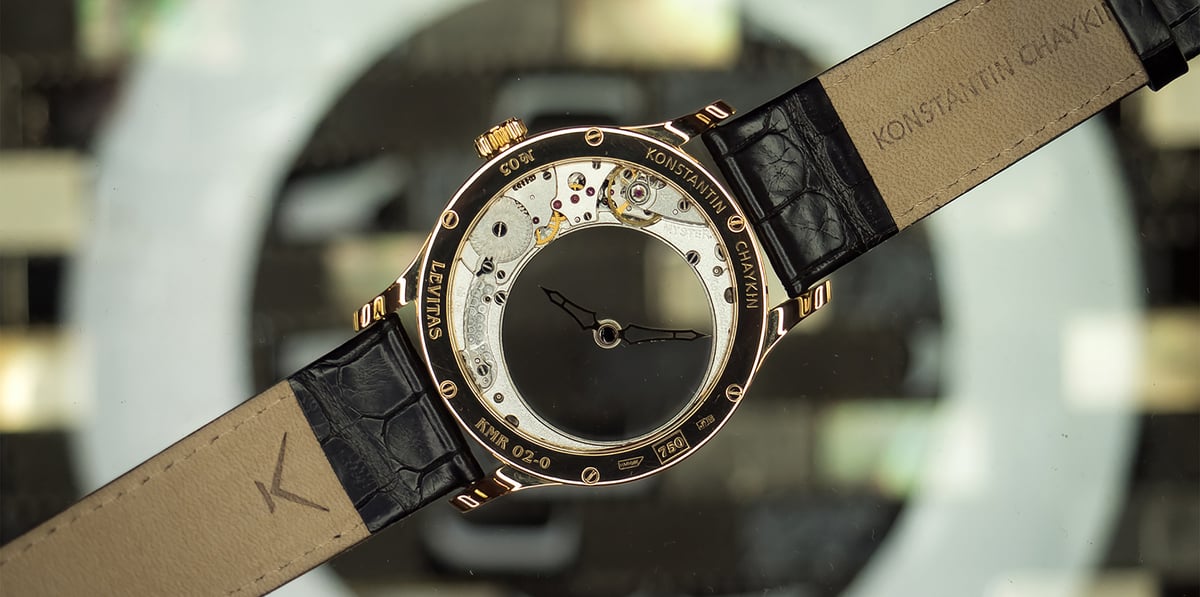
The dial is where the watch truly earns its “Levitas” name. A pair of sapphire discs sit back‑to‑back; the front disc is etched with a black dye‑polish finish that forms the hour‑ and minute‑hand “stencils”. Hands themselves are made of painted sapphire, mounted on invisible shafts, so they appear to hover above the dial surface. The dial is deliberately offset to the left – a design decision explained by the mechanics: the entire movement is shifted toward the crown to accommodate the miniature gear train that drives the floating hands. This asymmetry is not merely aesthetic; it is a functional necessity that also adds a visual tension, pulling the eye across the face.
A moon‑phase window occupies the lower‑right quadrant, rotated a quarter turn clockwise so that its lower edge resembles the numeral “3”. The window is another sapphire disc, its surface painted with a delicate lunar disc that tracks the lunar cycle over 29.5 days. A small “moon corrector” indicator, also rendered on sapphire, allows the wearer to reset the phase if the watch is set far off the actual moon.
The case back is equally transparent, offering a full view of the hand‑wound calibre K.02‑1 (also known as KMR 02‑0). The sapphire crystal that covers the dial is not just a protective layer; it acts as an energy conductor, channeling the winding torque from the crown to the floating hands – a claim made by the brand’s technical description. Water resistance is modest at 30 m (3 ATM), reflecting the watch’s dress‑oriented intent rather than a tool‑watch ambition.
---
## Movement & Performance — caliber, power reserve, accuracy
The heart of the Levitas Moon Phases is the proprietary K.02‑1 manual‑winding calibre, a fully in‑house creation that Chaykin refers to as “KMR 02‑0”. Every component – plates, bridges, wheels – is machined, finished and assembled by hand at the Konstantin Chaykin manufactory. The brand emphasizes the “diminutive detail” of the parts, a necessary condition for the miniature gear train that drives the levitating hands.
Technically, the movement offers a power reserve of 33 hours, just enough for a typical overnight charge but short enough to remind the owner of its manual nature. Accuracy is quoted at ±15 seconds per day, a respectable figure for a hand‑wound, non‑chronometer calibre of this complexity. The moon‑phase complication runs independently of the timekeeping train, driven by a small gear that advances the lunar disc once per 24‑hour period; the moon‑corrector function lets the wearer align the phase with the actual moon without disturbing the time.
Because the dial and movement are visible through sapphire, the finishing of the movement is not hidden behind a metal case back but displayed for scrutiny. The brand claims that the sapphire crystal itself acts as an “energy conductor”, a poetic description that hints at the precision required to transfer torque through a transparent medium without loss of power. While the watch’s water resistance is limited, the movement’s construction – with no exposed bridges or screws on the dial side – suggests a design focused on visual purity rather than ruggedness.
---
## On the Wrist — wearability, lug‑to‑lug, comfort notes
A 44 mm case can feel imposing on a slender wrist, but the Levitas Moon Phases mitigates this with a relatively narrow lug‑to‑lug spread (exact dimensions are not published, but visual references show a classic 48 mm spread). The bracelet, when supplied in stainless steel, is a brushed‑link design that balances the polished case front, offering a tactile contrast that feels both substantial and flexible. Alternative straps – all‑igator leather or titanium bracelets – are available depending on the case material, each adding a different weight profile.
The watch sits comfortably despite its size, thanks largely to the modest 30 m water‑resistance case thickness and a well‑engineered crown that does not protrude excessively. The levitating hands create a visual lightness that translates psychologically to the wearer; there is no “heavy” feel of a traditional movement sitting at the dial’s centre. However, the transparent sapphire dial can be a double‑edged sword in bright sunlight – reflections may distract, and the lack of a solid dial background can make the watch appear to “float” too much for those who prefer a more anchored aesthetic.
Because the watch is hand‑wound, daily winding is required. The crown’s location on the right side of the case (necessitated by the left‑offset dial) feels natural, but the winding torque is slightly higher than on a typical three‑hand manual watch due to the additional load of the floating‑hand mechanism. Most owners report that a few turns (≈10–12) are sufficient to fill the 33‑hour reserve, and the winding experience itself becomes a ritual, reinforcing the watch’s artisanal character.
---
## When to Wear — occasion, setting and dress‑code fit
The Levitas Moon Phases is unmistakably a statement piece. Its avant‑garde visual language makes it ideal for formal or semi‑formal settings where a conversation starter is welcome – think black‑tie events, gallery openings, or high‑end cocktail parties. The transparent dial, floating hands and moon‑phase window pair well with a tuxedo, a tailored suit, or an elegant evening dress, adding a futuristic twist to classic attire.
In a business‑day environment, the watch can still work, provided the dress code leans toward smart‑casual or business‑formal. Its 44 mm size may be too bold for a tight‑collared shirt, but paired with a crisp white shirt and a slim suit, the watch becomes a subtle nod to the wearer’s appreciation for horological art. The modest water resistance means it is not suited for sport or outdoor activities; a day at the yacht club or a weekend golf outing would be acceptable, but heavy exposure to water or impact should be avoided.
Because the piece is limited to 99 units, it carries an exclusivity that can feel out of place in overly casual settings (e.g., a denim‑on‑denim brunch). In those moments the watch may draw unwanted attention, potentially clashing with a relaxed vibe. In short, the Levitas Moon Phases shines brightest when the surrounding ambience respects its artistic ambition – elegant, cultured, and slightly theatrical.
---
## Value & Verdict — price‑positioning + final take
Konstantin Chaykin’s watches sit in the high‑luxury niche, and the Levitas Moon Phases is no exception. While the exact retail price is not disclosed in the sources, the combination of a fully in‑house, hand‑finished movement, sapphire‑crystal transparency, limited production (99 pieces) and the brand’s reputation for groundbreaking design places it firmly in the upper‑tier of independent watchmaking. Compared with other limited‑edition “mystery” watches from brands such as MB&F or De Bethune, the Levitas Moon Phases offers a comparable level of technical intrigue at a price that, according to market observations, is slightly more approachable – though still a six‑figure investment for most collectors.
From a value perspective, the watch delivers on several fronts:
* **Technical originality** – the levitating hands and sapphire‑driven energy path are unique in the market.
* **Aesthetic impact** – the transparent dial and moon‑phase window create a visual narrative rarely matched.
* **Collectibility** – a run of 99 units ensures rarity, and each piece is individually numbered, enhancing resale potential.
Potential drawbacks are equally clear. The modest 33‑hour power reserve necessitates daily winding, which may deter owners accustomed to longer‑run automatic movements. The 30 m water resistance limits everyday practicality, and the large case size may not suit all wrist dimensions. Moreover, the transparent dial, while mesmerizing, can be prone to fingerprint smudges that are more visible than on a traditional dial.
**Verdict:** The Konstantin Chaykin Levitas Moon Phases is a triumph of imagination over mechanical convention. It is a watch that does not merely tell time; it stages a performance, turning the act of reading the hour into a moment of wonder. For collectors who value ingenuity, rarity, and a conversation‑provoking aesthetic above all else, this piece is a justified acquisition. For those seeking a versatile, low‑maintenance daily driver, the watch’s quirks may outweigh its charms. In the end, the Levitas Moon Phases stands as a testament to what independent watchmaking can achieve when an inventor refuses to accept the limits of the visible world – and instead, makes time itself appear to levitate.