Konstantin Chaykin: The Brand Behind the Fairy Tale
Konstantin Chaykin founded his watchmaking atelier in Moscow in 2003. He was not the first Russian watchmaker, but he became the first to gain serious international traction as an independent. In 2010, he joined the Académie Horlogère des Créateurs Indépendants (AHCI), a signal that his peers considered him part of the global independent scene. His early work included complex astronomical clocks and pocket watches. Then came the Joker, and everything changed.
The Joker, launched in 2017, used two rotating discs for eyes to display the hours and minutes. It was irreverent, instantly recognizable, and surprisingly wearable. It spawned a family of Wristmons—Minions, Clown, Harley Quinn, and others—that turned Chaykin into a cult figure. But the brand's clockmaking roots never disappeared. The Lukomorye clock is a reminder that Chaykin is as much a mechanical artist as a watchmaker.
What Is Lukomorye?
Lukomorye is a fictional place from Russian folklore, most famously invoked in the prologue to Alexander Pushkin's epic poem Ruslan and Ludmila. The prologue begins: 'There's a green oak by the sea, a golden chain on that oak; and day and night a learned cat walks round and round on the chain.' From there, Pushkin conjures a world of mermaids, thirty-three bogatyrs, Baba Yaga's hut on chicken legs, and a prince who kidnaps a princess. It is a foundational text of Russian romanticism, a fairy tale that every Russian child knows.
Chaykin's Lukomorye clock takes that poem and turns it into a mechanical automaton. The clock is not simply a timekeeper. It is a miniature stage. On the hour, or on demand, figures from the poem come to life. The learned cat walks around the golden chain. The mermaid appears. The hut on chicken legs turns. It is a piece of horological theatre, and it is unmistakably Russian.
Design and Automaton
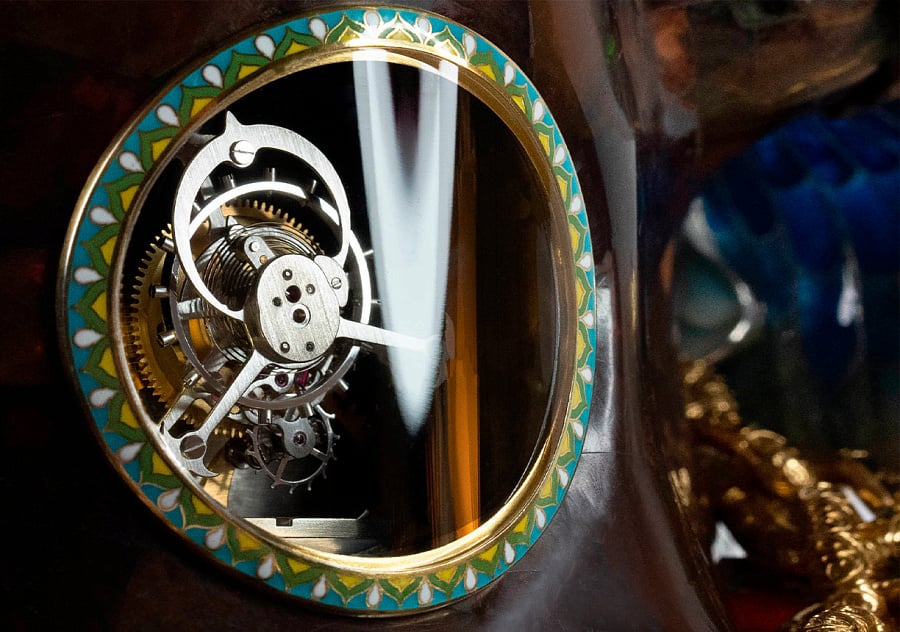
The Lukomorye clock is a mixed-media object. The case is built from wood, bronze, and glass, materials that give it a warm, artisanal feel. It does not look like a traditional carriage clock. It looks like a diorama, a display piece that invites you to lean in and watch. The dial is not a dial in the conventional sense. It is a hand-painted miniature scene that serves as the backdrop for the automaton. The time display is secondary, almost hidden, because the real show is the animation.
Chaykin's automatons are known for their smooth, almost eerie motion. The Lukomorye is no exception. The cat's chain-driven walk is the centerpiece. It is a simple mechanism, but the effect is magical. The mermaid rises from the sea. The bogatyrs march. Each element is crafted with the same attention to detail that Chaykin applies to his wristwatches. The result is a piece that feels alive.
Because the brand does not publish exact dimensions for this reference, we cannot tell you how large it is. But we can tell you that it is not a pocket watch. It is a table clock, designed to sit on a desk, a console, or a library shelf. It is meant to be seen from a distance and admired up close.
Movement and Mechanics
The Lukomorye clock is powered by a mechanical movement. Chaykin does not publicly disclose the caliber designation, power reserve, or frequency for this reference. What we do know is that it is an in-house creation, built in Chaykin's Moscow workshop. The automaton is driven by the same movement that drives the time display, which means the animation is not a separate battery-powered toy. It is integrated into the horological architecture.
This is important. Many automaton clocks use a separate motor for the animation. Chaykin's approach is more holistic. The movement is hand-finished, with the kind of beveling, polishing, and decoration you would expect from an independent atelier. The clock is not certified by COSC, and it is not a chronometer. It is a piece of mechanical art, and its accuracy is secondary to its performance.
The automaton itself is a complication. In watchmaking terms, a complication is any function beyond the display of hours and minutes. The Lukomorye has at least two: the time display and the automaton. Some versions may include additional features, but the brand has not published a full list. What matters is that the automaton is the star.
On the Desk: What It Feels Like to Live With
Since the Lukomorye is not a wristwatch, the usual metrics of wrist feel do not apply. You will not strap it on. You will not worry about lug-to-lug or case thickness. Instead, you will place it on a desk or a shelf and let it become part of the room. Its presence is monumental. It is a conversation starter, a piece that draws the eye and holds it.
The experience of living with the Lukomorye is one of anticipation. You wait for the hour to strike, or you press a button to activate the automaton. The cat walks. The mermaid appears. The hut turns. It is a small ritual, a moment of wonder in a day full of screens. For a collector who values mechanical delight over mere timekeeping, this is the appeal.
If you are used to wearing a watch every day, the Lukomorye will not replace that. It is not a daily wearer. It is a centerpiece. It is the piece you show to friends who think they have seen everything. It is the piece that makes your collection feel like a museum rather than a watch box.
Accuracy: What to Expect
Mechanical clocks are not chronometers. The Lukomorye is no exception. Expect it to keep time well enough for daily use, but do not expect quartz precision. The automaton may also affect the rate, depending on how often it is activated. If you are the kind of person who checks their watch against an atomic clock every morning, this is not the piece for you. If you are the kind of person who enjoys watching a cat walk around a golden chain, you will not care.
If accuracy becomes an issue, a qualified clockmaker can regulate the movement. But you should not buy the Lukomorye for its timekeeping. You should buy it for the theatre.
Occasions: Where It Belongs
The Lukomorye is not a sports watch. It is not a travel watch. It is not a daily beater. It belongs in formal interiors, offices, libraries, and collector displays. It is a piece for the home, not the wrist. It works best in a room where you spend time reading, thinking, or entertaining. It is a statement of cultural depth, a signal that you are not just buying logos.
If you have a study with dark wood shelves and a leather chair, the Lukomorye will look at home. If you have a minimalist white apartment, it will add a burst of narrative. It is versatile in the sense that it fits any space that values art. But it is not versatile in the sense that you can wear it to the beach.
Investment Value: Is It a Good Buy?
The Lukomorye clock is a niche object. It is not a Rolex Daytona. It does not have a deep auction history. There are no major auction records for this reference. The price is available on request, which usually means it is expensive. This is an emotional purchase. It is not an investment in the traditional sense. It is a passion asset.
That said, Chaykin's star has been rising. His wristwatches, especially the Joker, have strong secondary market demand. His clocks are rarer and more esoteric. If you buy one, you should hold it for the long term. It is unlikely to depreciate dramatically, but it is also unlikely to double in value overnight. The trend is stable. The hold recommendation is simple: buy it because you love it, not because you want to flip it.
Service and Maintenance
Servicing a clock like the Lukomorye is not like servicing a standard watch. It requires a specialist who understands automatons. Konstantin Chaykin's atelier is the best place to start. Authorized independent specialists may also be able to help, but you should not take it to a mall watch repair kiosk. The service interval is not published, but mechanical clocks typically need servicing every five to ten years, depending on the environment. The cost is also not published, but expect it to be significant. This is the price of owning mechanical art.
Similar Watches and Alternatives
If you love the idea of a poetic automaton but want something you can wear, consider the Van Cleef & Arpels Pont des Amoureux. It tells a love story on the dial, with two hands that meet once a day. It is romantic, mechanical, and wearable. The Jaquet Droz Charming Bird is another option. It features a singing bird automaton, a feat of miniature engineering. And if you want a desk clock that is equally sculptural, the MB&F Starfleet Machine is a kinetic object that looks like a spaceship. None of these are direct competitors, but they share the Lukomorye's spirit of mechanical wonder.
Homages: Is There a Budget Version?
No. There is no mass-market homage of the Lukomorye clock. The automaton, the hand-painting, and the cultural specificity make it impossible to replicate at a low price. If you see a cheap cat clock on Amazon, it is not a homage. It is a toy. The Lukomorye is a piece of art.
Reference Variants and Family
The reference TLU.04-0 is the only publicly documented version of the Lukomorye clock. Chaykin may have produced unique pieces or variations for specific clients, but they are not part of the public catalog. The clock sits within Chaykin's broader automaton collection, which includes wristwatches like the Joker, Minions, and Clown. It is not part of a numbered series like the Wristmons, but it shares their DNA.
Other Notable Models by Konstantin Chaykin
If you are new to Chaykin, start with the Joker. It is the watch that made him famous. The Minions are fun and collectible. The Clown is a more artistic take on the same concept. The Cinema collection includes pieces inspired by film. And the Lukomorye clock is the ultimate expression of his fairy-tale side. Chaykin is not a one-trick pony. He is a storyteller who uses gears instead of words.
Price and Value
The price of the Lukomorye clock is available on request. This is standard for high-end independent clocks. It is not a piece you will find on Chrono24 with a clear price tag. If you are seriously interested, you will need to contact Chaykin's atelier directly. The value proposition is not about dollars per millimeter. It is about dollars per wonder. For the right collector, it is worth every ruble.
Pros and Cons
Pros:
- Museum-grade automaton that brings Pushkin's fairy tale to life.
- Deep cultural narrative that sets it apart from generic luxury.
- Independent watchmaking pedigree from Konstantin Chaykin.
- Hand-crafted, in-house, and extremely rare.
Cons:
- It is not a wristwatch. If you want something to wear, look elsewhere.
- Extremely limited availability. You cannot walk into a boutique and buy one.
- Service complexity. Automatons require specialist care.
- Price on request. This is not a budget piece.
Final Verdict
The Konstantin Chaykin Lukomorye clock ref. TLU.04-0 is not for everyone. It is not a watch. It is a mechanical fairy tale. It is a piece of horological theatre that sits on your desk and reminds you that time can be magical. For the collector who already has the Joker and wants a centerpiece, it is a compelling, if esoteric, addition. It is a flex that no one else has. Just do not expect to wear it on your wrist.