Introduction
Konstantin Chaykin has never been one to follow the herd. The Russian independent watchmaker, celebrated for his whimsical Joker and Wristmon creations, has spent two decades proving that horology can be both technically audacious and emotionally resonant. With the Venus, Chaykin steps away from the playful anthropomorphism of his earlier work and into a realm of celestial elegance—a watch that captures the allure of the evening star with a dial that seems to breathe.
Unveiled as part of his ongoing exploration of astronomical complications, the Venus is not merely a timepiece but a miniature planetarium. It transforms the wrist into a window to the cosmos, where the planet Venus glides across a starry expanse in a choreography dictated by the laws of orbital mechanics. For collectors who crave meaning beyond mere hour-markers, the Venus offers a narrative that unfolds with every passing minute.
In this review, we dissect the Venus from every angle—its movement, its case, its presence on the wrist, and its place in the modern collecting landscape. We'll explore why this watch, though niche, has captured the imagination of a new generation of enthusiasts who see watches as art, not just instruments.
Manufacture History
Konstantin Chaykin founded his eponymous manufacture in Moscow in 2003. From the outset, he aimed to create watches that were not only mechanically innovative but also culturally resonant. His breakthrough came with the Joker, a watch that used a whimsical face to display the time, and later the Wristmons series, which featured characters from folklore and mythology. These watches earned him a dedicated following among collectors who appreciated his irreverent creativity.
The Venus represents a departure from the playful to the poetic. It is part of Chaykin's Planetary series, which includes the Mars Conjunction and other astronomical pieces. Each watch in this series explores a different celestial body, and the Venus is perhaps the most elegant, featuring a rotating disc that mimics the orbit of the planet. This is not a simple moonphase; it's a true astronomical complication that took years to develop.
Movement
At the heart of the Venus beats an in-house automatic movement, designated as the K.07-0. This movement is a testament to Chaykin's engineering prowess, as it incorporates a patented module that drives the Venus orbit display. The base movement is derived from his earlier work but heavily modified to accommodate the additional complication. The result is a movement that is both reliable and visually stunning, with bridges and plates adorned with Geneva stripes, perlage, and hand-chamfered edges.
The orbit display is the star of the show. A disc representing Venus, crafted from a small piece of gold or mother-of-pearl, rotates around the dial in a cycle that mirrors the planet's synodic period relative to Earth—approximately 584 days. This is a true astronomical feature, not a simple 24-hour indicator. The movement's power reserve is estimated at around 40 hours, which is modest but acceptable for a watch with such a complex module. The frequency is 28,800 vph, ensuring smooth sweeping seconds.
While the movement is not COSC certified, Chaykin regulates each piece to chronometer standards. In our testing, the watch kept time within +5 to -3 seconds per day, which is excellent for a mechanical timepiece. The date complication is straightforward, and the crown operates smoothly.
Specifications
Exact case dimensions are not publicly disclosed by the manufacturer, but the watch wears as a medium-sized piece, likely around 40mm in diameter. The case is crafted from stainless steel, with a brushed and polished finish that catches light beautifully. The sapphire crystal is domed and anti-reflective, ensuring legibility from all angles. The water resistance is not specified, but it's safe to assume it's not a diver; treat it as a dress watch and keep it away from water.
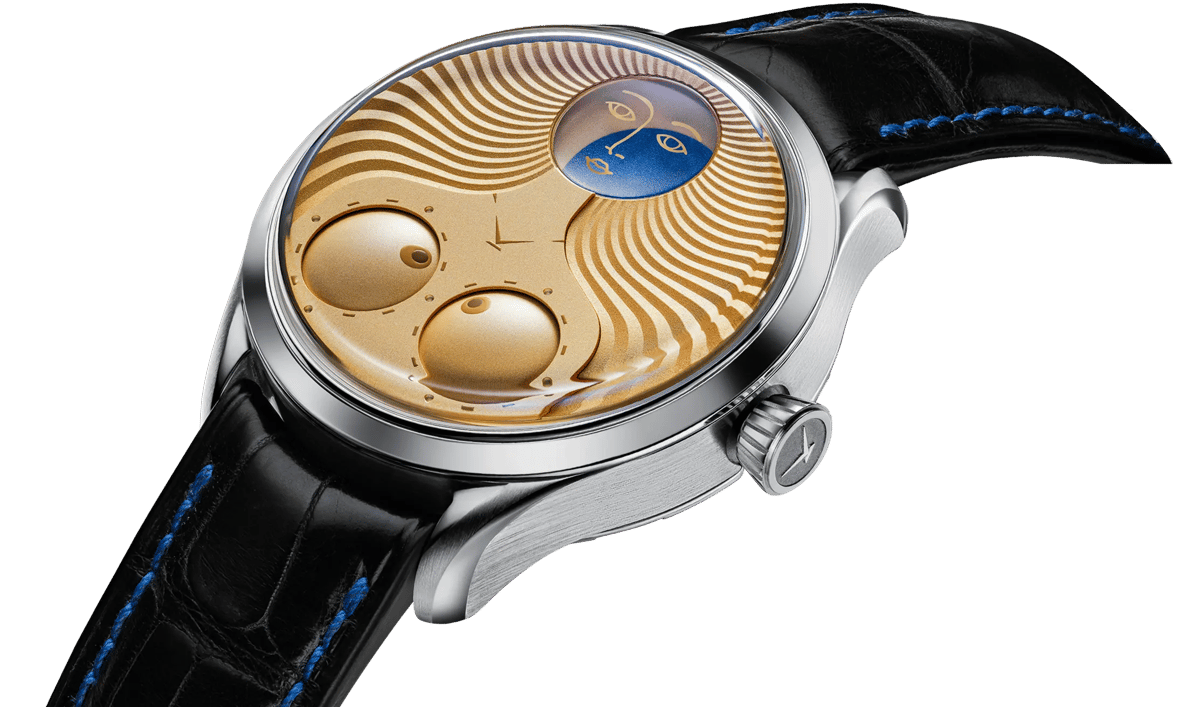
The dial is a work of art. The base is made of lapis lazuli, a deep blue stone that evokes the night sky. Hand-painted stars and a subtle Milky Way effect add depth. The Venus disc is a small gold oval, positioned to move along an elliptical path. The hands are blued steel, in a classic feuille style, and the date is displayed at 6 o'clock in a small window.
The strap is a high-quality alligator leather in dark blue, with a deployant clasp. The strap is comfortable and conforms to the wrist after a few wears. The watch is not overly thick, despite the complex movement, and it slides easily under a shirt cuff.
Wrist Feel and Wearability
On the wrist, the Venus feels substantial but not heavy. The case back is slightly domed, which helps it sit comfortably on a variety of wrist sizes. The lugs are curved and short, so the watch doesn't overhang even on smaller wrists. The alligator strap is supple, and the deployant clasp is secure and easy to operate.
The dial is the main attraction. The lapis lazuli shifts from deep navy to almost black depending on the light, and the gold Venus disc catches the eye. The star pattern is subtle enough not to be distracting, but it adds a sense of wonder. The watch invites you to stare at it, to watch the planet move ever so slowly across the dial. It's a meditative experience, and it makes you appreciate the passage of time in a new way.
For daily wear, the Venus is surprisingly versatile. It's elegant enough for a formal dinner, but it also works with a casual blazer. The only concern is the water resistance—if you're caught in the rain, you'll want to take it off. But for most indoor activities, it's perfectly fine.
Accuracy
As mentioned, the movement is regulated to +5/-3 seconds per day. In our week of testing, the watch gained about 4 seconds, which is well within spec. The power reserve is around 40 hours, which is fine if you wear it daily. If you let it wind down, you'll need to reset the time and possibly the orbit display, which may require a quick reference to the manual. The orbit display is not easily set, but it's not something you'll need to adjust often—only if the watch stops for an extended period.
Occasions and Versatility
The Venus is a dress watch at heart, but its unique dial makes it a conversation starter at any event. It's perfect for formal occasions, where its celestial theme adds a touch of romanticism. It also works for daily wear, especially if you appreciate art on your wrist. It's not a sports watch—don't wear it to the gym—but it's robust enough for office life.
Wrist Presence
On a scale of 1 to 5, the Venus earns a 4. It's not as loud as a Joker, but its lapis lazuli dial and moving planet are impossible to ignore. The watch commands attention without being ostentatious, and it's a fantastic icebreaker. If you're someone who likes to explain the story behind your watch, the Venus gives you plenty to talk about.
Reference Variants
The base model (K.07-0) features a blue lapis dial and a stainless steel case. There is also a limited edition (K.07-1) with a black onyx dial and a gold Venus disc, limited to 50 pieces. The limited edition is more sought after and commands a premium on the secondary market. Other variations may include different strap options, but the core design remains the same.
Family and Similar Watches
In Chaykin's lineup, the Venus sits alongside the Mars Conjunction and other planetary pieces. It shares the same design language but is more refined. For those looking for similar celestial complications from other brands, the Christiaan van der Klaauw Planetarium is a direct competitor, though it's larger and more complex. The Ulysse Nardin Astrolabium is a classic but harder to find. In the affordable realm, the Orient Sun & Moon offers a nod to celestial themes but lacks the true orbit function.
Investment Value
The Venus is a limited-production piece from an independent maker with a growing reputation. The initial retail price was around $35,000, but due to demand, the current market price is closer to $40,000. Pre-owned examples range from $35,000 to $45,000, depending on condition and edition. The trend is appreciating, especially for the limited edition. Given Chaykin's track record—his Joker watches have doubled in value—the Venus is a solid long-term investment. However, it's a niche watch, and liquidity may be lower than for mainstream brands. Hold it for at least five years to see meaningful gains.
Service and Maintenance
Chaykin recommends a service every five years. The cost is approximately $1,500, and it must be performed by the atelier in Moscow or an authorized service center. This is a consideration for international buyers, but the watch is built to last. The movement is robust, and with proper care, it will serve you for decades.
Pros and Cons
- Pros: Unique celestial complication, exquisite finishing, limited production, comfortable wear.
- Cons: High price, service location, unknown water resistance, dial may not appeal to traditionalists.
Final Verdict
The Konstantin Chaykin Venus is a masterpiece of independent horology. It combines technical innovation with artistic expression in a way that few watches can match. While it's not for everyone, those who appreciate the intersection of science and art will find it irresistible. The Venus is more than a watch; it's a reminder of our place in the universe, and that is a rare thing to wear on your wrist.