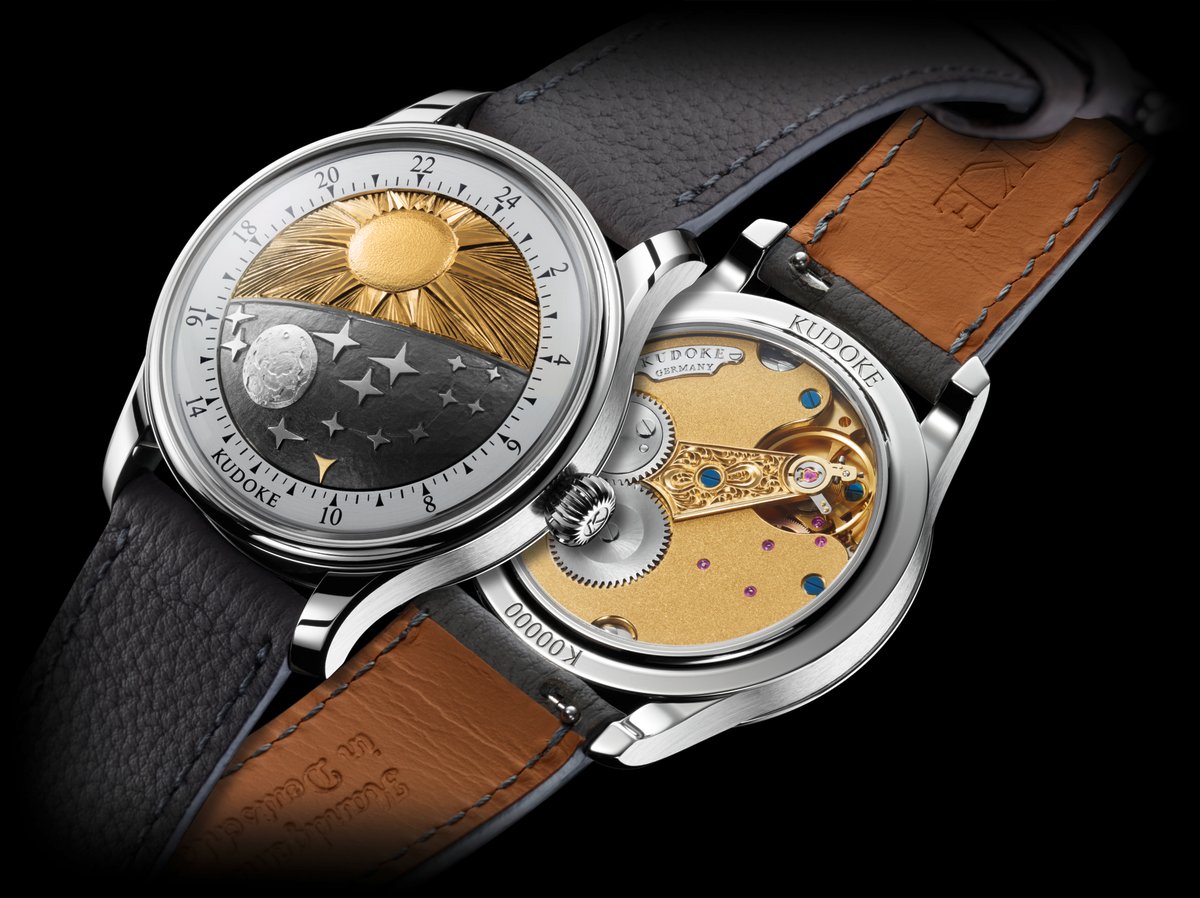
The Philosophy of Stefan Kudoke
In the world of horology, the term 'in-house' is often thrown around with reckless abandon. However, in the atelier of Stefan Kudoke, the term takes on a more literal meaning. Every Black Beauty begins its life as a series of raw components that are transformed through hundreds of hours of manual labor. Stefan Kudoke does not just assemble watches; he sculpts them. The Black Beauty is a testament to this sculptural approach, where the removal of material through skeletonization is just as important as the material that remains.
Kudoke’s background in restoration is evident in every bevel and engraving. Having worked on some of the most important historical timepieces in the world, he brings a sense of antiquity to his modern creations. The Black Beauty, however, is a departure from the traditional gold and silver tones. By utilizing black rhodium, Kudoke creates a watch that feels contemporary, almost architectural, while maintaining the soul of a 19th-century pocket watch.
Movement Architecture: The Kaliber 1
At the heart of the Black Beauty lies the Kaliber 1. While the base architecture is derived from the Habring² A11—a movement known for its robustness and chronometric reliability—Kudoke has completely reimagined it. The most striking feature is the large balance bridge, which is hand-engraved with an infinity symbol, a signature of the brand. This bridge is not just a functional component; it is the visual anchor of the entire movement.
The skeletonization process on the Black Beauty is particularly rigorous. Unlike laser-cut skeletons found in mass-produced watches, Kudoke’s work is done by hand. This results in slightly irregular, organic lines that catch the light in a way that machines cannot replicate. The black rhodium plating provides a stark contrast to the gold-toned wheels and the heat-blued screws, creating a depth of field that is mesmerizing. The frosting on the plates—a traditional German technique—adds a matte texture that further enhances the visual complexity.
Technically, the Kaliber 1 is a manual-wind movement beating at 28,800 vibrations per hour. It offers a 46-hour power reserve, which is more than sufficient for a daily wearer. The absence of a dial means the wearer is treated to a constant view of the escapement and the winding mechanism, turning the simple act of checking the time into an observation of mechanical art.
Aesthetics and Case Design
The case of the Black Beauty is a study in restraint. Crafted from high-grade stainless steel, it measures 39mm in diameter, a size that is widely considered the 'golden ratio' for modern dress watches. The polishing is impeccable, with a mirror finish that complements the dark tones of the movement. The bezel is thin, allowing the movement to take center stage, while the onion crown provides a touch of vintage flair and excellent grip.
The 'dial' is essentially the movement itself, bordered by a chapter ring that features laser-engraved Roman numerals. This ensures that despite the complexity of the skeletonization, the watch remains highly legible. The hands are a highlight in their own right—hand-finished 'Kudoke' hands with a spade-shaped hour hand that is a nod to historical English watchmaking. The contrast of the polished steel hands against the black rhodium movement ensures that the time is always readable at a glance.
The Wrist Experience
Wearing the Black Beauty is an exercise in 'stealth wealth.' To the uninitiated, it is a striking, dark timepiece. To the collector, it is an immediately recognizable piece of AHCI history. The 10.5mm thickness allows it to slide effortlessly under a shirt cuff, yet it has enough presence to be worn with a simple knit sweater. The lug-to-lug distance of 46.5mm is compact, ensuring that the watch does not overhang even on smaller wrists.
The transparency of the piece means that the skin of the wearer occasionally peeks through the movement, creating a dynamic interaction between the watch and the wrist. It feels alive in a way that solid-dial watches do not. The strap, typically a matte black alligator, is of exceptional quality, featuring a signed pin buckle that matches the case finishing.
Investment and Collectibility
In recent years, the market for independent watchmaking has exploded. Brands like Akrivia, Voutilainen, and Philippe Dufour have reached price points that are inaccessible to most. Kudoke remains one of the few independent masters whose work is still within reach, though this is rapidly changing. The Black Beauty is produced in very small numbers, and the waitlist for a new piece from Stefan’s workshop can stretch into years.
On the secondary market, Kudoke watches have shown remarkable resilience. They rarely appear at auction, as most owners are reluctant to part with them. When they do appear, they often sell for at or above their original retail price. For the young collector, the Black Beauty represents a sound investment in craftsmanship. It is a watch that will likely be more appreciated decades from now as the legend of Stefan Kudoke continues to grow.
Final Thoughts
The Kudoke Black Beauty is not a watch for everyone. It requires an appreciation for the 'hand of the maker'—those tiny imperfections and flourishes that signify a human touch. It is a watch for the person who values the soul of the machine over the prestige of a marketing budget. In an era of mass-produced luxury, the Black Beauty stands as a defiant reminder of what can be achieved with a steady hand, a sharp burin, and a singular vision.