The Emergence of the Handwerk Philosophy
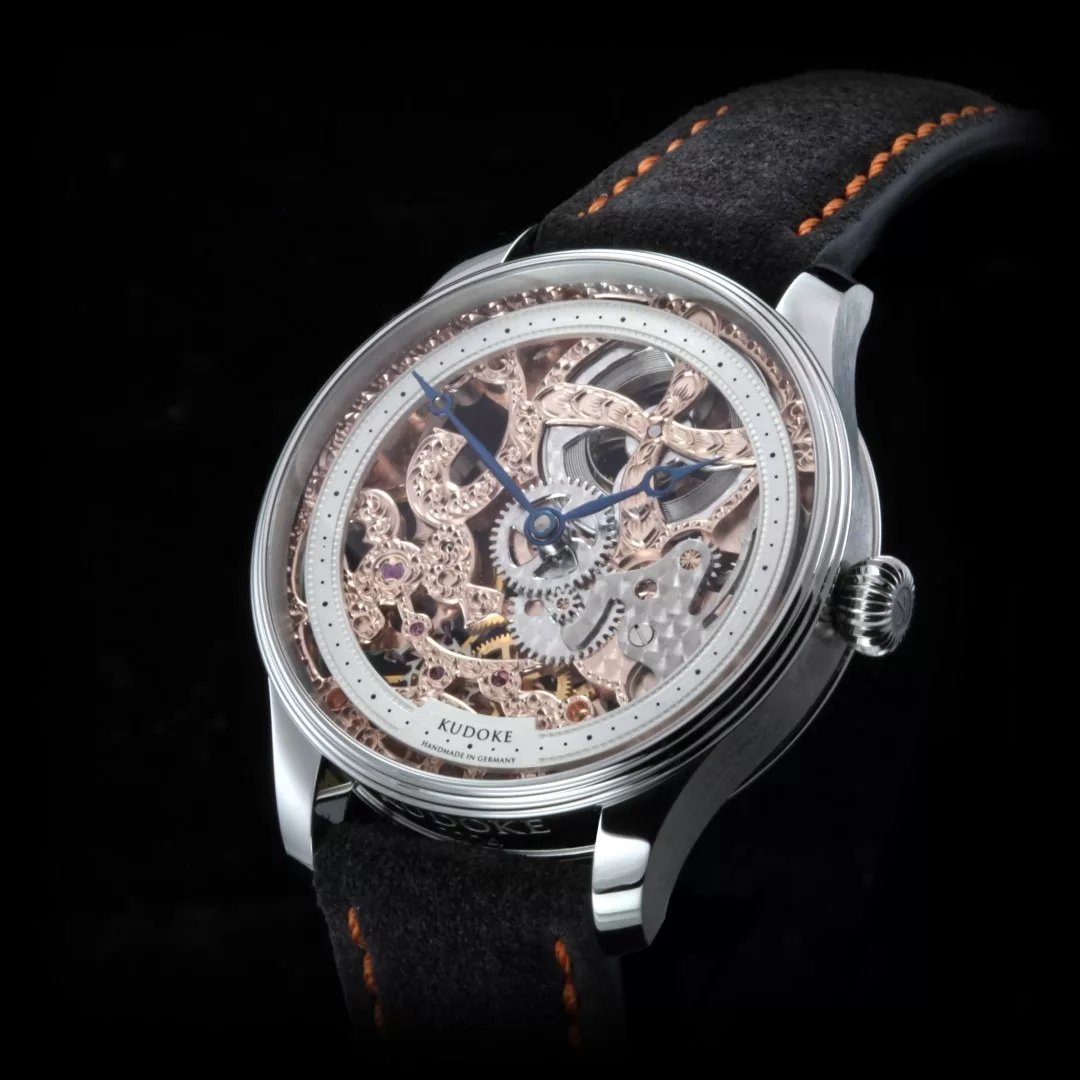
In the quiet town of Weesenstein, just outside Dresden, Stefan Kudoke operates a workshop that serves as a sanctuary for traditional horological arts. For years, Kudoke was known primarily for his skeletonized watches—pieces where the movement was stripped to its barest essentials and decorated with flamboyant engravings. However, the introduction of the Handwerk (Handcraft) collection, starting with the Kudoke 1 (HR1), marked a maturation of the brand. This was no longer just about decoration; it was about architecture.
The HR1 was designed to fill a void in the market: a high-end, hand-finished watch that felt distinctly artisanal but maintained a clean, legible, and classic aesthetic. By drawing inspiration from the 18th-century English school of watchmaking—notably the works of Thomas Mudge and John Arnold—Kudoke created a timepiece that feels like a lost artifact from a golden age, reimagined through a modern German lens. The result is a watch that emphasizes texture, depth, and the human hand over industrial perfection.
The Dial: A Study in Grattage and Geometry
The first element that captures the eye on the HR1 is the dial. It is not painted or lacquered in the traditional sense. Instead, it features a frosted finish known as 'grattage.' This technique involves a manual process of treating the surface to create a granular, matte texture that plays with light in a way that polished surfaces cannot. The silvered dial provides a soft, shimmering backdrop that enhances the legibility of the heat-blued steel hands.
The layout is a masterclass in balance. A prominent chapter ring, often referred to as the 'ring' in collector circles, is applied to the dial and features Roman numerals for the hours. This ring is vertically brushed, providing a sharp contrast to the frosted center. At the 9 o'clock position, a sub-seconds dial is recessed, offering a subtle asymmetry that adds character without disrupting the overall harmony. The hour hand is perhaps the most iconic element of the watch, featuring an 'infinity' symbol at its tip—a hand-finished detail that requires immense precision to execute in tempered steel.
The Case: Proportions for the Discerning Collector
The case of the HR1 is crafted from 316L stainless steel and measures a contemporary 39mm in diameter. In an era where many independent watchmakers lean toward oversized or experimental case shapes, Kudoke’s choice of a classic round case is a nod to timelessness. The bezel is stepped and high-polished, drawing the eye inward toward the dial. The lugs are relatively short and feature a gentle downward curve, which allows the watch to hug the wrist comfortably.
One of the standout features of the case is the onion-shaped crown. While often associated with pilot watches or vintage pocket watch conversions, here it serves as a tactile reminder of the watch's manual-wind nature. The crown is large enough to be easily manipulated, providing a satisfying click with every turn of the mainspring. The sapphire crystal on the front is slightly domed, while the exhibition caseback is flat, offering an unobstructed view of the mechanical artistry within.
Kaliber 1: Architectural Purity
The heart of the HR1 is the Kaliber 1. While the gear train and base architecture are derived from the Habring² A11—a movement known for its robustness and reliability—Stefan Kudoke has transformed it into something entirely his own. The most striking feature is the large, frosted bridge that covers a significant portion of the movement. This plate-style architecture is a direct reference to the English pocket watches of the 1700s, which favored large bridges over the multiple small bridges common in Swiss movements.
The finishing on the Kaliber 1 is exemplary. The bridges are hand-frosted, and the edges are meticulously chamfered and polished (anglage). The balance cock is the piece de resistance; it is hand-engraved with a floral motif that is unique to each watch. Unlike laser engraving, which is perfectly symmetrical and sterile, Kudoke’s hand-engraving shows the slight variations that prove a human hand guided the burin. The inclusion of a swan-neck regulator allows for fine adjustment of the rate, while also adding a traditional aesthetic flourish that enthusiasts appreciate.
Technical Specifications and Performance
The movement beats at a frequency of 28,800 vibrations per hour (4Hz), which is relatively modern for a watch with such vintage inspirations. This higher frequency contributes to better rate stability over time. The power reserve is approximately 46 hours, meaning the watch requires daily winding—a ritual that allows the owner to engage with the mechanical nature of the piece. The movement contains 18 jewels, each set in polished sinks that catch the light through the exhibition caseback.
Water resistance is rated at 50 meters. While the HR1 is certainly not a sports watch, this rating provides peace of mind for daily wear, protecting the movement from accidental splashes or rain. The lack of luminous material on the dial is a deliberate choice; lume would detract from the classical aesthetic and the fine finish of the heat-blued hands. In low light, the high contrast between the blued steel and the silvered dial remains surprisingly legible.
The Independent Market Context
For many years, the 'entry-level' for high-end independent watchmaking was considered to be in the $20,000 to $30,000 range. Brands like F.P. Journe and Akrivia have pushed those boundaries even higher. The Kudoke 1 (HR1) sits in a unique position. At a retail price of approximately $9,200, it offers a level of hand-finishing that rivals watches twice its price. It competes directly with brands like Dornblüth & Sohn and Habring², but offers a different aesthetic flavor—one that is slightly more ornate and movement-focused.
From an investment perspective, Kudoke has seen a steady rise in profile. The brand’s win at the Grand Prix d'Horlogerie de Genève (GPHG) for the Kudoke 2 brought international acclaim, and by extension, increased the desirability of the foundational HR1. Production is limited not by a marketing department, but by the physical capacity of Stefan Kudoke and his small team. This organic scarcity has led to a robust secondary market where well-maintained examples often sell for close to, or above, their original retail price.
Wrist Experience and Versatility
On the wrist, the HR1 is a study in understated elegance. It does not shout for attention with a large case or vibrant colors. Instead, it whispers its quality through the depth of its dial and the gleam of its polished surfaces. It is a watch that feels appropriate in a boardroom or at a black-tie event, yet it has enough structural integrity to be worn with a knit sweater and denim on a weekend. The 42mm lug-to-lug measurement is the key to its versatility; it fits a wide variety of wrist sizes without appearing over-scaled.
The tactile experience of winding the Kaliber 1 is one of the highlights of ownership. There is a specific resistance and sound to the winding mechanism that feels substantial. It is a reminder that you are powering a machine that was built, finished, and regulated by a master watchmaker. For the collector who values the 'soul' of a watch over its brand name, the HR1 provides a level of satisfaction that is rare in the modern horological landscape.
Conclusion: A Modern Classic
The Kudoke 1 (ref. HR1) is more than just a watch; it is a testament to the enduring appeal of hand-craftsmanship in a digital age. Stefan Kudoke has successfully blended the rigorous precision of German engineering with the artistic flair of historical English watchmaking. The result is a timepiece that feels both significant and personal.
For the sophisticated young collector, the HR1 represents an intelligent acquisition. It is a watch that rewards close inspection, revealing new details under a loupe that might be missed at first glance. It is a piece that respects the history of horology while carving out a unique identity for itself. In a world of mass-produced luxury, the Kudoke 1 stands as a beacon of artisanal integrity.