Independent German watchmaking and the Kudoke context
Kudoke is the independent German atelier associated with Stefan Kudoke, a watchmaker whose reputation rests on small-series work and hand-finishing rather than mass-produced volume. The brand belongs to the German independent tradition in which design restraint is paired with close attention to movement surfaces: bridges, balance cocks, screws, and the small transitions that separate a merely expensive watch from a hand-finished one.
The HS1 Ring should be understood in that context. It is not a watch that competes on complication count or on the breadth of its technical specifications. It competes on intimacy. The atelier model means fewer pieces, more direct communication with the maker, and a stronger sense that the object was assembled and finished by people who care about the underside of a bridge as much as the top of a dial. For collectors who have tired of interchangeable luxury products, that is a meaningful distinction.
The brand history also explains why the HS1 Ring feels more like a piece of watchmaking culture than a product launch. Kudoke's output has long been associated with hand-engraved and hand-finished details, and the HS1 name suggests a focus on skeletonization or exposed mechanical craft. Even without relying on unverified figures for this exact reference, the watch clearly belongs to a lineage in which movement presentation and artisanal finish are central.
Case, dial, and the discipline of restraint
The HS1 Ring is delivered in a stainless steel case with a sapphire crystal, a leather strap, and a pin buckle. Those choices tell you a great deal about its intent. Stainless steel keeps the watch grounded and wearable rather than precious, while sapphire brings modern scratch resistance to a traditionally styled object. The leather strap and pin buckle reinforce the dress-watch grammar; this is not a watch that wants a micro-adjust clasp or a bracelet with quick-release convenience.
The design is quiet. There is no lume, no date window, and no attempt to turn the dial into a sporty instrument. The HS1 Ring is a time-only watch, and that simplicity is its strength. A time-only dial has nowhere to hide. The proportions of the hands, the legibility of the markers, the finish of the case, and the quality of the strap all become part of the same visual argument. The HS1 Ring succeeds because it does not over-explain itself.
The Ring name suggests a framing element or a circular motif that draws the eye toward the center of the watch. Without inventing a specific design feature that may vary across examples, the broader effect is one of containment and focus. The watch invites the viewer to look through the dial and into the movement rather than around it. That is a very different pleasure from reading a complex chronograph or a travel watch. It is the pleasure of seeing a mechanical object at rest and understanding that its beauty comes from its construction.
The absence of lume is worth stating plainly. This is not a watch for a dark restaurant, a night flight, or a hiking trail. It is a watch for daylight, for an office, for a dinner where the sleeve is pulled back and the case catches the light. Collectors who expect a do-everything object may find that limiting. Collectors who already own a sports watch will understand it as a deliberate choice rather than a missing feature.
Movement architecture and finishing detail
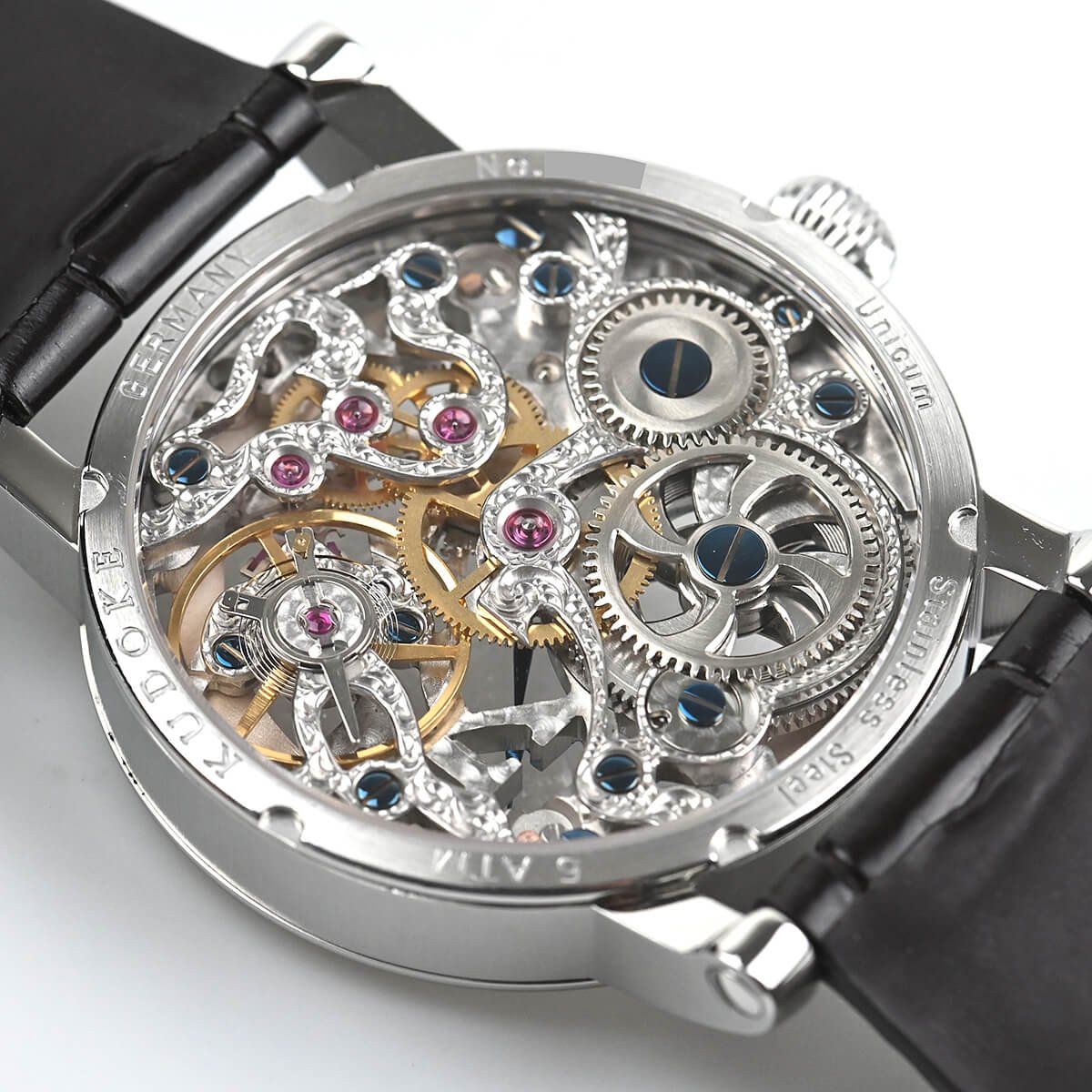
The HS1 Ring is a hand-wound watch, and that is central to its character. Manual winding establishes a daily ritual: the watch is not kept alive by the motion of the wrist but by the owner's hand. That ritual suits the independent, small-series nature of the piece. It also allows the movement to be designed and finished without the visual compromises sometimes imposed by a rotor. With no automatic winding system in the way, the architecture can prioritize what the owner sees through the back.
The movement is described here as a Kudoke HS1 hand-wound caliber, with the exact base architecture to be confirmed with Kudoke for reference hs-1. That caution is important. Independent brands often develop, modify, or finish movements in ways that do not map neatly onto the in-house versus outsourced language used by larger manufacturers. What can be said is that the HS1 Ring belongs to a watchmaking culture in which hand-finishing is not a marketing garnish but the main event.
Look for the signs of that culture: the quality of anglage on bridges, the consistency of polishing on steel components, the treatment of the balance cock, and the care taken with screws and jewels. In a hand-finished watch, these details are not identical from piece to piece in the way that machine-finished parts are. That variation is not a defect. It is evidence of the hand. The HS1 Ring should be judged on those terms, with the understanding that the movement is meant to be viewed and appreciated rather than hidden behind a solid caseback.
The time-only layout also keeps the movement legible. There is no date mechanism, no chronograph module, and no second time zone to clutter the view. The eye can follow the train, the balance, and the winding system without distraction. For collectors who care about movement architecture, that clarity is a virtue. The HS1 Ring is not trying to impress with complexity. It is trying to impress with the quality of the few things it does.
Wearing experience
The HS1 Ring wears as a proper dress watch should: modestly, with a low visual center of gravity and a case that stays close to the wrist. The leather strap and pin buckle keep the package light and traditional, and the absence of lume or bulky sport-watch hardware makes the watch feel calm rather than technical. It is the sort of piece that disappears under a shirt cuff and then rewards a deliberate look when the sleeve is raised.
Balance is the key impression. The watch does not fight the wrist, and its proportions read as restrained rather than oversized. Collectors who prefer a more assertive wrist presence may find it understated, but that is the point. The HS1 Ring is designed for close viewing and quiet wear, not for drawing attention from across the room. It pairs naturally with tailoring, knitwear, and the kind of casual dressing that still values a considered wristwatch.
The pin buckle deserves a word. It is less convenient than a deployant clasp, but it is also lighter, more traditional, and more in keeping with the watch's character. The leather strap will show wear over time, and that is part of the ownership experience. A dress watch on leather is not meant to look factory-fresh forever. It is meant to acquire the marks of the person who wears it.
In terms of presence, the HS1 Ring scores a four out of five. It is not a flamboyant watch, but the hand-finished character and independent identity give it quiet confidence. It will not dominate a room, but it will reward the person sitting across the table who knows what they are looking at.
Accuracy, winding, and daily ownership
No chronometer certification is claimed for this reference, and real-world accuracy should be confirmed on the specific example. Expect a well-regulated small-series mechanical movement that rewards regular winding and careful wear; ask the dealer or Kudoke for timing data before purchase. As with many independent hand-finished watches, the ownership experience is as much about mechanical character as about laboratory precision.
Daily ownership begins with winding. A hand-wound watch asks for a few moments of attention each morning, and the HS1 Ring turns that into a small ceremony. The reward is a direct relationship with the mainspring and the movement. There is no rotor spinning on the wrist and no sense that the watch is powering itself invisibly. The owner is part of the mechanism's daily life.
The lack of water-resistance guidance for this exact reference should be treated as a practical caution. This is not a watch to wear in the shower, at the pool, or during vigorous outdoor activity. It is a dress watch, and it should be treated as one. That does not make it fragile in normal wear, but it does mean the owner should be deliberate about when and where it is worn.
Variants, siblings, and alternatives
Reference hs-1 is the basis of this review. Kudoke may offer dial, finish, or strap permutations under the HS1 Ring umbrella, and those should be confirmed directly with the brand. Within the wider Kudoke family, the Kudoke 1, Kudoke 2, and Kudoke 3 provide useful context. They share the atelier's interest in hand-finishing, restrained design, and small-series production, but each model has its own character and mechanical focus.
Collectors comparing the HS1 Ring with other independents should consider the Dornblüth and Sohn 99.1, the Nomos Glashütte Lambda, and the Habring2 Erwin. Each offers a different flavor of independent or small-series watchmaking. Dornblüth and Sohn leans into German hand-finishing and traditional dial design. Nomos brings a more industrial, in-house German approach. Habring2 offers Austrian independent ingenuity and a similarly collector-focused ethos. None is a direct substitute for the HS1 Ring, but together they frame the choices available to a buyer who values craft over mass-market recognition.
For a more affordable entry into the dress-watch mood, the Orient Bambino 38 and the Timex Marlin Hand-Wound are honest alternatives. They cannot replicate the hand-finishing or the independent atelier experience, but they can deliver the silhouette and the ritual at a fraction of the cost. They are useful reminders that the HS1 Ring is not selling mere dress-watch functionality. It is selling the human work behind that functionality.
Value, service, and long-term ownership
The HS1 Ring is a price-on-request watch in the independent market, and its value should be judged accordingly. The price buys small-series production, hand-finishing, and the direct relationship that comes with an atelier brand. It does not buy the liquidity of a mainstream luxury sports watch or the service network of a global group. That trade-off is central to the ownership decision.
On the secondary market, small-series independents can hold value, but they trade in a narrow and patient market. Buyers should expect to wait for the right collector rather than assume a quick sale. The trend for this reference is best described as stable, with no major auction history to cite. That is not a criticism. It simply reflects the reality of a niche watch from a niche maker.
Service should be arranged through Kudoke or an experienced independent watchmaker. Authorized-only service is not necessarily required, but the owner should confirm current lead times and costs before purchase. A hand-finished independent watch is not a disposable object, and its long-term care should be part of the buying calculation. The good news is that mechanical dress watches of this type are generally straightforward to maintain when handled by someone who understands small-series work.
Final verdict
The Kudoke HS1 Ring is a connoisseur's dress watch: quiet in silhouette, rich in hand-finishing, and deliberately outside the mainstream. It rewards collectors who value movement architecture and small-series craft over specifications and brand recognition. For the right owner, it is less a status object than a personal mechanical companion.
It is not the obvious choice, and that is precisely its appeal. The HS1 Ring asks for patience, an appreciation of handwork, and a willingness to live with a time-only, hand-wound watch in a world of do-everything smartwatches and luxury sports models. For the sophisticated young collector building a personal collection rather than a portfolio of familiar logos, it makes a compelling case.