The Philosophy of the Memento Mori
In the world of horology, the concept of 'memento mori'—remember that you must die—is as old as the first clock towers. It serves as a poignant reminder that time is our most precious commodity. While many modern brands approach this theme with a sense of rebellion or gothic edge, Stefan Kudoke approaches it with the reverence of a medieval stone carver. The Kudoke Skull (Ref. Skull) is not a watch for the faint of heart, nor is it a watch for those who appreciate the sterile perfection of mass production. It is a watch that celebrates the human hand, flaws and all, though in Kudoke’s case, the 'flaws' are virtually non-existent.
The Artisan of Dresden: Stefan Kudoke
To understand the Skull, one must understand the man behind it. Stefan Kudoke is not a marketer; he is a watchmaker and an engraver. Having spent years at Glashütte Original and Breguet, he absorbed the rigorous technical standards of the industry before realizing that his true passion lay in the creative manipulation of metal. Since founding his eponymous brand in 2008, he has become a beacon for collectors who value 'Handwerk'—the German philosophy of manual craftsmanship. His workshop near Dresden is a sanctuary of traditional tools, where the high-pitched whine of a CNC machine is replaced by the rhythmic scrape of a burin.
The Dial: A Three-Dimensional Masterpiece
The centerpiece of the Ref. Skull is, naturally, the dial. Each dial is a unique commission, hand-engraved from a solid block of sterling silver or gold. The technique used is known as relief engraving, where the background is painstakingly removed to leave the skull and floral motifs raised. This creates a three-dimensional landscape that is staggering in its detail. The 'tremblage' technique is often employed on the background—a process where the engraver uses a chisel to create a finely grained, matte texture that contrasts beautifully with the polished surfaces of the skull.
The skull itself is rendered with anatomical accuracy, yet it possesses an ethereal quality. The way the light catches the eye sockets and the teeth reveals the hours of labor invested in each piece. Surrounding the skull, Kudoke often incorporates flowing acanthus leaves or floral patterns, a nod to the vanitas paintings of the 17th century. This juxtaposition of life (the flora) and death (the skull) is a classic horological trope, but rarely is it executed with such technical finesse.
The Case: German Restraint
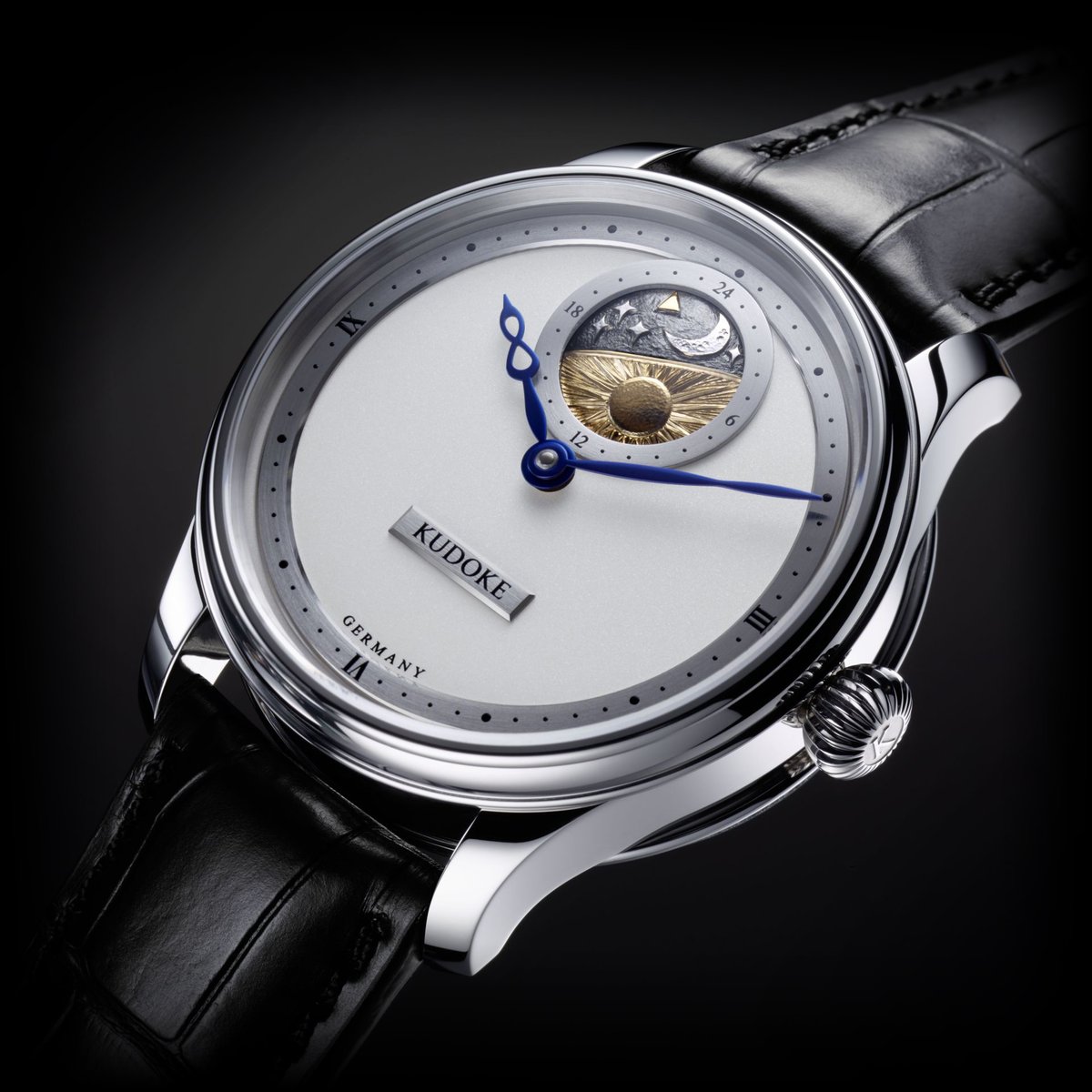
While the dial is flamboyant, the case is a model of German restraint. Measuring 42mm in diameter, the stainless steel case features a polished finish that acts as a frame for the art within. The bezel is thin, maximizing the dial aperture, while the onion crown provides a tactile connection to the movement. The lugs are short and steeply angled, allowing the 42mm case to wear more like a 40mm piece on the wrist. This is a critical design choice, as it prevents the watch from feeling like a 'statement piece' in the pejorative sense; it remains an elegant instrument of time.
The Kaliber 1: A Collaborative Triumph
Flip the watch over, and the technical prowess of Kudoke is further revealed. The Ref. Skull is powered by the Kaliber 1, a movement developed in close collaboration with Richard Habring of Habring². This movement is a significant step up from the modified Unitas calibers used in earlier Kudoke models. The Kaliber 1 features a distinctive bridge architecture that is unmistakably German. The large winding bridge is finished with a hand-applied 'frosted' texture, achieved by brushing the metal with a wire brush in a circular motion until a uniform grain is achieved.
The edges of the bridges are expertly chamfered (anglage), and the screw heads are polished to a mirror finish. The balance cock is the piece de resistance: hand-engraved with the same motifs found on the dial, it features a swan-neck regulator for precise adjustment. The movement beats at 28,800 vph and provides a 46-hour power reserve. It is a robust, reliable caliber that serves as the perfect canvas for Kudoke’s decorative skills.
Wrist Experience and Presence
On the wrist, the Kudoke Skull is a study in balance. It has a 'gravity' that is difficult to quantify. It doesn't scream for attention from across the room, but once noticed, it is impossible to look away. The depth of the dial engraving creates a sense of movement; as you rotate your wrist, the shadows shift, bringing the skull to life. It is comfortable, balanced, and feels like a bespoke garment. For the sophisticated young collector, it offers a refreshing alternative to the ubiquity of the integrated-bracelet sports watch. It is a choice that signals an appreciation for history, art, and the slow, deliberate pace of true luxury.
The Investment Landscape
From an investment perspective, Kudoke is in a very strong position. The brand produces fewer than 100 watches per year, and the demand for independent watchmaking is at an all-time high. The GPHG win for the Kudoke 2 in 2019 acted as a catalyst, bringing global attention to the brand. While the Skull is a more niche offering than the Kudoke 1 or 2, its status as a piece of wearable art ensures it retains its value. Pre-owned examples are rare and often sell for close to or above their original retail price. This is a low-risk entry into the world of high-end independents—a watch that is likely to become a family heirloom.
Final Verdict
The Kudoke Skull (Ref. Skull) is a rare beast in the modern watch market. It is a piece that refuses to compromise on its artistic vision, yet remains firmly rooted in the technical traditions of Glashütte and Dresden. Stefan Kudoke has managed to take a motif that could easily have been macabre or tacky and turned it into a profound meditation on time and craft. For those who value the touch of the artisan’s hand above all else, there is simply no better choice in this price bracket. It is, quite simply, a masterpiece.