The Intersection of Hype and Heritage
In the world of luxury horology, we often talk about 'soul.' Usually, it’s a marketing buzzword used to justify the price of a machine-made Swiss movement. But with the Kurono Tokyo Chronograph 1 (ref. CH001), the soul is undeniable. It emanates from the mind of Hajime Asaoka, a man who taught himself watchmaking by reading textbooks and experimenting in a small Tokyo workshop, eventually becoming a member of the AHCI (Académie Horlogère des Créateurs Indépendants). When Asaoka announced Kurono, the watch world held its breath. Could the master of $100,000 bespoke tourbillons really translate that magic into something accessible?
The answer arrived in the form of the CH001. This wasn't a diffusion line in the traditional sense; it was a curated aesthetic experience. The Chronograph 1 didn't just appeal to watch nerds; it appealed to the creative class—architects, designers, and the kind of collectors who haunt the Aoyama district of Tokyo. It brought 'drop culture' to the chronograph world, with a limited production run that sold out in minutes, leaving a trail of broken heart emojis across Instagram.
Design Language: Art Deco for the Modern Era
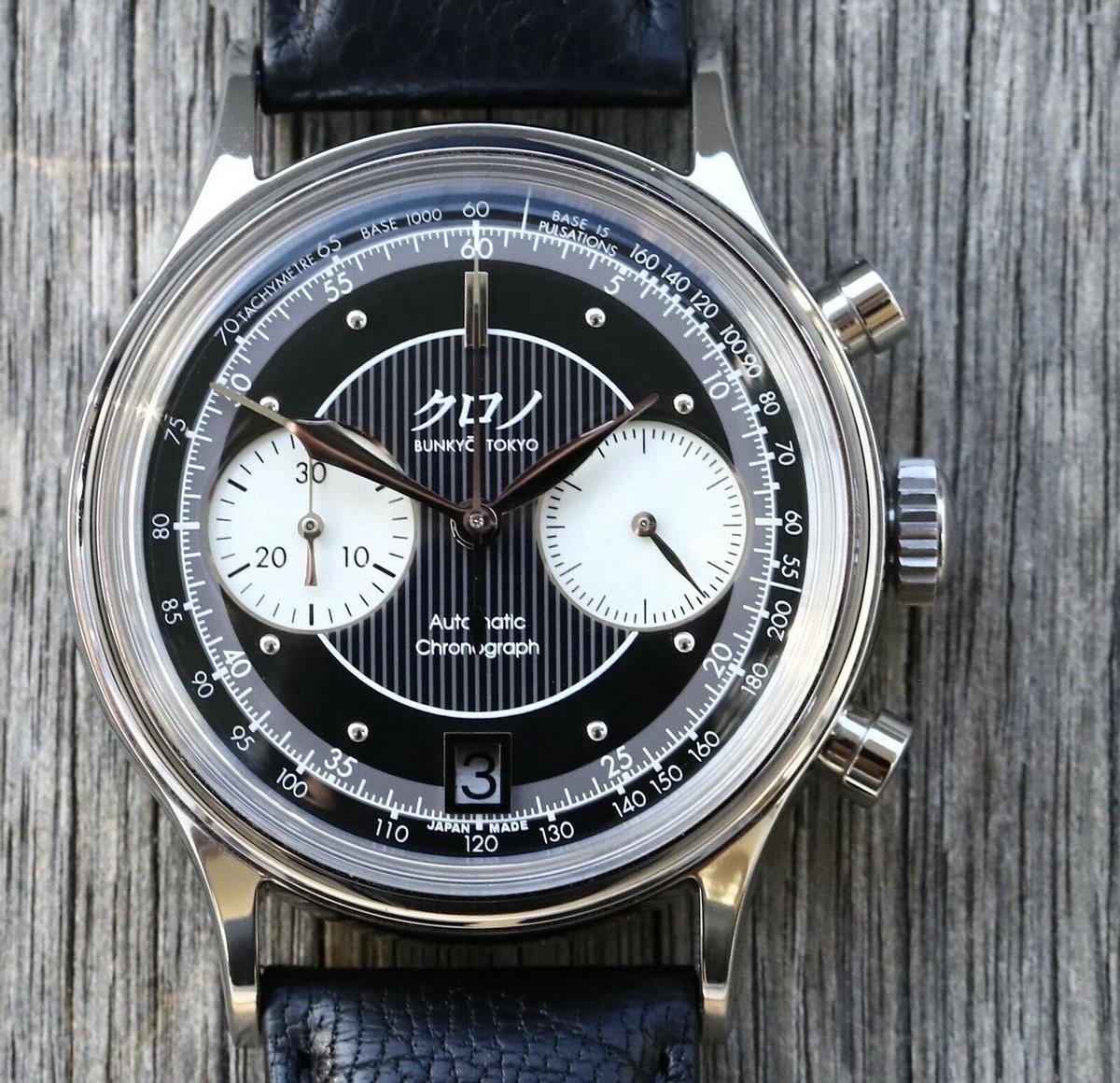
The dial of the CH001 is a masterpiece of layered complexity. At first glance, it’s a chaotic symphony of scales—tachymeter, telemeter, and sub-dials—all competing for attention. But look closer, and the logic of Hajime Asaoka reveals itself. The Art Deco influence is palpable, echoing the dashboard instruments of 1930s grand tourers. The use of high-polish steel hands against a multi-textured dial creates a sense of depth that is rarely seen at this price point.
The color palette is particularly striking. The CH001 features a mix of black, silver, and copper tones that shouldn't work together but do. The way the light hits the concentric circles of the sub-dials compared to the flat polish of the outer rings creates a dynamic visual experience. It is a dial that demands a loupe, not because the finishing is done by hand (it isn't), but because the design is so meticulously thought out that every millimeter feels intentional. The 'box' sapphire crystal adds to this, distorting the edges of the dial just enough to give it a vintage, warm glow without the fragility of old-school hesalite.
The Engine: Why the Seiko NE86A Matters
Purists often scoff at the inclusion of a Seiko movement in a watch that commands thousands of dollars on the secondary market. However, those purists are missing the point. The Seiko NE86A is not your entry-level 4R36. It is a flagship movement from Seiko’s specialized SII division. It features a column wheel—the hallmark of a high-end chronograph—and a vertical clutch. The latter is crucial: it ensures that when you press the start button, the chronograph seconds hand starts instantly without the 'jump' common in cam-actuated movements like the Valjoux 7750.
Furthermore, the choice of the NE86A was a strategic one by Asaoka. By using a reliable, mass-produced Japanese caliber, he could focus his resources on the parts of the watch the wearer actually interacts with: the case, the dial, and the overall silhouette. It also means that the watch is eminently serviceable. You don't have to send it back to a secretive Swiss atelier for six months; any master watchmaker with access to Seiko parts can keep this engine running for decades. In an era of 'disposable' luxury, there is a quiet brilliance in that level of practicality.
The Wrist Experience: A Lesson in Proportion
Wearing the Chronograph 1 is a reminder that 38mm is often the perfect size for a watch. In a market where chronographs have ballooned to 42mm and beyond, the CH001 feels like a return to elegance. The lugs are short and curve downward, hugging the wrist with a precision that makes the watch feel like an extension of the arm. The 13.9mm thickness is mitigated by the way the case back is contoured and the crystal is domed. It doesn't sit like a 'tuna can' on the wrist; it sits like a tailored suit.
On the leather strap, the watch is incredibly light. It’s the kind of piece you put on in the morning and forget about until someone at a coffee shop asks, 'Is that a Kurono?' And they will ask. The high-polish finish of the case gives it a radiance that punches way above its weight class. It doesn't scream for attention with size or gold; it whispers with quality and light play.
The Market and Investment Value
The CH001 was a GPHG (Grand Prix d'Horlogerie de Genève) nominee in the Chronograph category, a feat almost unheard of for a watch in this price bracket. This nomination acted as a catalyst for its value. While the MSRP was a relatively modest $3,680, the secondary market quickly realized that the supply would never meet the demand. Today, the CH001 is the most sought-after reference in the Kurono catalog, often trading for double its original price.
Is it a good investment? In the volatile world of watches, nothing is certain. However, the CH001 has two things going for it: it is the 'first' of its kind, and it has the direct imprimatur of a living legend. As Kurono continues to grow and release new models, the original Chronograph 1 will always be the 'Ur-Kurono'—the piece that started the revolution. For the collector who values cultural relevance as much as mechanical complexity, the CH001 is a blue-chip asset.
Final Verdict
The Kurono Tokyo Chronograph 1 (ref. CH001) is a triumph of design over dogma. It ignores the traditional Swiss rules of luxury—in-house movements, centuries of history, and over-the-top finishing—in favor of something more modern: a singular vision executed with Japanese precision. It is a watch for the new generation of collectors who see watches as wearable art rather than just mechanical tools. While the price of entry on the secondary market is steep, the reward is a piece of horological history that looks just as good with a tuxedo as it does with a vintage leather jacket. Hajime Asaoka didn't just give us a new watch; he gave us a new way to think about what a luxury watch can be.