The Philosophy of Hajime Asaoka
In the world of haute horlogerie, the name Hajime Asaoka is spoken with the kind of reverence usually reserved for the likes of Philippe Dufour or Francois-Paul Journe. A self-taught master and a member of the AHCI (Académie Horlogère des Créateurs Indépendants), Asaoka’s bespoke pieces are known for their architectural complexity and uncompromising finish. However, these pieces are largely inaccessible to all but the most elite collectors. Enter Kurono Tokyo.
The Chronograph 3 is the latest chapter in this democratization of high design. It is not a 'budget' watch in the traditional sense, but rather a focused expression of Asaoka’s aesthetic, built around a reliable, high-specification movement that allows the price to remain within reach of the sophisticated young collector. The design language is strictly Art Deco, drawing inspiration from the 1930s and 40s, yet it feels entirely contemporary due to its precision execution.
The Dial: A Study in Depth and Contrast
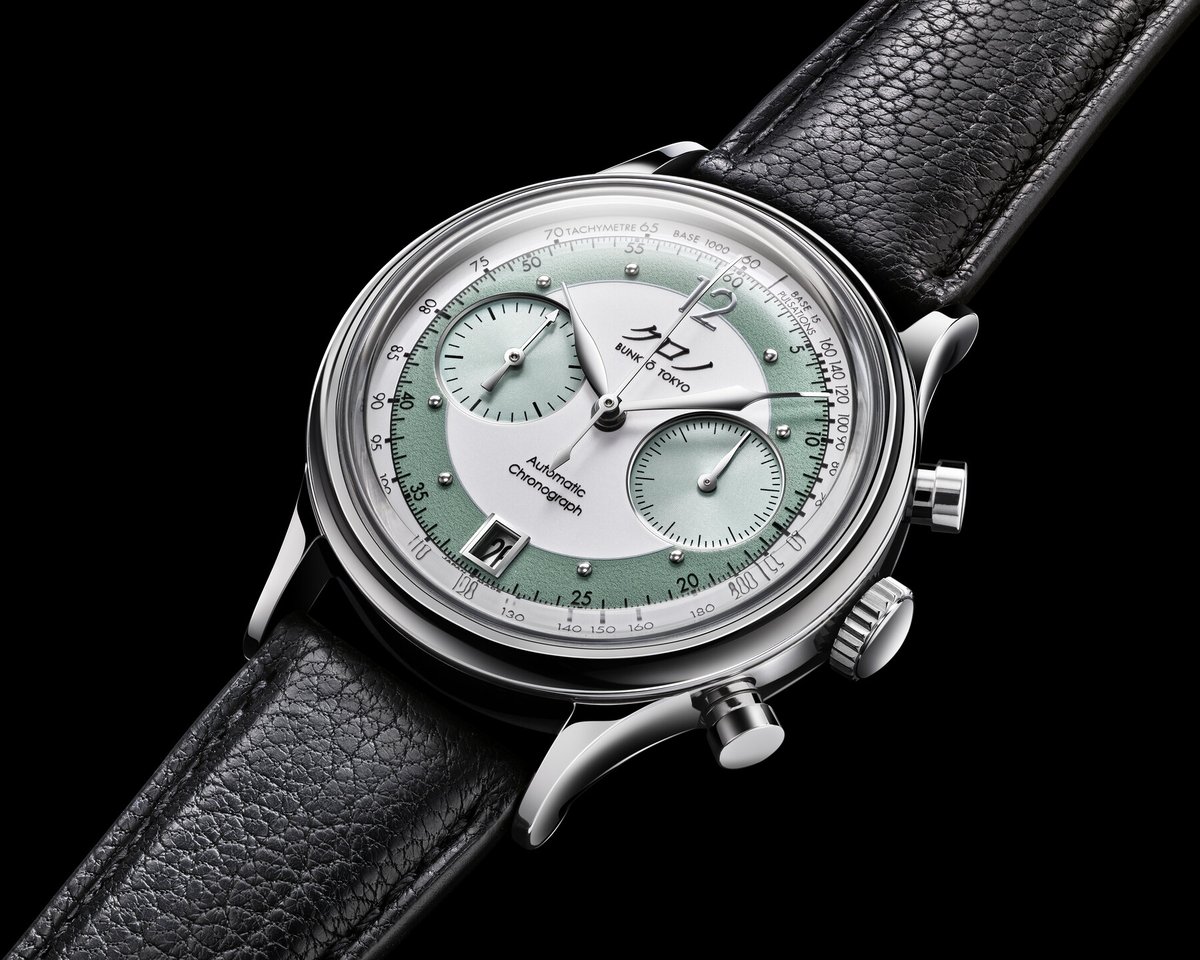
The centerpiece of the Chronograph 3 is undoubtedly the dial. It is a multi-layered masterpiece that utilizes concentric rings and varying finishes to create a sense of depth that is rarely seen in this segment. The use of a 'sector' layout—a hallmark of mid-century chronographs—is handled here with a Japanese sensitivity to proportion.
The sub-dials at 3 and 9 o'clock are slightly recessed, featuring a fine circular graining that contrasts beautifully with the smooth, lacquered finish of the main dial. The tachymeter scale on the periphery is printed with extreme precision, providing a technical frame for the more artistic elements within. One of the most subtle yet impressive details is the date window at 6 o'clock; it is framed with a polished steel surround that mirrors the indices, ensuring it integrates seamlessly into the design rather than feeling like an afterthought.
The hands are another point of distinction. The high-polish, leaf-shaped hands for the hours and minutes are slightly curved at the tips to follow the contour of the box sapphire crystal—a detail typically found in much more expensive timepieces. This curvature reduces parallax error and adds a layer of vintage charm that is essential to the watch’s character.
Movement Architecture: The Seiko NE86A
While some purists might clamor for a Swiss heart, the choice of the Seiko NE86A is a deliberate and technically sound decision by Asaoka. The NE86A is the flagship of Seiko’s mechanical movement catalog, designed specifically to compete with high-end Swiss calibers like the ETA 2894 or the Valjoux 7750.
The architectural highlights of the NE86A include a column wheel and a vertical clutch. The column wheel ensures a tactile, crisp 'click' when engaging the chronograph pushers, preventing the mushy feel associated with cam-actuated movements. More importantly, the vertical clutch allows the chronograph seconds hand to start smoothly without the 'jump' often seen in horizontal clutch systems. This is a crucial detail for a watch that prides itself on precision.
Furthermore, the movement features a unique triple-pointed hammer. This allows for the simultaneous and instantaneous resetting of the central chronograph seconds hand, the 30-minute counter, and the 12-hour counter (though only two are utilized in this bicompax layout). From a technical standpoint, the NE86A provides a level of mechanical sophistication that is perfectly aligned with the Kurono ethos of reliability and performance.
Case Construction and Ergonomics
The case of the Chronograph 3 is crafted from 316L stainless steel and finished to a mirror polish using techniques that mimic the 'Sallaz' polishing found on Grand Seiko models. There are no brushed surfaces here; every facet is designed to reflect light, emphasizing the fluid curves of the 'Tsunami' case design—a signature of Asaoka’s work.
At 38mm, the diameter is the 'golden ratio' for many collectors. It provides enough presence to be noticed while maintaining the elegance of a dress watch. The 13.5mm thickness is often a point of contention, but in practice, much of this height is attributed to the boxed sapphire crystal. The actual steel mid-case is relatively slim, which helps the watch sit close to the wrist. The lugs are short and curved, ensuring that the watch fits comfortably even on smaller wrists.
The pushers are of the 'piston' variety, offering a satisfying mechanical resistance. They are sized proportionally to the case, avoiding the oversized 'mushroom' look that can plague vintage-inspired chronographs. The crown is signed with the Kurono logo, providing a final touch of brand identity to an otherwise sterile and focused exterior.
The Collector's Perspective
Owning a Kurono Tokyo is as much about the community and the brand's unique release model as it is about the watch itself. By limiting production and using a 'time-limited' or 'lottery' system, Kurono has cultivated an aura of exclusivity that rivals much larger brands. However, unlike many hype-driven releases, the Chronograph 3 maintains its value through genuine design merit.
For the young collector, this watch represents a pivot away from the ubiquitous luxury steel sports watch. It is a choice that signals an appreciation for design history, independent watchmaking, and the specific nuances of Japanese craftsmanship. It is a watch that invites closer inspection, rewarding the wearer with details that only become apparent under a loupe.
Final Verdict
The Kurono Tokyo Chronograph 3 is a rare example of a watch that lives up to its own hype. It does not try to be an all-purpose tool watch; it does not offer 100 meters of water resistance or a ceramic bezel. Instead, it offers something increasingly rare in the modern market: a singular, uncompromising vision of what a beautiful chronograph should be. It is a technical achievement, an artistic statement, and a testament to Hajime Asaoka's status as one of the great designers of our time.