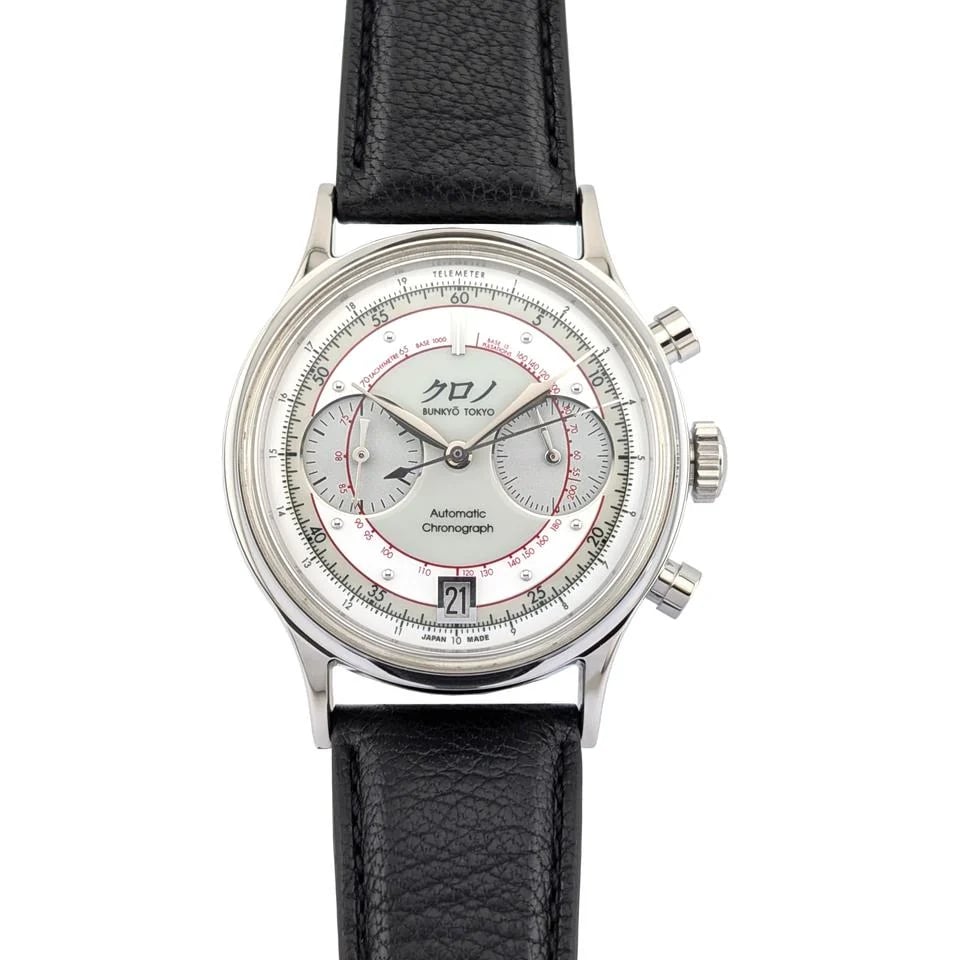
The Philosophy of Bunkyo Tokyo
In the world of horology, the term 'entry-level' is often used pejoratively. However, when Hajime Asaoka—the self-taught master and AHCI member—announced Kurono Tokyo, the intent was never to create a 'cheap' watch. Instead, it was an exercise in democratic excellence. The Chronograph II, specifically the reference CB012C64H, is the physical manifestation of this ethos. It is a watch that demands a technical appreciation of its architecture while offering a visual complexity that rivals the finest maisons in Switzerland.
The reference CB012C64H is often referred to as the 'Dark' or 'Copper' variant, distinguished by its multi-layered dial that utilizes light and shadow as much as it does pigment. To understand this watch, one must understand Asaoka’s obsession with the 1930s. This was an era where the chronograph was evolving from a scientific tool into a gentleman’s accessory, and that transition is captured perfectly here.
Movement Architecture: The Seiko NE86A
While many independent brands at this price point opt for the ubiquitous ETA 2894 or the Sellita SW510, Asaoka’s loyalty to Japanese engineering led him to the Seiko NE86A. This is a choice that speaks to the technical purist. The NE86 is part of Seiko’s 8R series, a family of movements that features both a column wheel and a vertical clutch—features typically reserved for high-end Swiss calibers like the Rolex 4130 or the Patek Philippe CH 29-535 PS.
The column wheel ensures that the pusher feel is crisp and tactile, avoiding the 'clunk' associated with cam-actuated chronographs. More importantly, the vertical clutch allows the chronograph seconds hand to start smoothly without the 'jump' often seen in lateral clutch systems. This is particularly vital for a watch that features both tachymeter and telemeter scales, where precision in timing is the stated objective. Furthermore, the NE86 utilizes a unique three-pointed hammer system. This technical solution ensures that when the reset pusher is engaged, the center seconds, minute counter, and hour counter all return to zero with perfect synchronization and instantaneous speed.
Dial Geometry and Finishing
The dial of the CB012C64H is a masterclass in depth. It is not a single flat surface but a series of concentric rings and recessed sub-dials that create a sense of three-dimensional architecture. The center of the dial is a deep, glossy black, which provides a stark contrast to the copper-toned telemeter scale that rings the periphery. The telemeter, a scale used to measure the distance of an event that is both seen and heard (originally for artillery), adds a layer of romanticism to the piece.
The sub-dials at 3 and 9 o'clock are slightly recessed and finished with a fine circular graining (azurage), which catches the light differently than the polished surfaces of the main dial. The use of 'syringe' hands for the hours and minutes is a nod to vintage military chronographs, but they are executed with a modern precision that ensures legibility despite the complexity of the scales. The date window at 6 o'clock is perhaps the most controversial element, yet its integration is handled with typical Asaoka restraint—color-matched to the dial and framed to maintain the symmetry of the layout.
Case Construction and Ergonomics
The case of the Chronograph II is forged from 316L stainless steel and finished to a level that belies its price point. Asaoka’s background in product design is evident in the way the light flows across the lug transitions. The lugs are short and curved, allowing the 38mm case to wrap comfortably around the wrist. This is a critical design choice, as the 13.9mm thickness could otherwise make the watch feel top-heavy.
One of the standout features is the box-shaped sapphire crystal. It mimics the look of vintage acrylic but offers the scratch resistance of modern materials. The way the crystal distorts the tachymeter scale at extreme angles adds a layer of visual interest that a flat crystal simply cannot provide. The pushers are simple pump-style, consistent with the mid-century aesthetic, and provide a satisfying resistance that confirms the quality of the internal column wheel.
The Investment Perspective
From an investment standpoint, Kurono Tokyo has defied the typical depreciation curve of modern watches. The brand’s strategy of 'timed releases' and strictly limited production runs has created a secondary market where demand consistently outstrips supply. The Chronograph II CB012C64H is particularly desirable because it represents the brand's most complex offering. While the MSRP was approximately $3,700, the pre-owned market often sees these pieces trading for a significant premium.
However, the true value of this watch lies not in its potential for appreciation, but in its technical integrity. For the collector who appreciates the nuance of movement finishing and dial symmetry, the Kurono offers a level of satisfaction that is usually only found in the five-figure range. It is a watch that rewards close inspection with a loupe, revealing the hand of a master who refuses to compromise on his vision.
Final Verdict
The Kurono Tokyo Chronograph II Ref. CB012C64H is more than just a successful 'hype' watch. It is a technically proficient, aesthetically brilliant tribute to the golden age of Japanese and European watchmaking. By housing a premium Seiko column-wheel movement within a case designed by one of the world's greatest living watchmakers, Kurono has created a modern classic. It is a piece that belongs in any serious collection, serving as a reminder that excellence in horology is not always a matter of price, but of perspective.