The Strategic Appeal of the Kurono Tokyo Chronograph II Shiro
In the landscape of modern horology, the term 'independent' often conjures images of six-figure price tags and avant-garde designs that look more like spacecraft than timepieces. However, Hajime Asaoka—a self-taught master and a member of the prestigious AHCI—shattered this paradigm with the launch of Kurono Tokyo. The Chronograph II 'Shiro' (ref. CB012C42L) is perhaps the most refined realization of this vision. It is a watch that demands to be analyzed not just through the lens of aesthetics, but through the cold, hard data of market demand and production scarcity.
Design Architecture: The 'Shiro' Aesthetic
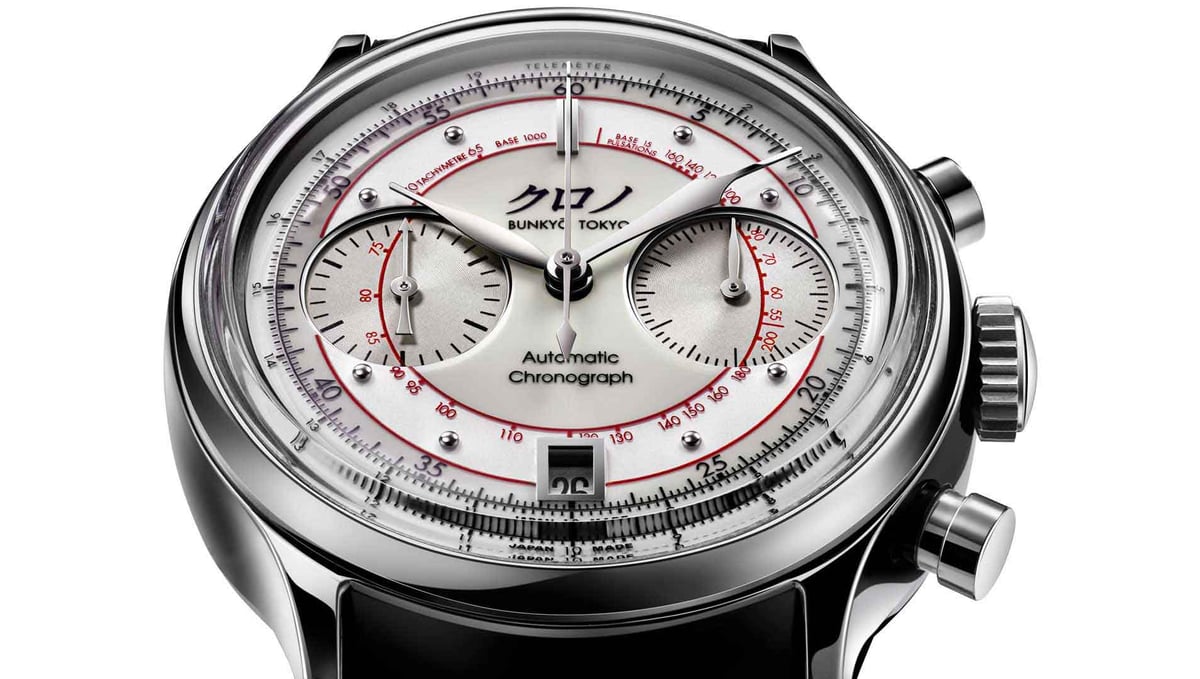
The name 'Shiro' translates to 'White' in Japanese, but to call this dial white is a vast oversimplification. The dial is a complex, multi-layered canvas that utilizes contrasting finishes to create depth. The base is a creamy, slightly off-white lacquer that evokes the porcelain dials of early 20th-century pocket watches. Against this backdrop, Kurono has layered a series of concentric scales: a telemeter on the outer perimeter and a tachymeter in the center. This 'multi-scale' approach was a hallmark of 1940s chronographs, used by doctors and engineers alike, and its revival here is executed with surgical precision.
The use of color is where the Shiro separates itself from its predecessor, the original dark-dialed Chronograph II. The Shiro utilizes a 'reverse panda' layout for its sub-dials—black registers at 3 and 9 o'clock—but accents them with copper and silver tones. The hands are high-polished and curved at the tips, a hallmark of Asaoka's obsession with detail. This curvature ensures that the hands sit as close to the dial as possible, reducing parallax error and allowing for the high-domed sapphire crystal that gives the watch its vintage silhouette.
Technical Prowess: The Seiko NE86A Caliber
To keep the Kurono line accessible, Asaoka opted for premium industrial movements rather than hand-finishing his own calibers. The choice of the Seiko NE86A for the Chronograph II series is a strategic one. Unlike the ubiquitous Valjoux 7750, which uses a cam-actuated system, the NE86A features a column wheel and a vertical clutch. For the collector, this means the 'click' of the chronograph pusher is smoother and more consistent, and the seconds hand does not stutter when engaged.
From an investment standpoint, the use of a Seiko-based movement is a double-edged sword. While it lacks the 'prestige' of a Swiss in-house caliber, it offers unparalleled serviceability. Any competent watchmaker globally can service an NE86, ensuring that the long-term cost of ownership remains low. For a young collector building a portfolio, this 'pragmatic luxury' is a significant draw. The movement is hidden behind a solid case back—a decision that maintains the watch's slim profile and avoids the need for expensive movement finishing that would drive up the retail price without adding functional value.
The Market Cycle: Hype vs. Value
When the Shiro was announced in February 2022, Kurono Tokyo utilized a time-limited ordering window. This strategy was designed to combat the 'bot' culture that had plagued previous limited-edition drops. Despite this, the secondary market immediately saw prices double. At its peak, the Shiro was trading hands for nearly $8,000 USD. As the broader watch market corrected in late 2023 and early 2024, Kurono prices followed suit.
However, the Shiro has found a very stable price floor. Unlike many 'microbrand' chronographs that lose 40% of their value the moment they leave the showroom, the Shiro continues to trade at a 20-30% premium over its original MSRP. This is the 'Asaoka Premium.' As Hajime Asaoka's bespoke pieces continue to climb in value at auction houses like Phillips and Christie's, the Kurono line acts as a 'halo' investment. It is the most affordable way to own a piece of his design language, and that fundamental demand ensures liquidity in the secondary market.
Ergonomics and Wrist Presence
The Shiro measures 38mm in diameter, a size that has become the new standard for the 'sophisticated' collector. While the 42mm+ era of the early 2010s is firmly behind us, 38mm offers a versatility that 36mm sometimes lacks. It has enough 'heft' to feel modern but enough restraint to remain elegant. The lug-to-lug distance of 46.7mm is conservative, meaning it will suit wrists from 6 inches to 7.5 inches with ease.
The lack of lume on the dial is a deliberate choice. Lume would interfere with the needle-thin precision of the scales and the high-polish finish of the hands. This reinforces the watch's position as a 'technical dress' piece. It is a watch for the boardroom or a high-end dinner, not for a dive or a dark cockpit. The 30m water resistance further underscores this; the Shiro is splash-proof but should never be submerged.
Investment Verdict
For the serious collector, the Chronograph II Shiro is a 'Strong Hold.' If you were fortunate enough to purchase at retail, you are sitting on a healthy gain. If you are looking to enter the market now, the current stabilization offers a safer entry point than the frenzy of 2022. The Shiro is arguably the most 'complete' design in the Kurono chronograph catalog—more legible than the original Chrono II and more technically interesting than the Chronograph I.
In a portfolio, the Shiro serves as the 'Independent' exposure. It provides a hedge against the mass-produced nature of the major Swiss conglomerates while benefiting from the artisanal reputation of its creator. As the 'young collector' demographic continues to favor Japanese craftsmanship and independent design, the Kurono Tokyo Chronograph II Shiro is positioned to remain one of the most liquid and desirable assets in the sub-$10,000 category.