The Genesis of a Modern Classic
In the rarefied air of independent watchmaking, the name Hajime Asaoka carries a weight similar to that of the great masters of the Jura Valley. As a self-taught watchmaker and a member of the AHCI (Académie Horlogère des Créateurs Indépendants), Asaoka’s bespoke creations are known for their architectural complexity and six-figure price tags. However, the launch of Kurono Tokyo in 2019 signaled a shift—a desire to bring the 'Bunkyo Tokyo' aesthetic to a wider circle of enthusiasts. The Chronograph P1 was the cornerstone of this ambition.
The P1 is not a secondary brand in the traditional sense; it is a curated expression of Asaoka’s design philosophy, utilizing modern manufacturing techniques to achieve a level of finish that was previously unattainable at this price point. It represents a bridge between the artisanal and the accessible, a concept that has resonated deeply with the new generation of sophisticated collectors who value design integrity as much as mechanical pedigree.
Aesthetic Architecture: The Dial and Case
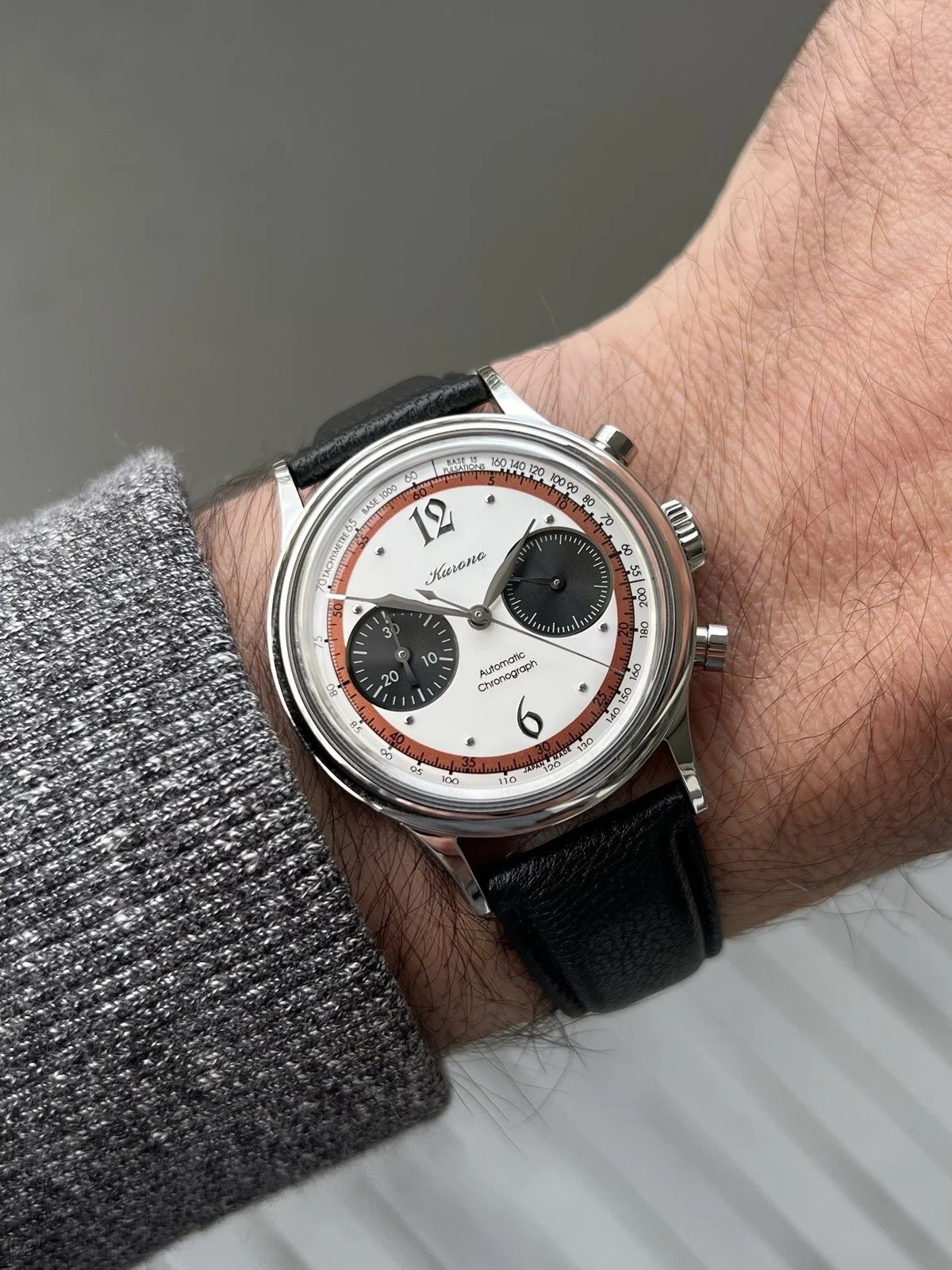
The visual impact of the Kurono Chronograph P1 is rooted in the principles of Art Deco, yet it is filtered through a distinctly Japanese lens. The dial is a multi-layered masterpiece, featuring a complex arrangement of scales—both a tachymeter on the outer periphery and a telemeter scale moving inward. This density of information is balanced by the impeccable execution of the sub-dials at 3 and 9 o'clock, which utilize a concentric 'azurage' finish to create a sense of depth and contrast against the primary dial surface.
The hands are a particular point of interest for the technical observer. They are not merely stamped; they are curved and polished to a mirror finish, a hallmark of Asaoka's attention to detail. The way the light plays across the high-polish surfaces of the 38mm 316L stainless steel case reflects a commitment to the 'Zaratsu-adjacent' finishing styles found in Japan's highest horological tiers. The case itself is a study in curves, with no sharp edges to be found, lending the watch an organic, pebble-like quality on the wrist.
The Heart of the Machine: The Seiko NE86 Caliber
While some might dismiss a non-Swiss movement, the selection of the Seiko NE86 for the P1 is a deliberate and technically sound choice. The NE86 is an integrated automatic chronograph movement that stands as a testament to Japanese engineering. Unlike many entry-level Swiss chronographs that utilize cam-actuated systems, the NE86 features a column wheel. This component, often found in much more expensive movements, ensures that the start, stop, and reset functions are crisp and tactile.
Furthermore, the inclusion of a vertical clutch system is a significant technical advantage. In traditional horizontal clutch systems, the engagement of the chronograph can lead to a slight 'jump' of the seconds hand as the gears mesh. The vertical clutch in the NE86 eliminates this, allowing for a perfectly smooth start. The movement also employs a triple-pointed hammer, a sophisticated mechanism that allows all three chronograph hands to be reset simultaneously and with perfect alignment. For the editor and the collector alike, these technical nuances justify the P1’s position as a serious horological instrument.
Wearability and Ergonomics
The dimensions of the P1—38mm in diameter and a lug-to-lug of 46.7mm—are an intentional nod to the golden age of chronographs from the 1940s and 50s. On the wrist, these proportions translate to a sense of effortless elegance. The watch does not shout; it whispers. The 13.9mm thickness is largely comprised of the box-section sapphire crystal, which adds a vintage warmth to the aesthetic while providing the scratch resistance of modern materials.
The ergonomics are further enhanced by the shape of the pushers. They are traditional pump-style pushers, but their placement and resistance have been tuned to provide a satisfying feedback. The crown, signed with the Kurono logo, is sized perfectly for manual winding, should the 45-hour power reserve need a supplement. It is a watch designed for the daily life of the urban professional, transitioning seamlessly from a boardroom setting to a weekend social gathering.
Investment and Market Context
From an investment perspective, the Kurono Chronograph P1 has outperformed almost every other watch in its initial price bracket. With only 68 pieces produced in the first run, the scarcity is real. On the secondary market, the P1 has become a 'grail' for many, with prices frequently reaching three times the original MSRP. This appreciation is driven not just by scarcity, but by the recognition of Hajime Asaoka as a living master of the craft.
For the collector, the value proposition lies in the combination of a master's design and a reliable, high-specification movement. It avoids the service headaches associated with vintage chronographs while offering the same soulful aesthetic. It is a piece that rewards close inspection with a loupe, revealing the precision of the dial printing and the consistency of the case polishing.
Final Verdict
The Kurono Tokyo Chronograph P1 is a triumph of vision over convention. It proves that a watch does not need a Swiss-made label or a five-figure retail price to be a work of art. By focusing on the fundamentals—proportion, light, and mechanical integrity—Hajime Asaoka has created a timepiece that stands as a benchmark for the industry. For those fortunate enough to own one, the P1 is not just a chronograph; it is a piece of horological history that captures the spirit of Japanese innovation and the timeless appeal of Art Deco design.