Why this watch matters more than its spec sheet
Kurono Tokyo does not build watches the way Swiss brands build watches. There is no catalogue, no configurator, no authorised-dealer network on every high street, and no press release full of tolerances and certifications. There is a design, announced in advance, made in a run small enough that most collectors will never see one in a boutique, sold largely through a lottery or a Japanese retail partner, and then gone. The Grand Jubilee Calendar is the calendrical entry in the brand's Grand line, and it is the clearest expression of what Kurono is actually selling: authored design and controlled supply.
That makes a conventional review almost useless. If you evaluate this watch on movement specification, water resistance, lume, and accuracy tolerance, it loses to a two-thousand-dollar Seiko on three of those four and ties on the fourth. If you evaluate it on the terms on which it is actually bought and sold — allocation mechanics, brand trajectory, fixed supply, secondary price behaviour — it looks considerably better.
So this review does both. It covers the object in the hand, and it covers the position in a collection. It also flags, repeatedly and deliberately, where the brand has not published information, because a review that fills those gaps with plausible-sounding numbers is not a review, it is fan fiction.
Kurono Tokyo: the Asaoka effect as a market force
Kurono Tokyo was launched in 2019 by Hajime Asaoka, one of Japan's most respected independent watchmakers. Asaoka's own bespoke work is a different universe entirely — hand-made, individually commissioned, priced where hand-made independently commissioned watches are priced. Kurono was the accessible outlet: the same eye for dial proportion, case profile and typographic restraint, applied to a production watch made in Japan and sold at a price a young collector could justify.
The brand's growth has been almost entirely word-of-mouth among collectors, which is the most durable kind. Its references do not advertise. They photograph exceptionally well, they read as obviously designed rather than obviously expensive, and they are made in quantities that make ownership feel like membership. That combination is precisely what turns a small Japanese atelier into a secondary-market story.
The Grand line is the top of the Kurono ladder. It represents the most ambitious case and dial work the brand does, and it is where the design language is most fully expressed. Every Grand release to date has been a single production run — not a permanent catalogue item that gets restocked, but a discrete event with a beginning and an end. That structural fact does more to explain the watch's resale behaviour than anything about the watch itself.
What the Grand Jubilee Calendar actually is
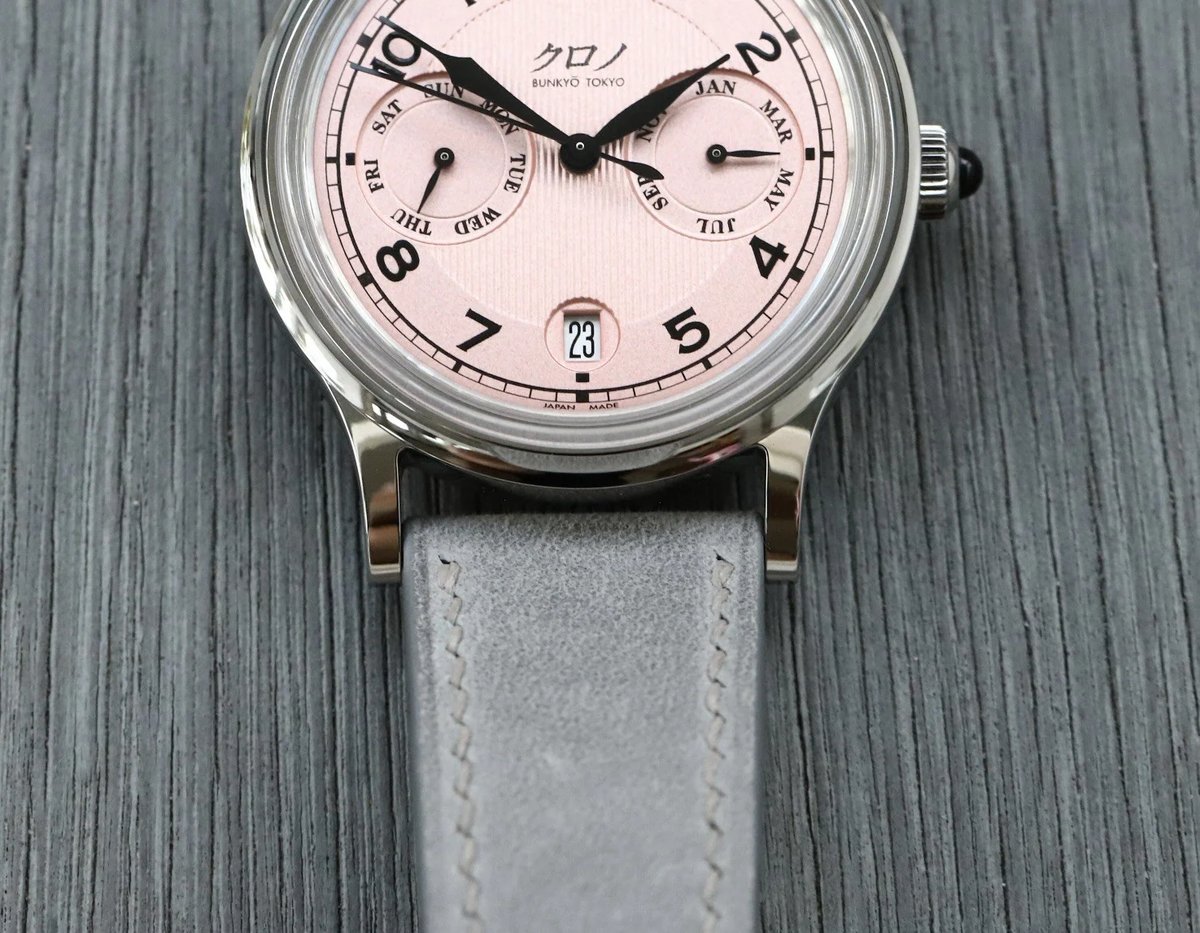
The name is literal: this is a Grand-line case and dial with a calendar function added. The calendar is displayed in a way that preserves the dial's calm rather than interrupting it, which is the central design challenge of any calendar watch and the thing Kurono handles better than most. A calendar complication adds information; the brand's instinct is to add information without adding noise, and the result reads as a dress watch that happens to know the date rather than a date watch that happens to be dressed.
What it is not is a technical showcase. There is no perpetual calendar mechanism, no leap-year complexity, no display-back theatre of hand-finished levers. Anyone comparing this to a Frederique Constant perpetual calendar on complication-per-dollar will find the comparison brutal and completely beside the point. The Grand Jubilee Calendar is a design object with a useful function, and it should be judged on whether the function is integrated gracefully. It is.
One structural caution for buyers: Kurono does not run a conventional variant matrix on Grand-line drops. Each release is a single configuration, and the brand does not restock a reference in the same form. When you are evaluating a specific example, verify the dial finish and the strap specification against the documentation from that specific drop. There is no general catalogue to fall back on.
Case, dial and finishing
The Grand-line case is the most persuasive argument the watch makes. It is a domed, softly profiled design with a pronounced mid-case and long, gradually tapering lugs — the kind of case that photographs flat and looks three-dimensional in the metal. Kurono's stainless steel cases are finished with a restraint that is rare at this price: broad polished surfaces, tight transitions, and an absence of the hard-edged, over-machined look that afflicts a lot of mid-market dress watches.
The dial is where the brand's reputation was built. Kurono's approach to colour, index geometry and typography is unmistakably Japanese and unmistakably Asaoka: asymmetric balance achieved through proportion rather than symmetry, indices placed with more care than the print suggests, and a willingness to let a dial be quiet. The calendar aperture is positioned so that it reads as part of the composition rather than an afterthought punched through the surface. Sapphire crystal covers it, as it should at this level.
The watch is supplied on leather with a pin buckle. That is the correct decision for a dress-oriented piece — a bracelet would fight the case profile and add visual weight the dial does not want. It also keeps the watch close to the wrist, which matters for how it actually wears. Buyers who intend to wear it hard should budget for a second strap, because leather at this price point is a consumable, not a permanent fixture.
The movement question — and why the answer is incomplete
Here is where honest reviewing gets uncomfortable. Kurono's Grand line uses a Japanese-made automatic base movement rather than an in-house calibre, and the brand's published technical documentation is deliberately lean. The calibre designation, beat rate, power reserve figure and jewel count are not consistently published across releases, and in the case of this reference, the brand has not put a complete technical sheet into the public domain in a form collectors can rely on.
That is not a scandal — plenty of small brands publish selectively — but it has real consequences. It makes independent valuation harder. It makes servicing conversations harder, because an independent watchmaker needs a calibre designation before quoting. And it makes the resale conversation harder, because a buyer cannot benchmark what is inside against anything published. If you are considering this watch, ask the selling dealer for the calibre designation and the authorised service route in writing. A dealer who cannot supply it is telling you something.
What can be said confidently is that the movement is a Japanese automatic of the class that has powered reliable, easily serviced watches for decades. It is not decorated for display and it is not certified as a chronometer. It is the correct choice for a brand prioritising design and price over mechanical theatre, and it will do its job for years with routine maintenance. It is simply not the reason to buy the watch.
On the wrist
The Grand Jubilee Calendar wears case-first. The domed profile and the long lugs mean the visual weight sits low and close to the arm, and because there is no bracelet pulling the head around, the watch stays put through a working day. There is no rotation, no flop, no constant readjustment — the small physical pleasures that separate a watch you wear from a watch you own.
On a smaller wrist, the Grand case sits comfortably within the arm's footprint and reads as a proper dress watch. On a larger wrist it reads as deliberate: a piece with presence rather than mass. It is not a watch that announces itself across a room, and anyone who wants that should look elsewhere. What it does do is reward the person sitting across the table.
The absence of lume is a design position rather than a cost saving, and it defines the watch's role. This is not a travel watch in the sense of a GMT, and it is not a watch for a dark cinema. It is a watch for daylight, meetings, dinners, and the specific pleasure of checking the date on something that was drawn rather than specified.
Accuracy, day to day
There is no chronometer certification and no published rate tolerance, so expectations should be set accordingly. Japanese automatic base movements of this class typically run within roughly minus ten to plus fifteen seconds per day across positions, with meaningful variation depending on state of wind and how the watch rests overnight. A well-regulated example will sit comfortably inside that band. A watch worn two days a week and left to stop will not, and never will.
The practical answer is that accuracy is not the point. If you need certified timekeeping, buy a certified watch. If you are buying a Kurono, you are buying a dial, a case and an allocation. Judge it on whether it makes you want to wear it, and set it once a week like everyone else who owns one.
The market: allocation, scarcity and the secondary spread
Kurono's commercial model is the single most important fact about owning one. Releases are announced in advance, produced in a fixed run, and sold through a lottery or a small number of Japanese retail partners. Western supply is structurally thin. That means the secondary market clears at a premium almost immediately after every drop, driven less by speculation than by simple arithmetic: more collectors want the watch than there are watches.
Grand-line references have historically been the strongest performers within the brand, for obvious reasons. They are the most ambitious designs, they are produced in the smallest numbers, and they attract the collector segment with the most staying power. The pattern across Kurono's history has been a sharp initial premium that compresses over the following twelve to twenty-four months, then settles onto a floor that has proved durable rather than spectacular. This is a scarce object with a soft floor, not a compounding asset.
Price discovery is genuinely difficult here, and any review that quotes you a confident range is guessing. Kurono is not an auction brand — there is no public record of hammer prices for this reference, because these watches trade through dealer networks and collector-to-collector rather than at auction. Current secondary pricing should be treated as an estimate in the low-to-mid four-figure USD band, and it should be verified against live dealer listings at the moment of purchase rather than taken from any published guide. Expect to pay a premium over the original issue price, and expect that premium to vary substantially by condition, completeness and the specific drop.
Issue pricing is set in Japan and converted, and it is not stable across drops. Do not anchor to a figure you read in a forum thread from two years ago.
Hold or sell?
Hold. The structural case for holding is straightforward: supply is fixed at a single run, the brand's cultural stock has risen consistently since 2019, and the Grand line sits at the scarce end of an already scarce catalogue. There is no mechanism by which more of this reference can enter the market. That is a stronger foundation than most limited editions can claim, because most limited editions are limited by a number the brand chose rather than by an actual production ceiling.
That said, be honest about what holding achieves. It protects capital reasonably well. It does not generate returns on the scale of sports-model Rolex, and it will not beat an index fund. The right framing is that you are holding a designed object with a durable floor, and the return you get is the pleasure of wearing something almost nobody else has. Collectors who buy Kurono as an investment and then complain about illiquidity have misunderstood the transaction.
If you do sell, sell into the first six to twelve months of a new drop, when attention is highest. Do not sell into a quiet quarter and expect the premium to hold.
Alternatives worth considering
If you want Japanese restraint with a date and a broader service network, a Grand Seiko SBGW231 gives you hand-wound mechanical purity, superlative case finishing and a far easier ownership experience. If you want complication-per-dollar and a genuine perpetual calendar, Frederique Constant's Slimline Perpetual remains the value benchmark and will embarrass almost anything at its price on specification. If you want German design authorship at a comparable level, the Nomos Tangente 38 Datum delivers it with more conventional distribution and published specifications.
None of them replicate what the Kurono does, which is to put a specific designer's hand on your wrist in a run small enough that ownership feels like participation. That is the whole argument, and it is a legitimate one.
At the entry end, a Seiko Presage Cocktail Time or an Orient Bambino will give you the silhouette and the Japanese dial sensibility for a fraction of the money, and neither will ever be mistaken for the real thing by anyone who knows what they are looking at.
Servicing and long-term ownership
Kurono does not publish an official service interval or a price schedule for the Grand line, and the base movement is a Japanese calibre that a competent independent watchmaker can service without difficulty. That said, the case and dial are limited-run parts, and authorised servicing is the safer route for anything involving the calendar mechanism or the dial furniture. Ask the selling dealer to document the authorised service route before you buy, and keep that documentation with the watch — it matters at resale.
Budget for a strap every couple of years if you wear it regularly. That is the real recurring cost of ownership, and it is the one most buyers forget to factor in.
Verdict
The Grand Jubilee Calendar is the right watch for the collector who already understands that Kurono's value proposition is authorship and scarcity rather than specification. Buy it because you want a calendar watch drawn by Hajime Asaoka and produced in a run small enough that you will rarely encounter another in the wild, and accept that the technical documentation is thin, the allocation is awkward, and the price discovery is opaque.
Hold it if you own it. The supply is fixed, the brand is on a multi-year upward trajectory, and the floor has held through every cycle so far. But do not mistake a scarce, well-designed object for a compounding financial asset — and do not buy one on the assumption that a confident number on a review site is a fact. It is not. Verify everything that matters before you commit.