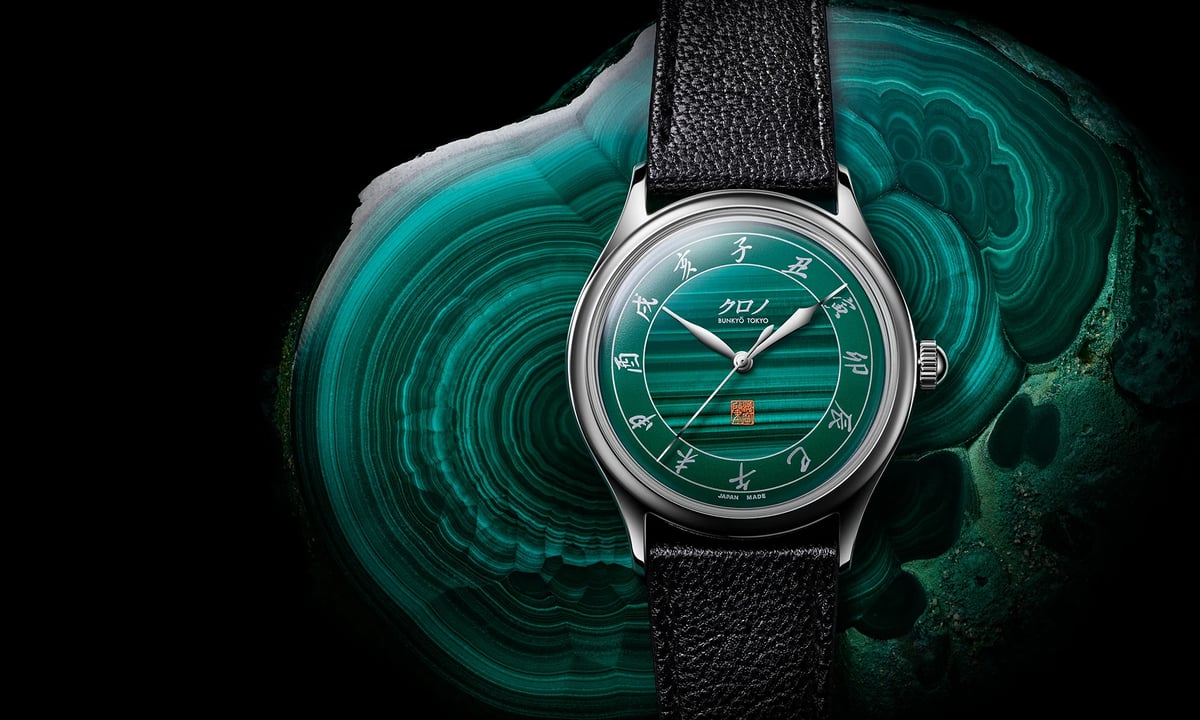
The Cult of the Anniversary: Why the Malachite Matters
In the world of luxury horology, the 'Anniversary' tag is often used as a lazy excuse to slap a new color on an existing model. But with Kurono Tokyo, the anniversary release is a ritual. It is the one time a year when Hajime Asaoka opens the gates to his design philosophy for a broader audience, usually through a time-limited ordering window that creates a digital stampede. The 2024 'Malachite' is the latest iteration of this phenomenon, and it arrives at a time when the watch market is undergoing a necessary correction. Gone are the days of 'flipping' a watch for 300% profit within minutes. Today’s collector is smarter, more discerning, and focused on long-term value. The Malachite addresses this shift by offering a dial that is arguably the most complex in the brand's history.
The allure of the Malachite isn't just in its scarcity; it's in the 'Asaoka DNA.' Hajime Asaoka is a member of the AHCI (Académie Horlogère des Créateurs Indépendants), a group that includes legends like F.P. Journe and Philippe Dufour. When you buy a Kurono, you are buying into that lineage. You are buying a watch designed by a man who builds tourbillons by hand in a Tokyo studio. This 'trickle-down' horology is the primary driver of Kurono’s market value. The Malachite, with its deep green, banded lacquer dial, feels like a piece of art that just happens to tell time. It represents a 'smart' buy—a watch that shows you know your history but aren't afraid to play with the 'new guard' of Japanese independents.
The Dial: A Masterclass in Lacquer and Light
Let’s be clear: this is not a solid stone dial. To expect a slice of genuine malachite at an $1,800 price point is to fundamentally misunderstand the economics of watchmaking. However, what Asaoka has achieved with lacquer is perhaps even more impressive. The dial is created using a multi-layered process that involves printing and lacquering to achieve a depth that mimics the natural striations of the mineral. Under a macro lens, the transitions between the dark forest greens and the vibrant emerald bands are seamless. It creates a sense of movement on the dial that changes depending on the light source—shifting from a near-black in low light to a vivid, mossy glow in direct sunlight.
The layout remains quintessentially Kurono. The high-polish 'Bunkyo Tokyo' signature at 12 o'clock and the minimalist handset ensure that nothing distracts from the texture of the dial. There is no date window to clutter the symmetry, a choice that collectors have lauded since the brand's inception. This dedication to purity is what separates Kurono from other brands using off-the-shelf movements. The design is the protagonist here, not the caliber.
Technical Specifications and the 'Miyota Question'
The elephant in the room with every Kurono review is the movement. The Malachite is powered by the Miyota 90S5. In the circles of 'Old Money' horology, a Miyota is often looked down upon as a 'microbrand' movement. But Edward Sterling’s take is different: in a watch where the value proposition is 90% design and 10% mechanics, the 90S5 is the perfect choice. It is ultra-slim, allowing the case to sit just 7mm thick (excluding the sapphire box crystal). It is reliable, easily serviced by any watchmaker from London to Tokyo, and it keeps the entry price at a level that encourages a younger generation to start their collecting journey.
The case itself is a work of art. 316L stainless steel, finished to a mirror polish that rivals Grand Seiko’s Zaratsu. The 37mm diameter is a nod to the mid-century dress watches that Asaoka admires. On the wrist, the proportions are flawless. It doesn't scream for attention with size; it whispers for it with elegance. The 3 ATM water resistance is, admittedly, a drawback. This is a watch for the boardroom, the gallery opening, or the rooftop lounge—not the poolside at the Aman. But if you're buying a lacquered anniversary piece to go swimming, you've missed the point entirely.
Market Analysis: Hold vs. Flip
From an investment perspective, the Kurono Anniversary Malachite is a fascinating case study. The 'Mori' (2020) remains the high-water mark for the brand, with secondary prices still commanding a significant premium. The Malachite, while sharing that green-dial DNA, enters a more mature market. The initial 'hype' has stabilized, which is actually good news for the long-term collector. We are seeing a shift from speculative buying to 'passion' collecting.
The secondary market range of $2,200 to $2,800 reflects a healthy 20-50% premium over retail. This indicates that while the 'get rich quick' flippers have moved on to the next crypto-trend, the horological community still values the brand. My recommendation? This is a 'Hold.' As Hajime Asaoka’s personal star continues to rise in the AHCI world, these early Kurono pieces will be viewed as the 'early works' of a master. They are the 5402s of the future—perhaps not in price, but certainly in cultural significance within the Japanese indie scene.
The Verdict: Who is the Malachite For?
The Kurono Anniversary Malachite is for the collector who is tired of the waitlists and the games played by the 'Big Three' Swiss brands. It is for the individual who appreciates the 'Wabi-Sabi' philosophy—the beauty of imperfection and the organic feel of the lacquered dial. It is a watch that says you are 'in the know.' It’s the kind of piece that sparks a conversation at a Soho House bar among people who actually know the difference between a mass-produced luxury item and a piece of design-led horology.
In conclusion, the Malachite is a masterclass in aesthetic execution. It doesn't try to be a dive watch, a pilot watch, or a 'do-it-all' sports watch. It is a dress watch with a soul, designed by one of the greatest living watchmakers, and offered at a price that—while premium for a Miyota—is a bargain for the design. If you can find one near the $2,500 mark, pull the trigger. Your future self (and your portfolio) will thank you.