The Genesis of the Celestial Special Project
In the high-stakes world of luxury horology, the name Hajime Asaoka carries a weight similar to that of Philippe Dufour or F.P. Journe, albeit with a distinctly Japanese modernist flair. When Asaoka launched Kurono Tokyo in 2019, the mission was clear: to offer the design language of his bespoke pieces—which often command six-figure prices and years-long waiting lists—to a wider audience. The Kurono Tokyo Special Projects INSEKI '隕石' is perhaps the most literal interpretation of this mission, utilizing a slice of the cosmos to create a dial that is as much a piece of natural history as it is a timekeeping instrument.
The INSEKI is not just another dial color variation. It belongs to the 'Special Projects' designation, a category within the Kurono ecosystem that typically involves more complex manufacturing processes or rarer materials. For the market-driven collector, this distinction is critical. While the 'Anniversary' pieces like the Toki or the Seiji are produced in larger quantities to meet demand, the Special Projects are inherently more limited by the availability of materials—in this case, the Muonionalusta meteorite.
The Dial: A Study in Widmanstätten Geometry
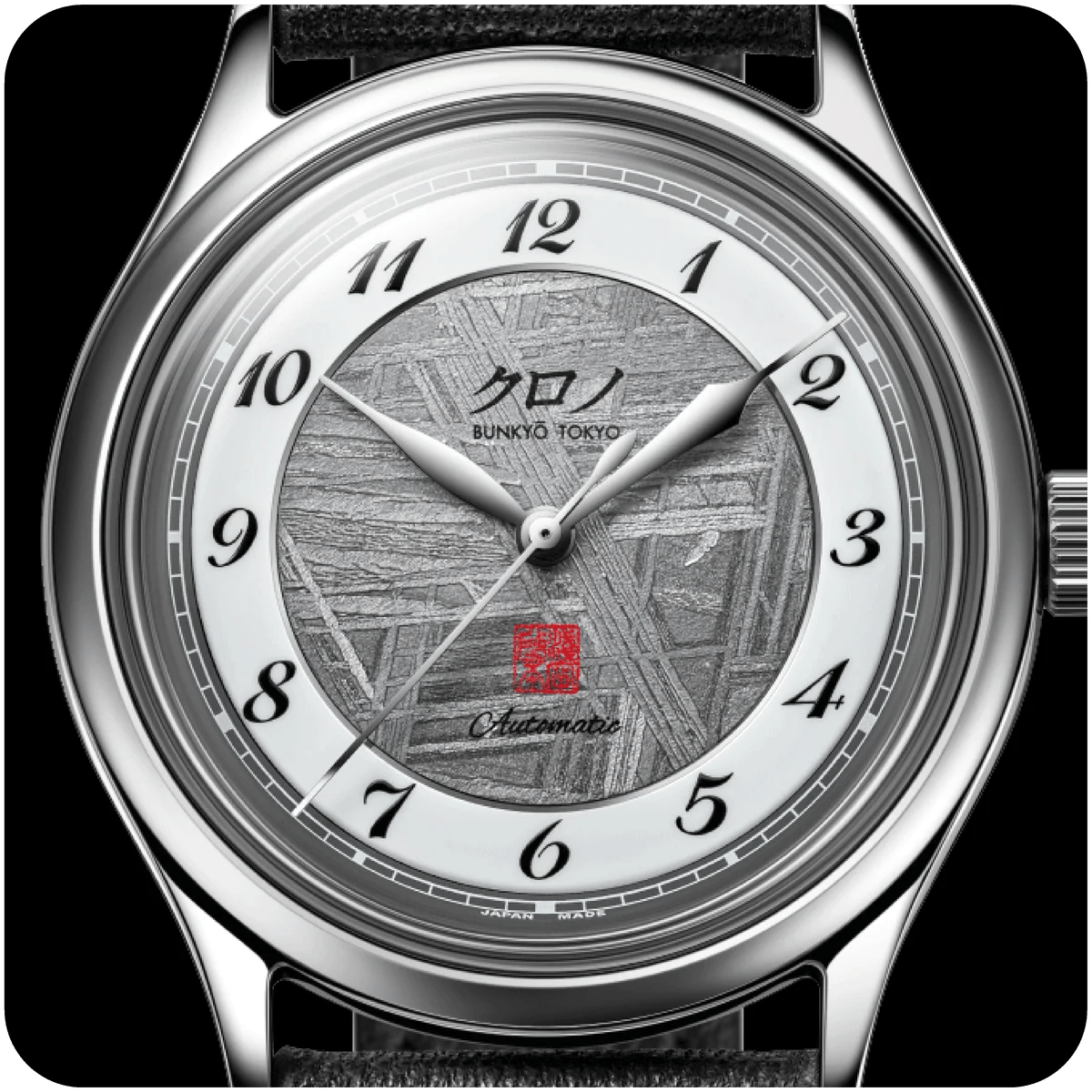
The centerpiece of the INSEKI is, undoubtedly, the dial. Sourced from the Muonionalusta meteorite, which impacted northern Scandinavia roughly one million years ago, the material is characterized by its Widmanstätten pattern. This unique crystalline structure is the result of the meteorite cooling over millions of years in the vacuum of space. When the iron-nickel alloy is sliced and etched with acid, these patterns are revealed, ensuring that no two INSEKI watches are identical.
From an investment perspective, this 'unique piece' attribute within a serialized production run is a significant driver of value. Collectors often pay premiums for specific patterns—some preferring tighter, more geometric lines, while others seek out more chaotic, organic textures. The dial is further enhanced by Kurono’s signature polished 'dots' for hour markers and the refined, tapered handset that has become a hallmark of Asaoka’s aesthetic. The lack of a date window preserves the symmetry of the dial, allowing the celestial material to take center stage.
Technical Architecture and the Miyota Debate
Under the hood of the INSEKI lies the Miyota 90S5. For some purists, the use of a mass-produced Japanese movement in a watch costing several thousand dollars on the secondary market is a point of contention. However, an analyst must look at the broader picture. By utilizing the 90S5, Kurono ensures three things: reliability, serviceability, and a slim case profile.
The 90S5 is a high-beat movement, oscillating at 28,800 vibrations per hour, which provides a smooth sweep of the seconds hand. It is also a 'true' no-date movement, meaning there is no 'ghost' crown position—a detail that sophisticated collectors appreciate as it demonstrates a commitment to the integrity of the design. From a maintenance standpoint, the 90S5 can be serviced by almost any watchmaker globally, a stark contrast to the proprietary movements of Swiss maisons that require expensive, long-duration factory servicing. This keeps the 'total cost of ownership' (TCO) low, a factor often overlooked by younger collectors but vital for long-term hold strategies.
Market Dynamics: The Kurono Premium
To understand the INSEKI’s value, one must look at the demand cycles of the brand. Kurono Tokyo pioneered the 'timed release' model, where a watch is available for a short window (often 10 to 20 minutes) to anyone who wants one, followed by a permanent cessation of production. This creates an immediate supply-demand imbalance once the window closes. The INSEKI, however, was part of a more restricted allocation, making it rarer than the high-volume Anniversary releases.
Current resale data shows the INSEKI holding a steady premium. While the broader watch market has seen a correction in 2023 and 2024, Kurono’s 'Special Projects' have proven more resilient than their entry-level counterparts. The INSEKI currently trades in the $3,500 to $4,500 range, a healthy margin over its original MSRP. For the serious collector, this suggests that the watch has moved past the 'hype' phase and into the 'collectible' phase, where its value is supported by its intrinsic rarity and the reputation of Hajime Asaoka.
Wrist Feel and Ergonomics
The 37mm case is a masterclass in proportions. In an era where many brands are downsizing from the oversized trends of the 2010s, Kurono was ahead of the curve. The 11.5mm thickness is deceptive; a significant portion of that height comes from the box-style sapphire crystal, which adds a vintage warmth to the piece. The actual steel mid-case is quite thin, allowing the watch to sit low on the wrist.
The lug-to-lug distance of 43.5mm is particularly well-judged. It provides enough 'span' to give the watch presence on a 7.5-inch wrist, yet remains perfectly wearable for those with 6-inch wrists. The high-polish finish on the case is executed to a standard that rivals Grand Seiko’s Zaratsu polishing, creating a mirror-like surface that reflects the environment and adds to the watch’s visual complexity.
The Verdict for the Sophisticated Collector
Is the Kurono Tokyo INSEKI a 'buy' in the current market? For the collector who prioritizes movement manufacture above all else, perhaps not. But for the collector who views horology as a form of wearable art and a speculative asset, the INSEKI is an essential acquisition. It captures a specific moment in Japanese watchmaking history—the rise of the 'accessible independent.'
The combination of a Muonionalusta meteorite dial, the design pedigree of Hajime Asaoka, and the limited nature of the Special Projects series makes the INSEKI a robust choice for a diversified portfolio. It is a watch that performs equally well at a black-tie event as it does in a casual setting, and its market data suggests that it will remain a sought-after piece for years to come. In the world of Vivir, where we value both the soul of the watch and its performance as an asset, the INSEKI receives a high recommendation.