The watch that disappears from the shop before you finish reading about it
Kurono Tokyo does not behave like a watch brand. It behaves like a small atelier that opens a door twice a year, sells everything in the room within minutes, and then goes quiet again. There is no showroom, no dealer network, no glossy catalogue explaining what you are about to buy. There is a web page, a date, and a queue.
That model has made the Tokyo label — the accessible project of independent watchmaker Hajime Asaoka — one of the most talked-about small names of the past half-decade. It has also made reviewing one slightly awkward, because Kurono is far more interested in how a dial reads in the hand than in how a case measures on a calliper. The Structure Chronograph S1 continues the pattern: a chronograph built around dial architecture, depth and colour rather than around a headline specification.
Which is exactly why I wore it for a week instead of a morning. A watch like this lives or dies on the second, fourth and seventh day — when the novelty has burned off and what is left is the simple question of whether you reach for it again.
From tourbillons to a Tokyo postcode
Hajime Asaoka built his reputation the hard way. Working essentially alone in Tokyo, he produced hand-made tourbillons under his own name — pieces with tiny annual output, prices to match, and finishing executed by a single pair of hands. He is one of very few Japanese independents to have earned serious collector attention outside Japan on the strength of hand work rather than marketing spend.
Kurono Tokyo, launched in 2019, was the other half of that idea. What if the same designer's eye — the love of dense, mid-century Japanese graphics, of deep, saturated dial fields, of typography borrowed from earlier signage — could be put on a wrist for the price of a mid-range Swiss watch? The answer arrived as a series of small, numbered batches made in Japan, sold direct, and gone almost immediately.
That is the context the S1 lands in. Kurono's chronograph line has always been the most mechanical expression of the brand's design language: more components, more dial furniture, more to look at. The S1 pushes hardest on the first half of its name.
What "Structure" actually means
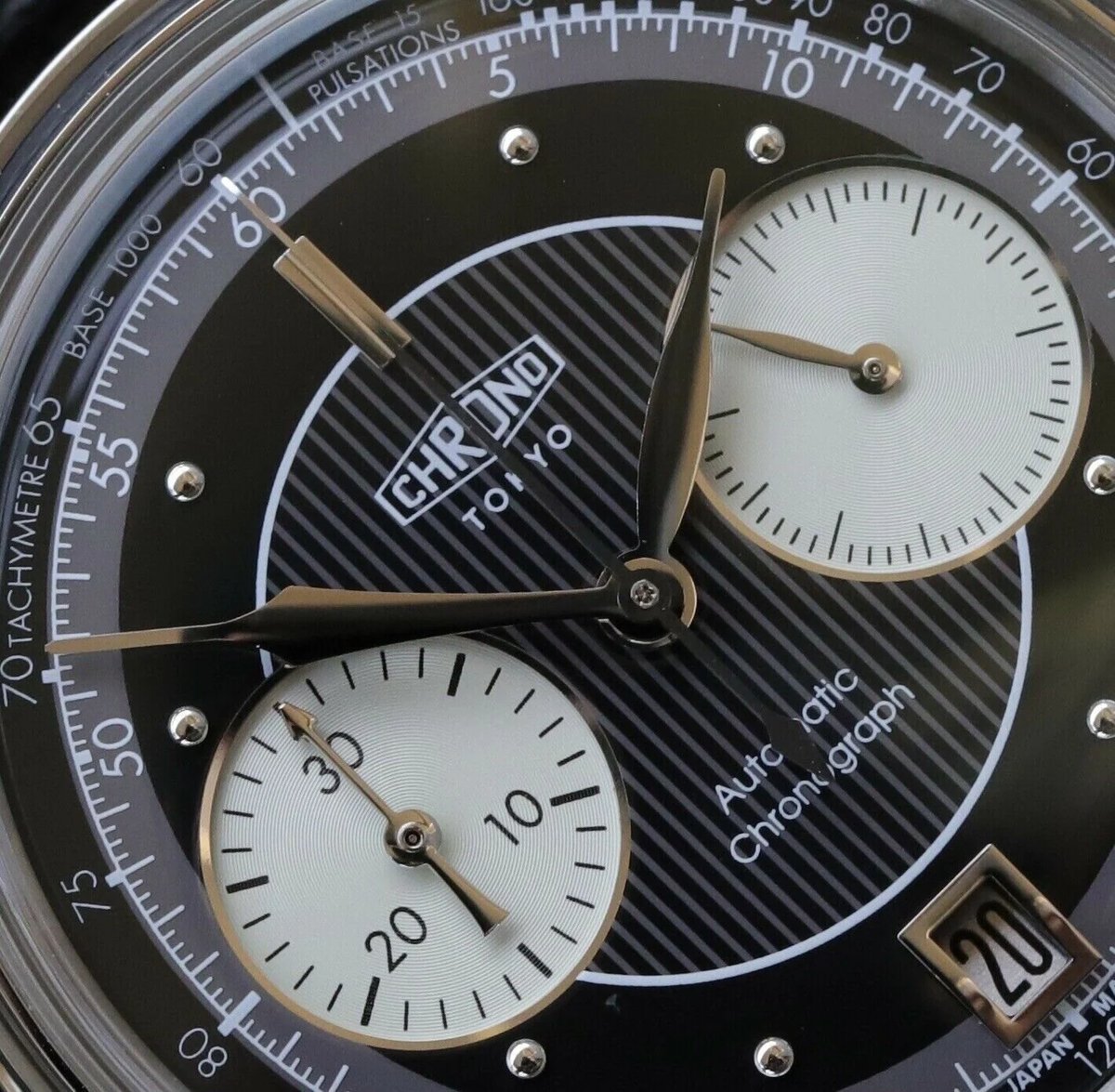
The organising principle here is depth. Kurono's best dials are not flat surfaces with things printed on them; they are shallow stages, built up in layers so that light lands differently on each plane. On the S1 that instinct is pushed further than on the brand's simpler three-handers, because a chronograph gives a designer more furniture to arrange — registers, a chapter ring, an outer track, hands at three different heights.
The result is a dial that rewards close looking and, crucially, does not fall apart at arm's length. That is harder to pull off than it sounds. Dense chronograph dials frequently collapse into visual noise the moment you step back from them, and the S1 avoids that by being ruthless about contrast rather than about decoration: the elements that need to be read first are the elements with the sharpest edge separation, and everything else is allowed to recede into shadow.
Typography does a lot of work. Kurono's lettering has always leaned on Japanese graphic traditions rather than Swiss ones, and the effect on the wrist is a chronograph that feels like an artifact from a different design lineage — familiar in layout, unfamiliar in accent. It is the sort of thing that makes strangers ask what it is, and makes watch people ask it more urgently.
On the wrist
The first thing that registers is restraint. This is a chronograph that behaves like a dress watch: it reads compact and vintage-leaning, with a case that settles rather than perches and a centre of gravity close enough to the arm that you stop noticing it by mid-morning. Nothing about it wants to be the loudest object in the room.
Balance is the reason it works. A chronograph carries more weight and more visual mass than a three-hander, and the failure mode is a watch that feels top-heavy and rotates on the wrist whenever you gesture. The S1 does not do that. On a leather strap with a pin buckle it is a genuine all-day object — light enough to forget during a long train ride, stable enough that you are not constantly recentring it.
The honest caveat is that comfort here is largely a strap story. Kurono ships leather, and leather is the right call for a watch with this much dial and this little tool-watch ambition — but a soft, broken-in strap transforms it. Swapping to a thin, unlined leather or a simple suede in the first week is the cheapest upgrade an owner can make, and it changes the felt sense of heft more than any case measurement could communicate.
A week in real life
Monday. The cuff test is the first real test any dress-adjacent chronograph faces, and the S1 passes it without drama. It slides under a shirt cuff instead of fighting it, which sounds like a small thing until you spend a day with a watch that does not. The pushers sit proud enough to find by feel but not so proud that they snag on fabric.
Wednesday. Legibility under office lighting is where the dial design earns its keep. Long, unbroken hand shapes and clear edge separation between the registers and the base dial mean you can read the time at a glance mid-conversation, which is the only legibility test that matters. The chronograph registers are legible but deliberately secondary — you can read elapsed minutes when you want to, and ignore them the rest of the time.
Friday. Pusher feel is the detail that separates a good chronograph from an adequate one, and this is where the column-wheel and vertical-clutch arrangement shows itself. The start is crisp, the stop is clean, and the reset snaps back to zero without the seconds hand twitching off the mark. Owners rarely run this test; they should, because a reset that lands fractionally off is a permanent irritation.
Saturday. Here the S1 is out of its element and knows it. There is no luminous treatment anywhere on the dial, which is a deliberate design choice rather than an oversight — this is an object built around contrast and colour, not around a dark-adaptation strategy. A late film, a dim bar, a power cut: you will be squinting. If you want a watch that reads at 2am, this is not it, and Kurono has never pretended otherwise.
Sunday. The last-day test is whether you take it off out of habit or out of relief. The S1 passed. The dial still looked good in flat grey light, the strap had taken the shape of the wrist, and nothing about the watch had started to feel like a costume.
The lume and water question, answered honestly
Two things need saying plainly. First, there is no luminous paint here. That is consistent with the brand's design philosophy and with the dress-watch brief, but it means the S1 is not the watch you keep on in a dark hotel room.
Second, Kurono has not published a headline water-resistance figure for this reference, and the case architecture — a slim, elegant, dress-leaning chronograph on a leather strap — should tell you everything you need to know about how to treat it. Wash your hands carefully, keep it out of the pool, and take it off before you do anything involving a screwdriver. Treat it as a fair-weather watch and you will never be disappointed; treat it as a sports chronograph and you will be.
The movement, and what we actually know
Kurono has not published a full technical dossier for the S1, and I am not going to invent one. What is well established across the brand's chronograph line is a reliance on Japanese-produced chronograph architecture built around a column wheel and a vertical clutch. That matters more on the wrist than it does on paper. A column wheel gives a light, precise pusher stroke; a vertical clutch lets the chronograph start without the slightest jump of the seconds hand and keeps the running seconds unaffected while the chronograph is engaged.
What you feel, in other words, is a shove rather than a squeeze — a distinctly mechanical, slightly old-fashioned satisfaction that has become rare at the more accessible end of the chronograph market, where modular cam-driven movements are the norm. It is the single strongest argument for owning the S1 over a well-made but inert alternative.
What you do not get is a decorated display-back show, or a published rate specification, or a chronometer certificate. Asaoka's priorities are visible on the front of the watch, not through the back of it.
Accuracy in ordinary use
There is no certification and no published rate, so expectations should be set accordingly. Over a week of mixed wear the S1 ran consistently — no drift dramatic enough to notice when checking against a phone clock each morning, and nothing that suggested the movement needed settling after shipping. A well-regulated Japanese automatic of this class typically lands within a handful of seconds a day in either direction. If yours is wildly outside that band, it is a regulation issue rather than a design flaw, and it is worth raising with the brand early.
The chronograph itself started, stopped and reset cleanly throughout, including a long timing run during a genuinely tedious meeting that I will not describe further.
Ownership reality: service, straps and the drop
Kurono services through its own channel in Japan rather than through a national distributor network. For owners in Japan that is straightforward. For everyone else it means return shipping, a wait, and the mild anxiety of sending a scarce object across a border. None of this is unusual for an independent, but it is a cost that should be priced in before purchase rather than discovered afterwards — particularly because a watch you cannot easily service locally is a watch you will hesitate to wear hard.
The strap situation is simpler and more cheerful. The lug geometry accepts a standard strap, which means the S1 is one of the easiest watches in this price bracket to personalise. A thin honey-brown calf, a grey suede, a soft navy — each changes the watch's register completely, from formal to something closer to weekend wear.
Value, scarcity and what the market actually says
Kurono sells direct, in single batches, without a permanent catalogue — so the secondary market exists because supply was fixed at the moment of release, not because the brand engineered a waitlist. That is a meaningful distinction. Historically, Kurono pieces have traded at or above issue in the immediate aftermath of a drop and then settled as the noise faded, which is the signature of scarcity rather than of collector frenzy.
There is no major auction history to point to, and no certified limited-edition provenance in the Swiss sense. Anyone buying the S1 as an investment is buying a thesis about taste. Anyone buying it to wear is buying something considerably more defensible: a small-batch, design-led chronograph with column-wheel actuation, made in Japan, that you will almost certainly never see on another wrist in your city. On that basis the value case is honest, even if it is not exciting.
What else to consider
If you want more watch and less poetry, the Zenith Chronomaster Sport delivers the same column-wheel satisfaction with a bracelet, a hundred metres of water resistance and a servicing network on every continent. The Grand Seiko Tentagraph is the technically superior Japanese answer, with a spring-drive chronograph movement that is genuinely remarkable and a case that is genuinely large. The Tudor Black Bay Chrono is the tool-watch reading of the same brief, and it will survive a decade of careless wear that would horrify the S1.
Further down the scale, the Baltic Tricompax chases the same mid-century chronograph proportions for a fraction of the money, and the Dan Henry 1964 does something similar for less again. None of them have Asaoka's hand on the dial, which is either the whole point or entirely irrelevant, depending on what you are buying.
The verdict
The Structure Chronograph S1 is not the chronograph you buy because you want the best-specified one at the price. It is the one you buy because you looked at the dial and could not quite stop looking at it, and because you want a pusher stroke that feels like something rather than a switch.
On the wrist it is comfortable, quietly distinctive and mechanically satisfying, provided you accept two things: that it is a fair-weather object, and that its spec sheet is deliberately thin. Wear it for a week and the absence of a headline number stops mattering. The absence of lume does not — but then, Asaoka never pretended it would.