The Architecture of an Aviator: The Laco Monte Carlo
To understand the Laco Monte Carlo, one must first understand the environment for which it was conceived. In the cockpit of a mid-century aircraft, a watch was not a luxury; it was a redundant flight instrument, essential for dead reckoning and fuel management. The Monte Carlo ref. 861815 translates this necessity into a modern context, utilizing the architecture of the Valjoux 7750 to provide a tri-compax layout that remains legible under the most demanding conditions.
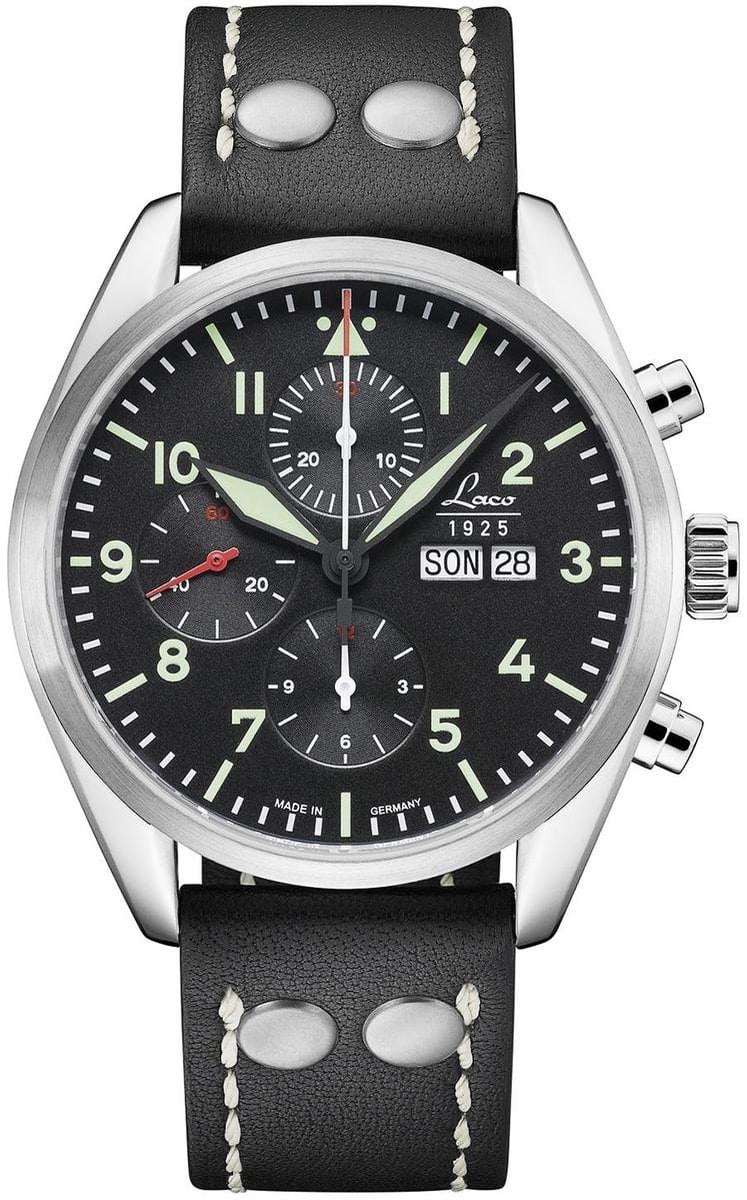
The case of the Monte Carlo is executed in 316L stainless steel, featuring a brushed finish that is both aesthetically pleasing and functional, as it minimizes reflections that could distract a pilot. Measuring 44mm in diameter, the case provides ample real estate for the dial, ensuring that the chronograph sub-dials are large enough to be read at a glance. The sapphire crystal is slightly domed and treated with an anti-reflective coating, further enhancing the clarity of the matte black dial.
The Heartbeat: Laco 50 and the Valjoux 7750 Legacy
At the core of the reference 861815 is the Laco 50 movement. For the uninitiated, this is Laco’s designation for the ETA/Valjoux 7750, perhaps the most famous automatic chronograph movement in history. Since its introduction in the early 1970s, the 7750 has been the backbone of the mechanical chronograph industry, known for its incredible robustness and ease of service.
Technical enthusiasts will appreciate the cam-actuated mechanism of the 7750. Unlike a column-wheel chronograph, which requires precise hand-finishing and is more susceptible to shock, the cam system is engineered for durability. When you engage the pusher at 2 o'clock, there is a tactile, heavy resistance followed by a definitive 'snap' as the chronograph starts. This is the hallmark of the 7750 architecture. The movement also features a day and date complication at 3 o'clock, a practical addition for a daily wearer. The unidirectional winding rotor is another characteristic feature; it spins freely in one direction, often creating a subtle vibration on the wrist—a phenomenon known affectionately by collectors as the '7750 wobble.'
Dial Layout and Legibility
The dial of the Monte Carlo is a masterclass in functional design. Following the traditional pilot watch aesthetic, the base is a deep matte black, which provides maximum contrast for the white Arabic numerals and hands. The use of Super-LumiNova C3 ensures that the watch remains highly visible in low-light environments, glowing with a bright green hue that is synonymous with vintage aviation instruments.
The sub-dial arrangement is classic 7750: a 30-minute counter at 12 o'clock, a 12-hour counter at 6 o'clock, and running seconds at 9 o'clock. Laco has wisely kept the sub-dials clean, avoiding unnecessary decorative concentric circles (guilloché) to maintain the instrument-like feel. The central chronograph seconds hand is slender and reaches the edge of the minute track, allowing for precise timing down to the fraction of a second.
On the Wrist: A Presence of Purpose
Wearing the Laco Monte Carlo is an exercise in appreciating scale. With a thickness of 15mm, it is a tall watch. It does not pretend to be a dress watch, and it will likely struggle to fit under the tight cuff of a formal shirt. However, when paired with a leather flight jacket or casual attire, it looks perfectly at home. The 52mm lug-to-lug distance is significant, but the lugs are tapered sharply, which mitigates the 'overhang' effect on smaller wrists.
The strap is equally impressive. Laco provides a thick, black calf leather strap with contrasting white stitching. The quality of the leather is evident from the first wear; it is supple yet sturdy, and the stainless steel pin buckle is signed with the Laco logo, providing a cohesive finishing touch. For those who prefer a more utilitarian look, the Monte Carlo also pairs exceptionally well with a grey or black NATO strap, which further emphasizes its military heritage.
Engineering and Finishing Details
While Laco is often praised for its historical accuracy, the Monte Carlo shows a more refined side of the brand's manufacturing capabilities. The transition between the brushed surfaces of the case and the polished edges of the pushers and crown is crisp, indicating high-quality CNC machining and hand-finishing in Pforzheim. The screw-down case back is engraved with the Laco logo and technical specifications, protecting the movement and contributing to the 5 ATM water resistance rating.
One detail that often goes unnoticed is the crown design. It is a 'diamond' or 'onion' style crown, slightly oversized to allow for easy manipulation even while wearing gloves. This is a direct nod to the original B-Uhr watches, where pilots needed to adjust their timepieces in freezing cockpits. In the Monte Carlo, it serves as a tactile reminder of the watch's origins.
Investment and Market Positioning
In the current horological market, the Laco Monte Carlo 861815 occupies a unique 'sweet spot.' At a retail price of just under $2,000, it offers a genuine German-made alternative to the more expensive Swiss chronographs from brands like IWC or Breitling. While it may not have the same level of brand recognition among the general public, it carries immense respect within the enthusiast community.
From an investment perspective, the Monte Carlo is a stable asset. It is not prone to the wild price fluctuations seen in the luxury integrated-bracelet steel watch market. Instead, it maintains a steady value on the secondary market, making it a safe entry point for a young collector looking to acquire their first serious mechanical chronograph. Its reliance on the ETA 7750 base also ensures that maintenance costs will remain reasonable over the lifetime of the watch, as parts are readily available globally.
Final Thoughts
The Laco Monte Carlo 861815 is a watch for the individual who appreciates the 'form follows function' philosophy. It is a heavy-duty instrument that honors Laco's century-long history while providing the modern features—automatic winding, sapphire crystal, and day-date functionality—that make it a practical daily companion. It is a piece of Pforzheim engineering that wears its history on its sleeve, or rather, on the wrist of the sophisticated collector who knows that true luxury lies in mechanical integrity and historical authenticity.