The Pforzheim Pedigree: Why Laco Matters
To understand the Laco Phoenix, one must first understand the soil from which it grew. Pforzheim, Germany, is not just a city; it is the heart of the German jewelry and watchmaking industry. Laco’s history is inextricably linked to this city’s resilience. During World War II, Laco was one of only five companies—alongside A. Lange & Söhne, IWC, Wempe, and Stowa—tasked with producing the B-Uhr. These were not mere watches; they were navigational instruments, oversized and hyper-accurate, meant to be worn over flight suits.
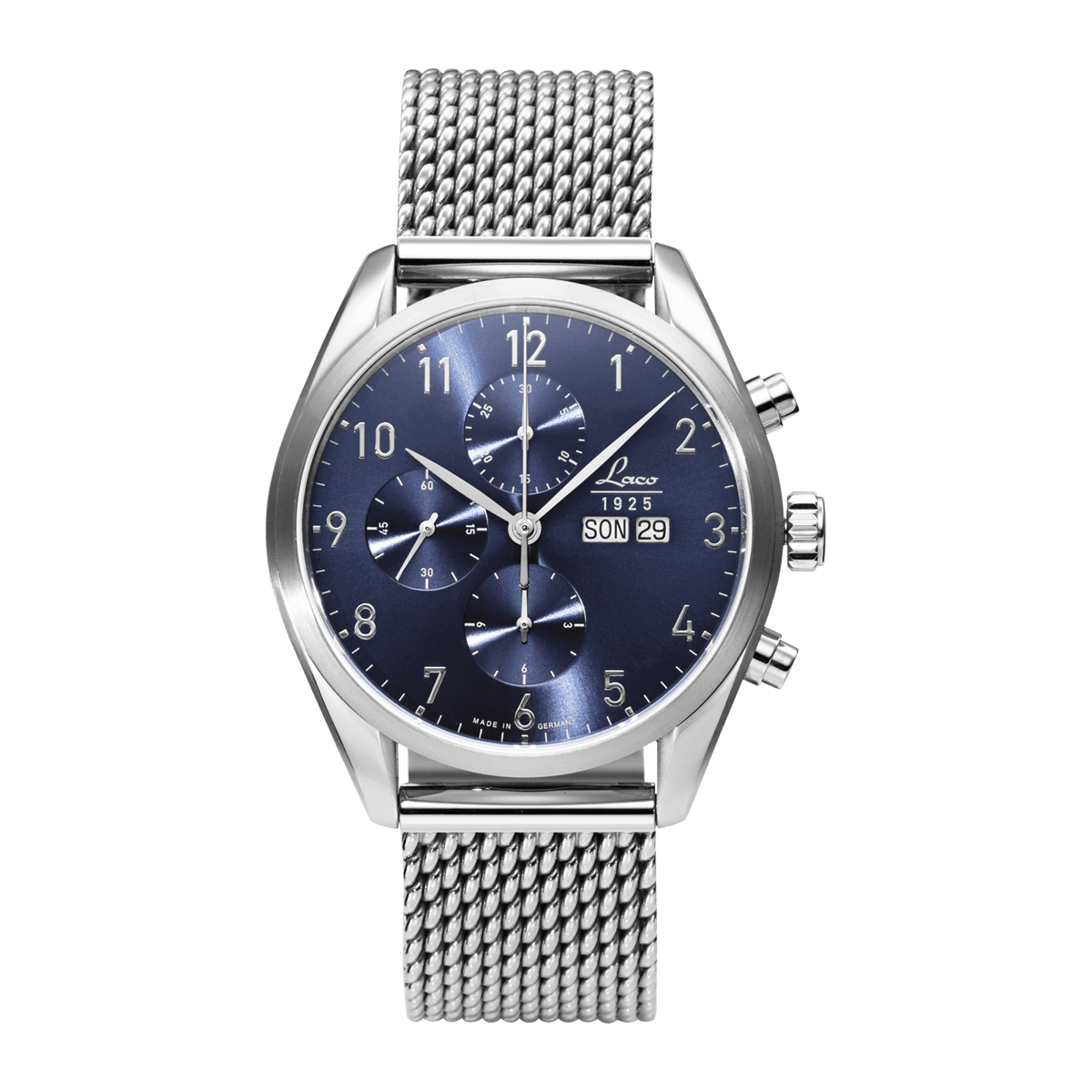
The Phoenix Ref. 861916 carries this DNA, but it refuses to be a prisoner of the past. While Laco’s 'Original' line caters to purists who want every detail of the 1940s models, the 'Special Models' like the Phoenix are for those of us who live in the present. They take the technical requirements of the pilot—clarity, durability, and ease of use—and translate them into a form factor that fits into a modern lifestyle.
Case and Construction: The Beauty of Sandblasting
The first thing you notice when picking up the Phoenix is the finish. Most luxury watches use a mix of brushed and polished surfaces to create a play of light. Laco has gone in the opposite direction here. The entire 42mm stainless steel case is sandblasted to a uniform, matte grey finish. This serves two practical purposes: it eliminates glare, which is essential for pilots, and it makes the watch incredibly resistant to the visible signs of daily wear. Minor scuffs and 'desk diving' marks that would ruin a polished bezel simply disappear into the matte texture of the Phoenix.
At 13mm thick, the watch has a presence. However, the lug-to-lug measurement of 50mm is the critical number for the daily wearer. On my 6.75-inch wrist, the lugs reached toward the edges but did not overhang. The straight, purposeful lines of the case give it a 'blocky' feel that reinforces its tool-watch credentials. This is a watch that feels like it could survive a drop, a scrape against a brick wall, or a sudden change in cabin pressure without losing its composure.
The Dial: A Study in Contrast
Legibility is the primary 'complication' of any pilot watch, and the Phoenix excels here. The dial is a deep, matte black that absorbs light, providing the perfect backdrop for the stark white Arabic numerals. But the star of the show is the use of orange. The minute track and the seconds hand are rendered in a vibrant, safety orange that pops against the monochrome base. This isn't just an aesthetic choice; it draws the eye immediately to the most critical information.
The use of Super-LumiNova C3 ensures that the watch remains readable long after the sun has set. C3 is known for its bright green glow and is widely considered the king of luminosity in the watch world. In my testing, a brief charge under a desk lamp was enough to keep the dial legible throughout an entire night. The date window at 6 o'clock is a welcome modern addition, integrated subtly so as not to disrupt the symmetry of the dial—a common pitfall in pilot watch design.
Movement: The Reliable Laco 24
Inside the Phoenix beats the Laco 24 movement. For the uninitiated, this is Laco’s designation for the Sellita SW200-1 in its Elaboré grade. While some might clamor for an in-house movement, there is a distinct advantage to the SW200-1 in a daily-wear tool watch: serviceability. Any watchmaker from New York to Tokyo can service this movement. It is the 'small-block V8' of the watch world—reliable, parts are plentiful, and it gets the job done.
Laco’s watchmakers regulate these movements in-house, and it shows. Over my week of wear, the Phoenix stayed remarkably consistent. Whether I was active or sedentary, the rate stayed within a tight 5-second window. The hacking seconds feature—where the seconds hand stops when you pull the crown—allows for precise synchronization with a reference clock, a nod to the navigational roots of the brand.
The Weekly Wear: Comfort and Utility
I wore the Phoenix through a variety of scenarios: a morning commute, a flight, a casual dinner, and a weekend hike. The grey NATO strap is high quality, with hardware that matches the sandblasted finish of the case. While NATO straps are famous for their security—if one spring bar fails, the watch remains attached to the strap—they do add bulk. If you prefer a slimmer profile, the Phoenix would look spectacular on a black riveted leather strap or even a grey tropic rubber strap for a more 'squad watch' vibe.
The only area where the Phoenix might give some users pause is the 50-meter water resistance. While perfectly adequate for rain, splashes, and the occasional hand-wash, I wouldn't recommend taking it for a swim. In a world where many tool watches offer 100m or 200m, 50m feels a bit conservative. However, given its identity as a pilot watch rather than a diver, this is a fair trade-off for the case design.
The Verdict for the Sophisticated Collector
For the young collector looking to move beyond entry-level fashion watches and into the world of 'real' horology, the Laco Phoenix is a compelling entry point. It offers a bridge between history and modernity. It doesn't feel like you are wearing your grandfather's watch, yet it carries the same name and craftsmanship that navigated the skies eighty years ago.
At an MSRP of approximately $640, it represents exceptional value. You are paying for German engineering, a history that cannot be bought or faked, and a design that prioritizes function over flash. The Phoenix is a watch for the person who values the journey as much as the destination—a reliable companion for whatever 'flight' you find yourself on today.