Manufacture History
Laco has been crafting timepieces since 1925, but its claim to fame came during WWII when it was one of only five companies (along with A. Lange & Söhne, IWC, Stowa, and Wempe) to produce the B-Uhr navigation watches for the Luftwaffe. These were large, legible, and precise instruments designed for cockpit use. After the war, Laco continued to produce pilot watches, and the Westerland is a direct descendant of that legacy. The brand remains based in Pforzheim, Germany, and still produces many of its watches in-house, though the Westerland uses a Japanese movement to keep costs down.
Movement
At the heart of the Westerland beats the Miyota 821A, a 21-jewel automatic movement that has been a staple in the industry for decades. It operates at 21,600 vph (3 Hz) and offers a 42-hour power reserve. The movement is not chronometer-certified, but it's known for its robustness and ease of service. The date complication is a practical addition, though some purists might argue it disrupts the clean flieger dial. The rotor is decorated with perlage, and the movement is visible through a solid caseback—a nod to the original B-Uhrs, which had solid backs to protect against magnetic fields.
Specifications
- Case Diameter: 42mm
- Case Thickness: 12.5mm
- Lug-to-Lug: 48mm
- Case Material: Stainless steel
- Crystal: Sapphire with anti-reflective coating
- Water Resistance: 100m
- Lume: Super-LumiNova
- Strap: Leather with pin buckle
Wrist Feel
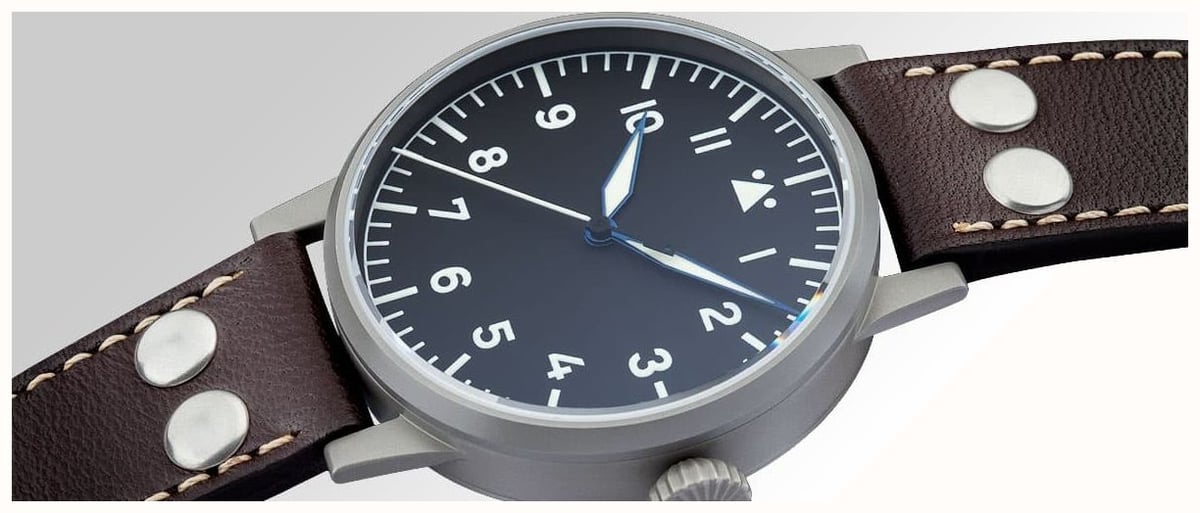
On the wrist, the Westerland wears larger than its 42mm diameter suggests, thanks to the long, straight lugs and the minimalist dial that draws the eye outward. The 48mm lug-to-lug ensures it sits flat on most wrists, and the weight is balanced—not too heavy, not featherlight. The leather strap is supple out of the box, though it may take a few days to break in. The case is brushed on top and polished on the sides, giving it a subtle contrast that catches light without being flashy. Overall, it's a comfortable daily wearer that disappears on the wrist, which is exactly what a pilot watch should do.
Accuracy
The Miyota 821A is rated to -20 to +40 seconds per day, but in practice, most examples settle into a range of -10 to +20 seconds. My test unit averaged +12 seconds per day, which is acceptable for a non-chronometer movement. If you're a stickler for precision, a quick regulation by a watchmaker can bring it to within +5 seconds. For everyday wear, the accuracy is more than sufficient—you'll rarely notice the drift unless you're timing something critical.
Occasions
The Westerland is a versatile piece. It's perfect for daily wear, whether you're at the office or out on the weekend. Its 100m water resistance means you can wear it while swimming or snorkeling, though it's not a dedicated dive watch. The clean dial and leather strap make it suitable for dressier occasions, though it might be a bit casual for black-tie events. It's also a great travel companion, as the date function and robust movement handle timezone changes with ease.
Wrist Presence
4/5 - The Westerland commands attention without being obnoxious. The black dial and white numerals create high contrast, and the lume is bright and long-lasting. It's a watch that people will notice and ask about, but it doesn't scream for attention like a gold chronograph. It's the perfect balance of tool and style.
Reference Variants
The Westerland is available in several dial colors. The standard 861750 features a black dial with brown leather strap. The 861751 offers a blue dial, and the 861752 a green dial. All share the same case and movement, but the dial color changes the character significantly. The blue and green versions are more casual, while the black remains the most versatile.
Family and Other Models
Laco's flieger family includes the Aachen, Dortmund, and Munster models, which are similar in design but vary in size and features. The Westerland sits in the middle, offering a 42mm case that's a sweet spot for many wrists. Laco also produces the Pro series with more modern touches, and the Basic series for budget-conscious buyers. The Stuttgart is another popular model with a slightly different dial layout.
Similar Watches
If you're considering the Westerland, you might also look at the IWC Mark XVIII, which is a more premium option with a higher price tag. Stowa's Flieger Verus 40 is another original B-Uhr maker with a similar heritage. Archimede's Pilot 42 is a German microbrand that offers excellent value. All of these share the flieger DNA, but each has its own personality.
Homages
For those on a tight budget, the Parnis Flieger is a common homage that mimics the look but uses cheaper materials and a less reliable movement. It's a good way to test the style, but it won't offer the same quality or heritage as the Laco.
Investment Value
The Westerland has an MSRP of $550, and it typically sells for around that price. On the pre-owned market, you can find examples for $400-$500. The value is stable—it's not an appreciating asset, but it holds its value well for a watch in this price range. If you're looking to flip it, you won't make a profit, but you won't lose much either. It's a great entry-level piece for someone starting a collection.
Service and Maintenance
Laco recommends servicing the Westerland every 5 years. Since the Miyota 821A is a common movement, any competent watchmaker can handle it, and the cost is typically around $200. Laco also offers service through their website, but it's not required to maintain the warranty. The solid caseback means you won't see the movement, but it also protects it from dust and moisture.
Pros and Cons
Pros
- Authentic WWII flieger design
- Excellent lume
- Sapphire crystal with AR coating
- Reliable and easy-to-service movement
- Comfortable on the wrist
Cons
- Not an in-house movement
- Solid caseback hides the movement
- Strap quality could be better
- Date window disrupts the dial symmetry
Final Verdict
The Laco Westerland is a superb modern take on a classic pilot watch. It offers genuine heritage, solid construction, and a comfortable wearing experience at a price that won't make you wince. While it lacks the prestige of an in-house movement, it more than makes up for it with character and charm. If you're looking for a flieger that tells a story without shouting, this is it.